
What is the story of the Palace of Versailles?
The Palace of Versailles represents the zenith of French splendor, power, and aesthetic perfection. What began as a small hunting lodge just outside Paris was transformed, at the command of King Louis XIV, into the world’s largest and most political palace. Every stone, every mural in the palace, whispers stories of centuries of intrigue, scandal, power struggles, and architectural secrets, even as it tells the tale of the royal family’s magnificent life. This opulent structure was not merely a residence but a golden cage where the political ambitions of kings and the complex social lives of courtiers were constantly staged.
The story of Versailles begins with King Louis XIII’s discovery of this marshy land in the 1620s. At the time, it was just a small village and forested area suitable for hunting. In 1624, the King built a modest brick and stone hunting lodge here. This initial structure was tiny compared to the colossal dimensions of the current palace and served as a private retreat where the King sought to escape the crowds and rest. Louis XIV showed respect to his father by preserving this lodge and building the immense palace around it, thus creating a historical core at the heart of the palace.
What was the political goal of Louis XIV, the Sun King’s Vision?
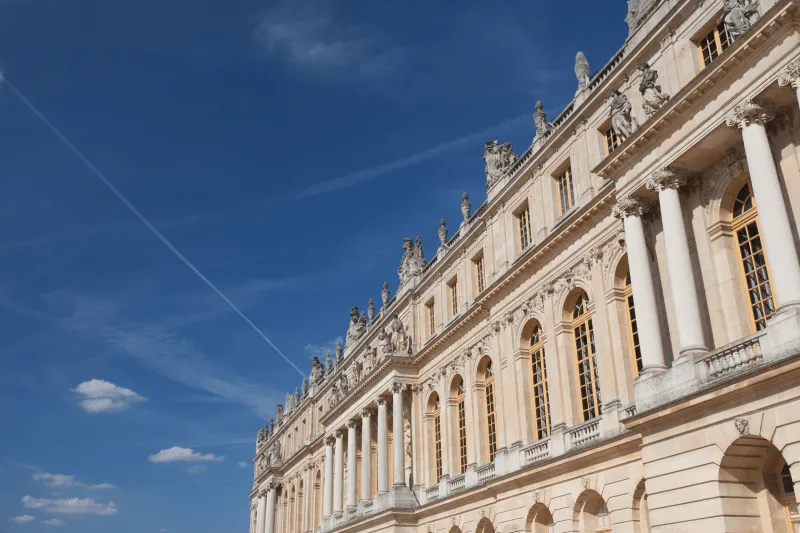
King Louis XIV saw Versailles not just as a residence, but as a political instrument to consolidate his absolute power. In 1682, he formally moved the royal residence from Paris to Versailles. His goal was both to position himself as God’s representative on earth (the Sun King) and to keep the nobility under constant surveillance, away from Paris. The Palace became a center that offered the nobles opportunities to gain prestige and titles, yet simultaneously kept them in a state of continuous competition and dependence.
When did the Palace of Versailles become one of Europe’s greatest architectural masterpieces?
The transformation of Versailles took place under the guidance of the greatest architects of the time, Louis Le Vau and subsequently Jules Hardouin-Mansart. Le Vau designed the first large palace wings surrounding Louis XIII’s hunting lodge. Hardouin-Mansart, however, was the one who gave the palace its final, most magnificent form; the famous Hall of Mirrors and the North-South Wings are especially his creations. These two architects created the most splendid examples of French Classicism, making Versailles one of the most impressive architectural works in Europe.
The High-Cost Project and Financial Secrets of the Palace of Versailles
The construction and upkeep of the Palace of Versailles placed an enormous burden on the French treasury, and this was one of the palace’s biggest secrets. The project’s costs were constantly concealed and understated by the monarchy. According to some estimates, these expenditures, equivalent to hundreds of billions of euros in modern money, covered everything from the construction materials to colossal hydraulic projects and the luxury of the furnishings. While the Palace symbolized the wealth of France, it was also a silent harbinger of the approaching financial crisis and the Revolution.
<div data-gyg-href="https://widget.getyourguide.com/default/city.frame" data-gyg-location-id="16" data-gyg-locale-code="en-US" data-gyg-widget="city" data-gyg-partner-id="R47O1PB"></div>What is the heart and most famous part of the Palace of Versailles?
The heart and most famous section of the Palace of Versailles is the Hall of Mirrors (Galerie des Glaces), which is 73 meters long. This gallery was designed to symbolize Louis XIV’s power and France’s economic supremacy. Its walls are lined with 357 mirrors, produced using glass craftsmanship that was monopolized by Venice at the time, demonstrating the success of French industry. The frescoes on the ceiling narrate the King’s military and political victories. The Hall is a tangible manifestation of absolute power, used for royal ceremonies, balls, and diplomatic receptions.
The Secret of King Louis XIV’s Bedroom
King Louis XIV’s bedchamber was one of the most sacred and political spaces in the palace. This room was not just for sleeping but served as a stage where the most important rituals of daily life were performed. The “Lever du Roi” (King’s Rising) and “Coucher du Roi” (King’s Retiring) ceremonies took place here with the attendance of hundreds of nobles. These ceremonies involved a complex set of hierarchy and etiquette rules that determined the nobles’ proximity to the King, and thus their status. Even the King’s most private moments were turned into a public spectacle that reinforced his political power.
The Sacred Bed and the Cipher of Etiquette
The royal bed was the cipher of the palace’s hierarchy and etiquette. Nobles who were allowed to stand closest to the royal bed held the highest status. For instance, the honor of assisting the King in dressing in the morning belonged to the highest-ranking nobles, and there was a specific title-holder for each piece of clothing. These rituals caused nobles to compete with each other, focusing all their attention on the King, thereby making them struggle for trivial privileges at Versailles instead of seeking political power away from Paris.
The Odor Problem and the Secrets of Cleanliness at the Palace of Versailles
Behind the splendor of the Palace of Versailles lay a major secret concerning hygiene and odor. In an era where hundreds of people lived and toilet systems were primitive, the palace was known to perpetually smell bad. Chamber pots (chambres à la chaise) were commonly used, but cleaning was difficult. Courtiers and the King would use heavy perfumes (especially orange blossom) to mask the foul odor. The inadequacy of toilet habits at the palace, combined with the medical beliefs of the time (the idea that bathing led to disease), made hygiene the palace’s best-kept source of shame.
Secret Passages within the enormous structure of the Palace of Versailles
Within the colossal structure of the palace, there was a network of secret passages and stairs known only to the royal family and the closest servants. These passages allowed the King to move unnoticed from public areas to his private apartments or the rooms of his mistresses. Louis XIV and Louis XV, in particular, frequently used these secret routes to maintain their private lives by escaping the palace’s etiquette and protocol. These passages are evidence of the personal and often scandalous lives that unfolded beneath the official narrative of the palace.
The Intrigues of Madame de Montespan, Louis XIV’s Most Famous Mistress
Madame de Montespan, Louis XIV’s most famous mistress, was at the center of one of the greatest scandals in palace history: the Affair of the Poisons (Affaire des Poisons). This event, which began in the 1670s, involved allegations of poison, witchcraft, and black masses being used among the high society of the palace and Paris. It was rumored that Montespan resorted to black magic to regain the King’s attention and deal with rival mistresses. Although Montespan herself was acquitted of direct charges, the scandal exposed the moral decay and intrigues lurking beneath the palace’s glittering surface.
Queen Marie Antoinette’s Secret
When Queen Marie Antoinette grew weary of Versailles’ strict protocol and public life, she retreated to the Petit Trianon and its associated farm, the Hameau de la Reine (Queen’s Hamlet). Gifted to her by King Louis XVI, this small château represented her quest for a simple, rustic life, completely different from the palace’s formality. Here, the Queen would dress as a simple shepherdess and imitate an ordinary life with her attendants. This escape is one of the most striking secrets demonstrating the pressure the palace’s rigid rules placed on the Queen.
What message did the Gardens of the Palace of Versailles also convey?
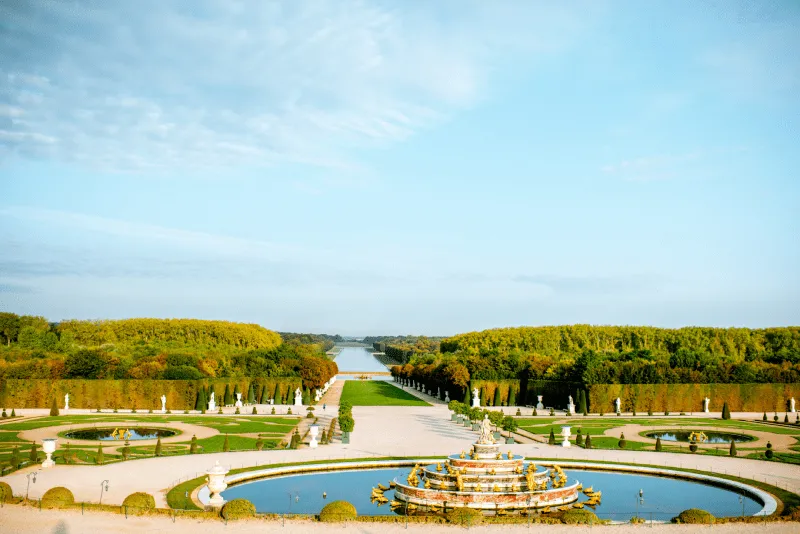
The immense gardens of Versailles, designed by André Le Nôtre in the French Formal Garden (Jardin à la française) style, symbolize man’s control over nature. Le Nôtre used optical illusions to make the gardens appear to stretch endlessly towards the horizon. Paths and canals that narrowed as they receded made the gardens appear larger than they actually were. This design also carried a political message, implying that the King’s authority and power knew no bounds.
What was the purpose of the Grand Canal behind the Palace of Versailles?
One of the most impressive features of Le Nôtre’s gardens is the Grand Canal, which stretches 1670 meters behind the Palace. Louis XIV used this canal to float Venetian gondolas and stage miniature naval battles. Royal sailors were even specially trained to row and operate boats on the canal. The Canal was not just a visual aesthetic element but a colossal water-based leisure area, demonstrating the King’s extravagance and penchant for entertainment.
Challenges Encountered During Royal Visits
A massive water supply system was required to feed the countless fountains and water features in the Gardens of Versailles. The Machine de Marly (Machine de Marly), designed to pump water from the Seine River, was the largest and most complex hydraulic engineering marvel of its time. However, this machine constantly malfunctioned and proved inadequate. Consequently, it was impossible to run all the fountains simultaneously during royal visits; attendants had to turn the fountains on and off sequentially according to the royal walking route. This difficulty was a secret of the technical limitations hidden behind the palace’s dazzling facade.
The Palace’s Army of Artists and Artisans
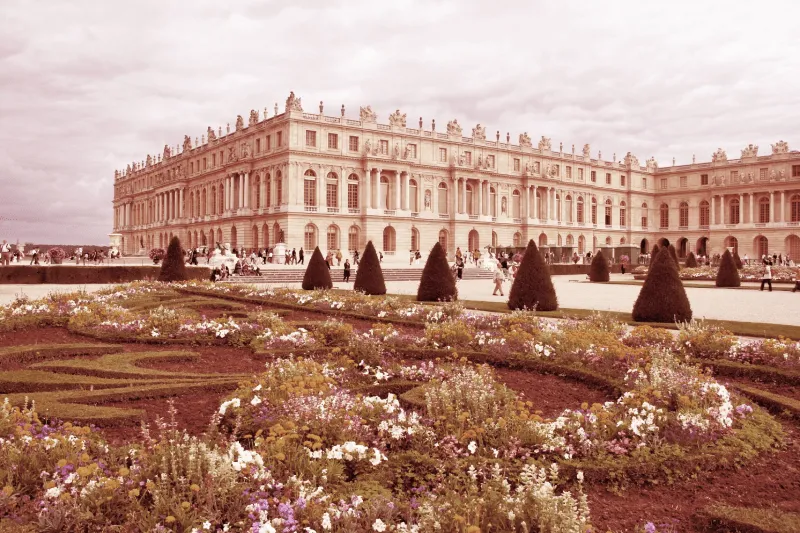
Versailles was a center not only for kings and nobles but also for thousands of artists, artisans, decorators, and construction workers. The construction and continuous maintenance of the Palace attracted France’s most talented craftsmen. These masters ensured that every detail, from the mirrors in the Hall of Mirrors to the marble carvings in the Royal Chapel, was perfect. The Palace was a living art workshop that played a vital role in the development of French art and craftsmanship.
Kitchen Secrets of the Palace of Versailles
The royal kitchens were one of the busiest yet most secretive parts of the palace. Hundreds of cooks and servants prepared meals for thousands of people every day. Louis XIV’s kitchen was notorious for its extreme waste and luxury. The sheer amount of food prepared just for the King’s table was incredible. The organization and complex hierarchy of the kitchens represented the pinnacle of gastronomy art of the period, yet stood in sharp contrast to the famine suffered by the general population.
Louis XIV’s Secret Wives and Royal Marriages
King Louis XIV’s private life held some of the palace’s deepest secrets. After the death of his first wife, Marie-Thérèse, the King secretly married his mistress, Madame de Maintenon. Although this marriage received approval from the Catholic Church, it remained unofficial and a secret within the court. Maintenon held great influence over the King and subtly guided palace politics from behind the scenes. This secret marriage was a political mystery that significantly altered the atmosphere of the palace during Louis XIV’s later years.
What is the secret of the Royal Opera?
The Royal Opera (Opéra Royal) is one of the most secret and magnificent halls in the Palace of Versailles. Although planned to open for the marriage of King Louis XV’s grandson, the future Louis XVI, and Marie Antoinette, its opening was delayed due to costs. This hall, built entirely of wood, boasts perfect acoustics and enormous stage machinery. Its ability to raise the stage floor to transform the opera house into a colossal ballroom made the Opera an example of architectural ingenuity.
Louis XV’s Quest for Secrecy
In contrast to Louis XIV’s public lifestyle, his grandson, Louis XV, preferred to live a more private life. He had a complex of private apartments and laboratories built just below the palace’s roof. Here, away from public eyes, he conducted scientific experiments, particularly engaging in chemistry and clockmaking. These apartments reveal a completely different side of the palace’s formality, demonstrating the King’s search for privacy and his personal interests.
What political disaster did Queen Marie Antoinette cause?
Queen Marie Antoinette’s extravagant lifestyle and Austrian origins made her a target for the French populace and nobility. Her luxurious spending at the Palace, and especially the artificial ‘simplicity’ game at the Queen’s Hamlet (Hameau), increasingly alienated her in the eyes of the public. The Queen faced the biggest secret at Versailles: the war to maintain her reputation in the eyes of the public. This image war was a silent political disaster that played a significant role in the outbreak of the Revolution.
The Secret of the Royal Library
The Royal Library, established by Louis XIV, was one of the most intellectual and quietest areas of the palace. This library was not just a collection of books but also a center for the scientific and philosophical developments of the era. It housed rare manuscripts and volumes reflecting the personal interests of the King and subsequent monarchs. This library demonstrates that beneath the palace’s surface, constantly filled with balls, feasts, and intrigues, an intellectual depth also existed.
What were the tunnels beneath the Palace of Versailles for?
The extensive network of tunnels and basements beneath the Palace of Versailles hosted the secret lives of hundreds of servants who ensured the palace ran smoothly. Servants used these tunnels to move quickly from one end of the palace to the other without encountering nobles, transporting food and wood. This underground world was an organized logistical secret, completely hidden from view, yet vital to making the palace’s splendor possible.
What was the reason that led to the construction of Petit Trianon?
During his relationship with Madame de Montespan, Louis XIV had a “Porcelain Pavilion” (Trianon de Porcelaine) built on the Trianon grounds, covered with tiles mimicking Chinese porcelain. This structure was a symbol of the court’s taste for exotic luxury. However, due to poor quality tiles and vulnerability to winter weather, the pavilion rapidly deteriorated and was demolished shortly after. This event was a shameful secret of a quickly executed project failing despite the King’s disregard for cost, leading later to the construction of the Petit Trianon.
The Marble Courtyard: The Heart of the Palace and Display of Power
The Marble Courtyard (Cour de Marbre) at the palace entrance is the oldest and most symbolic area of the palace. This courtyard, where Louis XIII’s original hunting lodge stood, is paved with black and white marble tiles. This courtyard was the venue for the King’s grand welcoming ceremonies and military parades. The courtyard’s architecture represents a period when French art broke free from Italian influence and found its own Classical style.
Why was the King’s Bedroom so heavily guarded?
The Guards’ Room (Salle des Gardes), located on the main corridor leading to the King’s bedchamber, was the epicenter of the palace’s security. Elite guards protected the King here twenty-four hours a day. However, the presence of these guards symbolized the constant fear felt by the royal family regarding threats from the public and sometimes from within. The layers of security and the rigidity of the protocol were a silent secret demonstrating how closed-off and suspicious the palace was to the outside world.
The Revolution and the Sack of Versailles Palace
The French Revolution of 1789 brought the golden age of Versailles to an end. On October 5-6, 1789, a crowd led by Parisian women forced King Louis XVI and Marie Antoinette to return from Versailles to Paris. The Palace was looted, and its furniture and artworks were sold or dispersed to museums in Paris. This event was a dramatic and irreversible secret that marked the end of absolutism and terminated the palace’s political significance.
The Transformation of the Palace of Versailles into Ruins
After the French Revolution, Napoleon Bonaparte considered restoring the palace but deemed it too costly and politically risky. Napoleon preferred to use other palaces in Paris instead. During this period, Versailles was largely neglected and began to fall into near ruin. Napoleon’s lack of interest in Versailles was a bitter secret that showed how much the political power the palace once held had diminished.
The Transformation of the Palace of Versailles into a Museum
The salvation of Versailles occurred during the reign of King Louis Philippe. In 1837, he decided to convert the palace into the “Museum of the History of France, dedicated to all the Glories of France” (Musée de l’Histoire de France). With this decision, the palace ceased to be a royal residence and became a symbol of French national identity. This transformation was an important secret that allowed the palace to evolve from being a monument to dynastic ambition to becoming the historical heritage of all French people.
Restoration and Modern Legacy
Throughout the 20th century, large-scale restoration work was carried out at Versailles, particularly thanks to the generous donations of American philanthropist John D. Rockefeller. These efforts ensured that the palace and gardens regained their original splendor. Today, Versailles is not only a museum but also one of France’s biggest tourist attractions. The Palace continues to be constantly renovated with modern techniques while preserving the secrets of the past, and it remains open to visitors.
Rituals of Daily Life at the Palace
Daily life at the Palace was based on the rigid rituals created by Louis XIV. Every action, from eating to taking a walk, was determined according to a specific noble hierarchy. These rituals required nobles to constantly seek the King’s favor. This intense protocol is an important secret, showing that courtiers not only lived in luxury but also existed in an environment of constant social pressure and competition.
Balls and shows at the Palace of Versailles
The Palace of Versailles was famous for its magnificent balls, masked parties, and theatrical performances. These events were opportunities to display the Royal Family’s wealth and cultural superiority. One of the most famous events was the “Grand Balls” organized by Louis XIV in 1668, where the entire court wore fantastic costumes, and performances lasted for hours. These spectacles were not just entertainment but also evidence of the King’s power and imagination.
The Palace of Versailles had a private library and secret reading rooms for the nobility
In addition to the main libraries in the palace, there were also secret reading rooms and small salons where nobles could privately devote themselves to reading and philosophical discussions. Especially during the reigns of Louis XV and Marie Antoinette, these rooms, where Enlightenment ideas circulated, were intellectual havens where thoughts contrary to the palace’s official Catholic and absolutist line could be discussed. These rooms were secret centers of the palace’s intellectual opposition.
Versailles Palace: Whispers of History
The Palace of Versailles, while maintaining its grandeur even today, harbors thousands of stories, secrets, and scandals hidden within its walls. Everything from Louis XIV’s political calculations to Marie Antoinette’s private escape points, from the shame of inadequate water systems to the dark shadows of the Affair of the Poisons, reveals a complex and human-focused history beneath the palace’s splendid facade. Visiting Versailles is not just seeing an architectural structure but listening to the whispers of history’s greatest golden cage.
Free Consultation
Fill out the form below to get your free medical travel plan and price quote.