
Is the Louvre at least as captivating as the Mona Lisa?
The Louvre Museum is one of the most magnificent temples of art and history, welcoming millions of visitors every year. For most, the pinnacle of this visit is limited to seeing Leonardo da Vinci’s world-famous Mona Lisa. However, behind this iconic portrait, the vast corridors and halls of the Louvre house humanity’s most crucial moments, artistic genius, and cultural heritage. In this article, we will explore over 30 works and areas that are overshadowed by the Mona Lisa, yet are equally fascinating in their artistic and historical significance, and are must-sees for every art lover. The Louvre is not just a museum; it is a masterpiece in itself.
What is the hidden history in the lower levels of the Louvre?
The history of the Louvre dates back much further than a simple art repository. The structure was initially established as a large medieval fortress, built in the late 12th century by King Philip II to protect Paris against Norman raids. This fortress served as a defense base with its strong walls and moats. Today, the foundations and remnants of this ancient castle can still be seen in the lower levels of the museum, particularly in the Sully Wing, through archaeological excavations. These ruins offer visitors the chance to personally experience the museum’s millennia-long history and show how deeply rooted the current glorious structure is.
How did the Louvre become a national treasure?
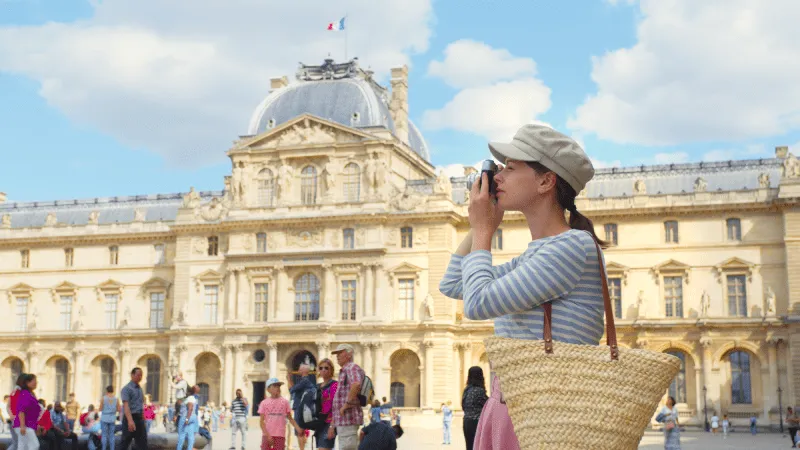
The medieval fortress began its transformation into a grand Renaissance palace in the 16th century under King Francis I. Succeeding monarchs, especially Louis XIV, continued to expand the palace, adding colossal wings and elegant courtyards. During this period, the Louvre was the main residence of the French kings, and they adorned its walls with their personal art collections, including works by Italian Renaissance masters. Even after Louis XIV moved his residence to Versailles, he kept his collections here, paving the way for the palace to become a center for art. The Louvre is the finest example of a palace’s transition into a national treasure.
How did the French Revolution affect the fate of the Louvre?
The French Revolution changed the destiny of the Louvre forever. On August 10, 1793, the revolutionary government opened the former royal palace to the public under the name “Musée Central des Arts” (Central Art Museum). This was one of the first major public museums in the modern sense. The museum’s collection rapidly grew richer with artworks confiscated from churches and noble properties during the Revolution. During the Napoleonic era, the collection expanded further with artifacts seized during military campaigns across Europe. This transformation was a pioneering step in art history, taking art out of the confines of the elite and making it accessible to everyone.
What are the three colossal figures in the Louvre besides the Mona Lisa?
In the Louvre’s sculpture collection, three great female figures stand out, attracting visitors like the Mona Lisa but carrying much older and universal meanings. These are the Winged Victory of Samothrace, the Venus de Milo, and the Great Sphinx. These masterpieces represent the aesthetic understanding of different civilizations and the pinnacle of sculptural art. Each is a timeless symbol of beauty and power, showcasing the ideals and artistic capabilities of its respective era. These three colossal figures virtually take every visitor who enters the museum on a journey into the depths of history.
What does the Winged Victory of Samothrace, a must-see artwork at the Louvre, symbolize?
The Winged Victory of Samothrace is one of the most mesmerizing and dynamic sculptures of the Hellenistic period. Dating back to the 2nd century BCE, this work was created to celebrate a naval victory by the Rhodians. Although the head and arms of the statue are missing, its delicate drapery (himation), which appears wind-swept and clings to the body, reflects the movement and excitement of victory with incredible realism. Symbolizing a naval triumph, this work captivates visitors with its stance at the top of the Daru staircase, as if descending from the sky.
What is the artwork displayed at the Louvre that is known as a symbol of perfect beauty?
Dating to around 100 BCE, the Venus de Milo (Aphrodite) is considered a classic Greek sculpture of the goddess of love and beauty. Despite the loss of her arms, this very absence has increased the sculpture’s mystery and potential for interpretation. The smooth finish of the marble and the figure’s graceful posture embody the Ancient Greek ideal of beauty. The statue was discovered on the Greek island of Milos in 1820 and quickly became one of the most important icons of Western art. The hall where Venus is displayed is designed to emphasize her timeless grandeur.
Artifacts Reflecting the Pharaonic Era at the Louvre Museum
The Great Sphinx of Tanis, located in the Louvre’s Sully Wing, is one of the oldest and most magnificent pieces in the Ancient Egyptian collection. Dating to around 2600 BCE, this work combines the body of a lion and the head of a human. The Sphinx symbolizes strength and royal authority and was believed to protect the power of the pharaoh. Silently greeting visitors at the entrance of the museum’s Egyptian antiquities section, this colossal sculpture reflects both the monumental scale and the mystical atmosphere of the Pharaonic era’s art.
Don’t miss the Mona Lisa and other works of art at the Louvre!
The Louvre’s Italian painting collection, housed in the Denon Wing, where the Mona Lisa is located, showcases the depth of the Renaissance’s golden age. This collection includes masterpieces not only by Da Vinci but also by Italian masters such as Titian, Raphael, Botticelli, and Veronese. Visitors often focus on the crowd around the Mona Lisa, overlooking the magic of the other colossal canvases and delicate portraits displayed in the same halls. These masters demonstrate the Renaissance innovations in human figure, perspective, and light.
Works of art at the Louvre Museum that reflect psychological depth.
In addition to the Mona Lisa, the Louvre hosts some of Leonardo da Vinci’s most important works. These include the less-known but equally complex Virgin of the Rocks and Saint John the Baptist. The Virgin of the Rocks perfectly demonstrates Da Vinci’s use of atmospheric perspective (sfumato) and the mysterious interaction between the figures. Saint John the Baptist, with his enigmatic smile emerging from a dark background and his pointing hand, reflects the psychological depth of the late Renaissance.
Which is the largest canvas painting in the Louvre Museum?
Hanging directly across from the Mona Lisa, Paolo Veronese’s painting The Wedding at Cana (1563) is the largest canvas in the Louvre (over 67 square meters). It depicts the biblical miracle of turning water into wine, but portrays it as a lavish feast full of 16th-century Venetian wealth and grandeur. With its crowded composition, vibrant colors, and richness of detail, the work showcases the dramatic and decorative power of the Venetian School. Its immense size and dynamic composition virtually pull visitors into that luxurious banquet.
Which artwork has attracted the most attention after the Mona Lisa?
Another Renaissance master, Raphael’s Portrait of Balthasar Castiglione (c. 1514–1515), is considered the pinnacle of portraiture. Castiglione was a famous diplomat of the era and the author of The Book of the Courtier. The painting captures the sitter’s elegance, intellectual depth, and serenity. Raphael’s masterful use of soft light and the model’s calm gaze directed at the viewer transform the portrait into both a warm and profound psychological analysis. The work, despite being in the same hall immediately after the Mona Lisa, evokes a separate admiration.
Another unforgettable work you must see in Louvre
Titian (Tiziano Vecellio), one of the greatest names of the Venetian School, depicts Christ’s suffering before the crucifixion with a dramatic play of light and shadow in his painting The Crowning with Thorns (c. 1542). Titian’s rich, saturated color palette and bold brushstrokes emphasize the muscular anatomy of the figures and the violence of the event. This work is a powerful example of how the Italian High Renaissance could merge classical form with emotional intensity. The emotional impact created by the work, combined with its technical mastery, makes it unforgettable.
The Response of French Art to Political and Social Events
The Richelieu and Denon wings of the Louvre house the peak of 19th-century French painting. This period represents a transition from the rigid rules of Neoclassicism to the emotional explosion of Romanticism. Ranging from the elegant nudes of Jean-Auguste-Dominique Ingres to the dramatic tragedy of Théodore Géricault and the revolutionary spirit of Eugène Delacroix, these works reveal how French art reacted to political and social events.
What is Delacroix’s masterpiece?
Eugène Delacroix’s painting Liberty Leading the People (La Liberté guidant le peuple, 1830) is the most iconic work of French Romanticism and the revolutionary spirit. The painting depicts the July Revolution of 1830, portraying the allegorical figure of Liberty, bare-chested and holding a tricolor flag and a musket, at the forefront of the uprising. This work is not merely a history painting but also a manifesto for the universal quest for freedom and the power of the people. Delacroix’s dynamic composition and dramatic use of light lend a unique energy to the painting.
Géricault’s Tragedy: The Raft of the Medusa
Théodore Géricault’s The Raft of the Medusa (Le Radeau de la Méduse, 1818–1819) is one of the most powerful tragedies of 19th-century Romanticism. The painting narrates the dramatic story of the survivors of the French frigate Medusa, which sank in 1816. Géricault emphasizes the tension and despair of the human bodies in the work with dark colors and a diagonal composition. This colossal canvas went down in history as a powerful critique of the struggle for survival at sea and the political corruption of the era.
What is that painting that is at the center of aesthetic debates?
Jean-Auguste-Dominique Ingres’ painting The Grande Odalisque (La Grande Odalisque, 1814) is a work where Neoclassical form meets exoticism. Ingres creates a deliberate deviation from the classical ideal by painting the nude figure with an anatomically elongated back and an unusual pose. Adorned with Orientalist elements (turban, peacock fan), this painting was at the center of aesthetic debates in 19th-century French art and caused significant controversy at the time.
Which civilizations has the Louvre Museum been a part of?
The Louvre Museum is home not only to European art but also to the treasures of Ancient Near Eastern, Egyptian, and Greek civilizations that form the roots of Western civilization. The vast halls of the Richelieu Wing and the lower floors of the Sully Wing display the earliest examples of writing, law, and art, spanning from Mesopotamia to the Persian Empire and the glorious pharaohs of Egypt.
What are the oldest and most comprehensive examples of written law exhibited at the Louvre Museum?
One of the most important historical artifacts in the Louvre is the Code of Hammurabi, belonging to the Babylonian King Hammurabi (18th century BCE). This stele, approximately 2.25 meters high, contains 282 laws inscribed in cuneiform script. These laws, including the principle of “an eye for an eye, a tooth for a tooth,” provide detailed information on how social order, justice, and the punishment system operated in an ancient civilization. This work is one of the oldest and most comprehensive examples of written law known.
Assyrian Sculptures: Winged Bulls (Lamassu)
The Assyrian winged bulls, or Lamassu, brought from Khorsabad, are among the most impressive and awe-inspiring works in the Ancient Near East section. These colossal stone figures, dating to the eighth century, combine the body of a lion or bull, eagle wings, and a human head. They were designed to guard the entrances of Assyrian palaces, serving as both physical and spiritual protectors. The presence of these sculptures in the museum allows visitors to feel the grandeur and power of an Assyrian palace.
Heroes of Ancient Greece: Apollo Belvedere
Many Ancient Greek sculptures displayed in the Louvre are Roman-era copies, but they reflect the magnificence of the original work. One of these is the copy of the Apollo Belvedere, showcasing the idealized athletic form of the god of art, Apollo. This statue served as a source of inspiration for Renaissance and Neoclassical artists, shaping the image of male beauty and heroism in Western art. The figure’s dynamic posture and flawless proportions demonstrate the technical excellence of Greek sculptural art.
Northern European Art and Details at the Louvre Museum
The Northern European painting collection in the Louvre’s Richelieu Wing, distinct from the Italian Renaissance, is filled with works focusing on light, shadow, and daily details. Flemish and Dutch masters pioneered genres such as portraiture, landscape, and still life. This section opens a window for visitors into the bourgeois life, moral narratives, and extraordinary meticulousness of 17th-century Holland.
Jan Van Eyck’s Subtlety: The Virgin of Chancellor Rolin
Jan van Eyck’s The Virgin of Chancellor Rolin (c. 1435), a pioneer of early Flemish art, stands out for its incredible detail and brilliant use of color. The painting depicts Chancellor Rolin praying with the Virgin Mary and the Christ Child. The landscape in the background, with its detailed city and river, is so meticulously rendered that it suggests the advanced optical instruments of the period. Van Eyck is famous for his ability to capture light through the masterful use of oil painting technique.
Rembrandt’s Play of Light: Bathsheba at Her Bath
Rembrandt van Rijn’s Bathsheba at Her Bath (1654), a genius of the Dutch Golden Age, is not just a mythological scene but also a deeply psychological portrait. The painting portrays the solitude and anxiety of Bathsheba as she reads King David’s letter and contemplates her fate. Rembrandt’s skillful use of light to draw the figure out of the dark background (Chiaroscuro) directs the viewer’s entire attention to the woman’s inner world. The work is a zenith of using light and shadow to create emotional intensity.
The Architectural Marvels of the Louvre
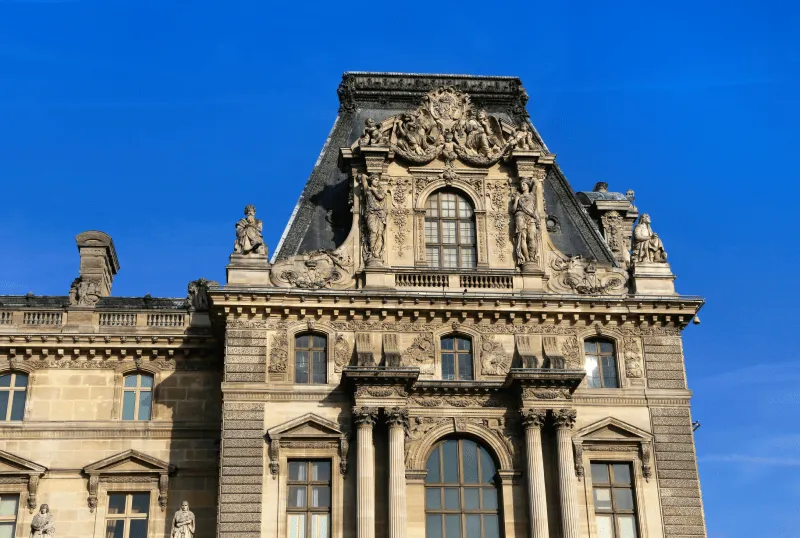
The Louvre is a masterpiece not only for the works it houses but also for its centuries-long architectural evolution. This palace, built upon the foundations of a medieval fortress, combines Renaissance, Classicism, and finally, the modern touch of glass and steel. The museum buildings themselves stand as an architectural lesson, acting as colossal containers for displaying art masterpieces.
What was the purpose of building this modern symbol of the Louvre?
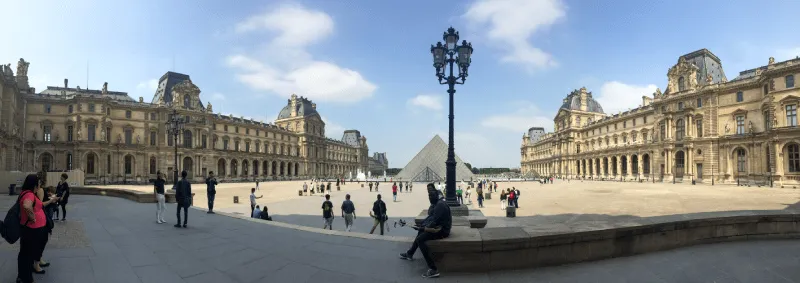
The modern symbol of the Louvre is the glass pyramid, opened in 1989 and designed by Chinese-American architect I.M. Pei. This modern structure, which initially sparked great controversy, brings a bold contrast to the courtyard of the Classical Palace. The Pyramid was built to centralize the museum’s main entrance, streamline visitor flow, and provide natural light to the underground areas. Today, the Pyramid is recognized as a global symbol of the Louvre’s renewed and modernized face.
The Richelieu Wing and Exterior Courtyard Sculptures
The Richelieu Wing, the northern wing, is named after Cardinal Richelieu and was completed in the late 19th century. This wing once housed the French Ministry of Finance but was opened as a museum in 1993. The lower floors of Richelieu are dedicated to Mesopotamian and Islamic art, while the upper floors house Northern European and French painting collections. The courtyards facing the Cour Carrée display the magnificent works of French sculptors.
Which is the most magnificent hall in the Louvre Museum?
The Apollo Gallery (Galerie d’Apollon), located in the Denon Wing, is one of the museum’s most splendid halls. It was designed during the reign of Louis XIV as a prototype for the Hall of Mirrors at Versailles. Its ceiling is adorned with Eugène Delacroix’s The Triumph of Apollo, and this gallery houses the museum’s most valuable decorative arts, including the French crown jewels. This hall, decorated with gold leaf and frescoes, showcases the opulence of the French monarchy.
Department of Egyptian Antiquities: Mummies and Pharaohs
The Louvre’s Department of Egyptian Antiquities has one of the most comprehensive collections in Western Europe. Founded by Jean-François Champollion, the Egyptologist who deciphered the Rosetta Stone, this section offers works ranging from the daily life of the pharaohs to religious rituals. With thousands of pieces, from mummies to sarcophagi, imposing sculptures to delicate jewelry, it sheds light on over 3000 years of Egyptian civilization.
What are some of the works of ancient Egyptian art exhibited at the Louvre?
Dating to around 2600 BCE, the Seated Scribe sculpture exhibits an extraordinary realism despite the strict conventions of Ancient Egyptian art. Unlike the statues idealizing pharaohs, this work vividly captures the careful, aged, and wise expression of a scribe, emphasized by the crystal stone details in the eyes. This realistic portrait highlights the high status of scribes in Egyptian society and the artists’ attention to detail.
Ramses’ Masterpieces and Monuments
The Egyptian section contains colossal sculptures and fragments of monuments belonging to one of Egypt’s greatest pharaohs, Ramses II. These works were crafted on an exaggerated scale and detail to reflect Ramses’ grandeur and power. Especially the monumental gate fragments and statues inscribed with his name are critical for understanding the artistic and political splendor of the New Kingdom period. These monuments are concrete evidence of the pharaohs’ quest for immortality.
Small but Important Works of Art in the Louvre Museum
In the crowded halls of the Louvre, there are small-scale works that can easily be overlooked among the giant paintings and sculptures but whose artistic value is priceless. These works often require more intimate and detailed observation but are no less significant than the large masterpieces in terms of the artistic depth and technical mastery they offer.
Despite its small size, it is the most remarkable artwork
The painting The Lacemaker (La Dentellière, c. 1669-1670) by Dutch master Johannes Vermeer is one of the museum’s most valuable pieces despite its small size. In this work, Vermeer masterfully uses light and spatial arrangement to capture the intense concentration of a young woman weaving lace. The close-up composition and the sharpness of the focal point in the painting are a tribute to the quiet and intense moments of 17th-century Dutch daily life.
Artemisia Gentileschi: Susanna and the Elders
Susanna and the Elders (Susanna e i vecchioni, c. 1610) by Artemisia Gentileschi, one of the most important female painters of the Baroque era, is a dramatic biblical scene painted from a female perspective. Gentileschi powerfully expresses Susanna’s terror and the threat of the old men through the technique of chiaroscuro. This work is significant not only for its artistic mastery but also for representing the powerful presence of women in the art world.
Why is the Preservation and Restoration of Works of Art Important?
The Louvre Museum conducts continuous restoration and maintenance work to protect its immense collection. This process is a scientific effort that ensures the works endure for centuries. Restoration laboratories engage in a wide range of activities, from the chemical analysis of paintings to the structural repair of sculptures. The museum meticulously fulfills its responsibility to preserve the original colors and textures of the artworks, allowing future generations to witness this heritage.
The Future of the Louvre and New Sections
The museum continues to modernize and expand while preserving its historical texture. Continuously changing exhibitions and new display areas maintain the museum’s dynamic structure. The Louvre aims to strengthen its mission as a universal museum by dedicating more space not only to Western art but also to the arts of Africa, Asia, and Oceania. These new approaches broaden the scope of the collection, aiming to offer visitors a more inclusive experience of world art.
Visitor Tips: Escaping the Crowds
To fully experience the Louvre, avoiding the Mona Lisa queues is essential. The most important tip is to visit the museum right before opening hours or during late hours, such as on Wednesday and Friday evenings (excluding Tuesdays when it is closed). Additionally, instead of the main axes like the Denon and Richelieu Wings, you can start with a quieter visit to the Ancient Egyptian and ruin sections on the lower floors of the Sully Wing. Booking tickets online will significantly reduce the waiting time for entry.
Artistic Events and Cultural Programs
The Louvre is not only an exhibition space but also an active cultural center. The museum regularly hosts conferences, film screenings, special exhibitions, and workshops. These events offer an opportunity to understand art history and the cultural context of the works in greater depth. Furthermore, the museum’s courtyards and halls sometimes host concerts and other performing arts, creating new and dynamic interactions between art and the audience.
The Louvre’s Stories of Crime and Mystery
Throughout its history, the Louvre has been the scene of many mysterious events and crime stories. The most famous is the theft of the Mona Lisa by Vincenzo Peruggia in 1911. This incident cemented the painting’s worldwide fame. There are also heroic stories of museum staff secretly evacuating the collection during World War II to protect it from Nazi looting. These stories highlight the value of the artworks and the struggle for their preservation.
Museum Shop and Bookstores at the Louvre
In addition to the main galleries, the Louvre Museum features a large museum store and bookshops offering a wide range of products, from art history literature to decorative objects. These areas provide visitors with the opportunity to learn more about the museum’s collections and take home an artistic souvenir. The art publications section, in particular, houses rare and important art books from around the world.
The Zenith of French Sculptural Art
In addition to Italian and Greek works, the Louvre’s sculpture collection also includes important examples of French sculptural art. This collection, ranging from Puget to Houdon, particularly presents the dramatic and elegant works of the French Baroque and Neoclassical periods. Among these, the magnificent copies of the Horses of Marly (Chevaux de Marly) and Canova’s sculpture of Psyche Revived by Cupid’s Kiss stand out.
Cour Carrée: The Quadrangle Courtyard
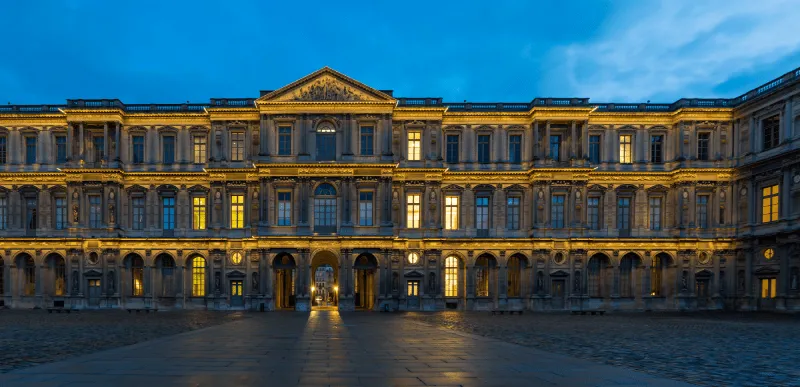
The Cour Carrée, the oldest and historic courtyard of the Louvre, is a quadrangle built upon the remnants of the medieval fortress. The buildings surrounding the courtyard feature architectural elements from the Renaissance and Classicism periods. The facades of this courtyard are like a summary of the centuries of work by French architects. Its historical texture and architectural balance make it an indispensable backdrop for photographers.
Department of Decorative Arts and Royal Furniture
The Department of Decorative Arts, located in the Richelieu Wing, is one of the museum’s least visited but richest sections. This section displays furniture, ceramics, glassware, and clocks used by French kings and courtiers. Particularly the apartments belonging to Napoleon and the possessions of Marie Antoinette showcase the luxury and elegance of the late French monarchy.
Ancient Persian and Islamic Arts
In addition to its Western collections, the Louvre also houses extraordinary works from Ancient Persian and Islamic civilizations. The Persian section features impressive archer friezes and pottery from Susa, while the Department of Islamic Arts displays a rich collection of Islamic heritage, ranging from carpets to miniatures and ceramics. These sections emphasize the museum’s cultural diversity and universality.
Napoleon’s Appetite for Art and Collection Growth
Napoleon Bonaparte played a critical role in the growth of the museum’s collection. Artworks seized during military campaigns turned the Louvre into the largest museum in Europe. During that period, the museum was also known as the “Musée Napoléon.” Although most of these works were returned after Napoleon’s fall, this period established the museum’s global recognition.
Architect Pierre Lescot’s Renaissance Touches
Pierre Lescot’s (16th century) role in the architectural evolution of the Louvre is significant. Following the demolition of the medieval fortress, Lescot rebuilt the western wing of the palace in an elegant French Renaissance style. This section, known as the Lescot Wing, is filled with classical columns, niches, and ornaments, representing the finest example of the palace’s transition to the Renaissance.
The Importance of Temporary Exhibitions for Visitors
The Louvre Museum, in addition to its permanent collection, regularly hosts temporary exhibitions that generate worldwide interest. These exhibitions typically bring together works from the museum’s own collection with masterpieces borrowed from other museums around the world, focusing on a specific artist, period, or theme. These temporary exhibitions are an important part of the museum’s academic and cultural mission.
Educational Programs for Children and Young People
The Louvre offers educational programs and tours specially designed to foster a love for art in younger generations. These programs allow children to interact with artworks, learn artistic techniques, and enjoy the museum experience in a fun way. Special workshops and guided tours organized for families make art education accessible and engaging.
The Museum’s Digital Presence and Accessibility
Today, beyond the physical visit, the Louvre makes a large portion of its collection accessible online. Digital archives, high-resolution images, and virtual tours allow art lovers from all over the world to explore the museum’s treasures. This digitization effort is a significant step that strengthens the museum’s mission of inclusivity and education.
The Louvre as a Turning Point in Art History
The founding of the Louvre as a museum is not just a change in a building but also a radical shift in the role of art in society. The acceptance of artworks as a national heritage for the public and their democratization laid the foundations of modern museology. Therefore, the Louvre is not just a collection but a turning point in art history.
The Art of Discovery at the Louvre
The Louvre Museum is a nexus of millennia of civilization and artistic genius, extending far beyond the allure of the Mona Lisa. From the dramatic stance of the Winged Victory to the legal legacy of the Code of Hammurabi, from Veronese’s massive feast to Vermeer’s subtlety, every corner awaits discovery. On your next visit to Paris, instead of following the crowd, create your own art journey and experience the hidden magnificence of the Louvre.
Free Consultation
Fill out the form below to get your free medical travel plan and price quote.