
Part of: Dental treatment in Turkey — prices, what is included and country comparison.
What is Teeth Whitening?
Teeth whitening (Bleaching) is the process of making teeth lighter and brighter by using chemical agents without damaging their natural structure. This method, which is at the forefront of conservative applications in aesthetic dentistry, is performed using techniques applied in the dentist’s chair (Office Bleaching) or self-applied by the patient at home (Home Bleaching). The basic scientific principle of this procedure is that active substances (usually hydrogen peroxide or carbamide peroxide) penetrate the enamel and dentin layers of the tooth, oxidizing and decolorizing the organic compounds that cause staining.
The idea of whitening teeth dates back hundreds of years in medical history. The first primitive whitening methods in the 18th century involved abrasive chemicals like nitric acid, which caused irreparable damage to the tooth enamel. The modern and scientifically based teeth whitening process, however, began in the late 20th century, particularly in the 1980s, with the development of carbamide peroxide for home use. It was discovered that this material, initially used to treat gum diseases, lightened tooth color. This discovery made teeth whitening a safe, effective, and popular aesthetic procedure.
The whitening agents used today have been optimized through many years of scientific research and formulated to provide maximum efficacy without harming the tooth structure. Teeth whitening not only addresses aesthetic concerns but also significantly boosts an individual’s self-confidence by making the teeth look healthier and cleaner. Its non-surgical nature, rapid results, and conservative quality have made it the most demanded aesthetic dentistry treatment globally.
What Are the Causes of Tooth Discoloration?
Changes in tooth color are generally divided into two main categories: extrinsic factors affecting the outer surface of the tooth (enamel) and intrinsic factors affecting the inner structure of the tooth (dentin). Understanding the source of the discoloration is critical for correct planning of the teeth whitening treatment.
Extrinsic Stains (External Stains): These stains are pigment-based, usually adhering to the tooth enamel surface and not entirely removed by daily brushing. They are generally easier to treat and respond quickly to whitening.
- Food and Beverages: Dark-colored drinks like coffee, tea, red wine, and cola, and intensely pigmented foods like tomato sauce and soy sauce accumulate on the surface of the tooth enamel.
- Tobacco Products: Nicotine and tar in cigarettes, cigars, and other tobacco products form stubborn, brown-black stains, darkening the tooth color.
- Poor Oral Hygiene: Plaque and tartar buildup resulting from irregular brushing and flossing cause teeth to look yellow or brown.
Intrinsic Stains (Internal Stains): These stains originate from pigments lodged in the dentin layer of the tooth during or after tooth development, and they may be more difficult or impossible to whiten.
- Medication Use: Tetracycline antibiotics, particularly when used during childhood tooth formation, embed themselves in the dentin structure, causing permanent, grey-blue or yellow-brown bands of discoloration.
- Trauma and Root Canal Treatment: A blow to the tooth can cause the nerve tissue (pulp) to die, and blood byproducts within it can seep into the dentin tubules, leading to a dark grey or near-black discoloration from within the tooth (internal staining).
- Fluorosis: Excessive fluoride intake can cause white to brown spots and streaks (hypomineralization) on the tooth enamel.
- Aging: As age progresses, tooth enamel wears down and thins. The underlying dentin layer, which is naturally yellower and darker, becomes more noticeable, making the teeth look generally darker and yellower.
Whitening primarily targets organic pigments. For stubborn intrinsic stains like Tetracycline, longer and more intense treatment sessions or protective coverings like laminate veneers may be necessary.
How Does Teeth Whitening Work? The Chemical Mechanism
The basis of the teeth whitening procedure relies on the power of active chemical agents like hydrogen peroxide (H₂O₂) or its precursor, carbamide peroxide [CO(NH₂)₂ • H₂O₂]. These agents work by breaking down the organic molecules that change the tooth’s color.
Penetration of Active Agents: When the whitening gel contacts the tooth’s enamel and dentin layers, the peroxide compound in the gel begins to break down, releasing oxygen molecules. These oxygen molecules penetrate the coloring organic pigments (chromogens) within the enamel and dentin through the microscopic porous structure of the tooth (dentin tubules and enamel prisms).
Oxidation and Decolorization: Chromogens, which make teeth appear yellow, brown, or grey, are complex organic molecules with long, multiple bonds. Oxygen radicals attack these long molecules and break them down into shorter, simpler, and colorless molecules with single bonds (oxidation products).
- Change in Molecular Structure: When coloring pigments are broken down, their manner of reflecting and absorbing light changes. These small, colorless molecules scatter light differently, which makes the tooth appear whiter.
- Light Diffusion: Whitening teeth is not just about lightening the color, but also about increasing the tooth’s ability to reflect and scatter (diffuse) light. The decolorized surface reflects more blue and white light, giving the tooth a bright and white appearance.
This chemical reaction does not damage the hard structure of the tooth (enamel and dentin); it only chemically modifies the pigment molecules trapped inside. Therefore, the whitening procedure does not thin your teeth or disrupt their structure, making it a non-surgical, conservative treatment.
In-Office (Clinical) Whitening: Fast and Effective Solution
In-office whitening (Office Bleaching) is a method applied in the dentist’s office under the supervision of a dentist, using powerful whitening agents. It is ideal for patients who want quick and controlled results.
Application Process: In in-office whitening, high-concentration hydrogen peroxide gels, typically between 15% and 40%, are used.
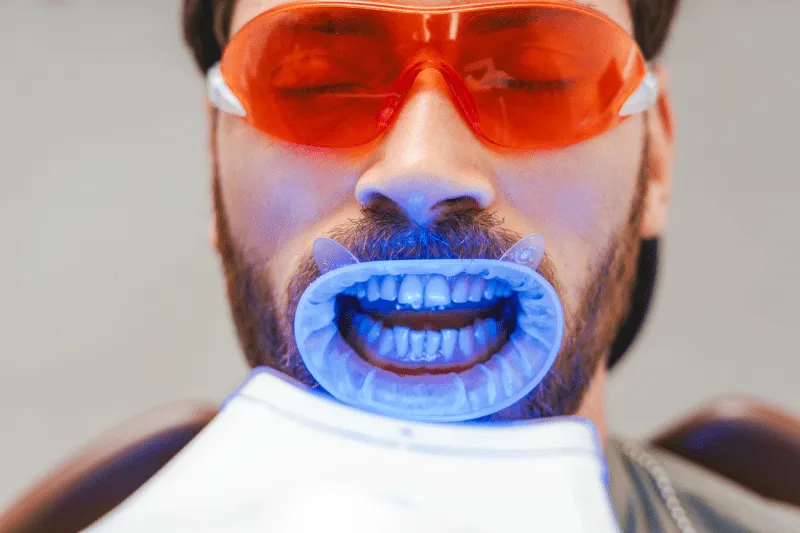
- Protection (Isolation): To prevent the high-concentration agents from contacting the gums, lips, and cheeks, the gums are isolated with a special barrier gel (gingival barrier), and cheek retractors are used. This step is vital to prevent soft tissue burns.
- Gel Application: The whitening gel is carefully applied only to the front surface of the teeth.
- Activation (Light Assistance): In most in-office whitening procedures, special blue LED light (not Laser or Halogen light) or UV light sources are used to accelerate gel activation. Light increases the decomposition rate of peroxide molecules and the release of oxygen radicals, thereby speeding up the whitening effect.
- Session Cycles: The gel is typically left on the teeth in 15-20 minute periods, according to the manufacturer’s instructions, and this procedure is repeated for a total of 2 to 3 cycles (sessions).
Advantages:
- Speed: Noticeable results are achieved in a single session (approximately 1 hour).
- Control: Since the procedure is continuously monitored by the dentist, it is the safest method. The risk of sensitivity or gum contact can be controlled immediately.
- Intensity: The highest degree of whitening can be achieved due to the use of high-concentration gels.
Disadvantage: The cost per session is higher than the at-home type, and some patients may experience temporary sensitivity (twinge) in the first 24 hours after the procedure.
At-Home (Home) Whitening: Comfort and Flexibility
At-home whitening (Home Bleaching) is a method applied by the patient at home, using custom-made trays prepared by the dentist and lower-concentration gels (usually 10% to 20% carbamide peroxide).
Application Process:
- Custom Tray Production: The dentist takes an impression of the patient’s mouth to prepare a thin, transparent, and flexible thermoplastic tray (whitening tray) that fits precisely onto the teeth. This tray keeps the gel on the tooth surface and minimizes contact with the gums.
- Gel Application: The patient carefully places the amount of gel demonstrated by the dentist into the trays.
- Usage Duration: Depending on the gel concentration, the trays are typically worn for a few hours during the day (e.g., 2-4 hours) or overnight.
- Treatment Duration: The treatment usually lasts for 1 to 2 weeks to reach the desired level of whiteness.
Advantages:
- Comfort and Flexibility: The patient can apply the treatment according to their own schedule and in the comfort of their home.
- Longevity: The long-term contact of the low-concentration gel generally provides a deeper whitening and increases the permanence of the results.
- Cost: The total treatment cost may be lower than the in-office type.
- Maintenance: The prepared trays can be reused for maintenance whitening when needed in the future (e.g., once every 6-12 months), with just a few days of low-concentration gel application.
Disadvantage: Results take longer to appear, and incorrect placement of the trays or excessive gel use can cause gum irritation.
Is Internal Whitening Possible for Root Canal Treated Teeth?
Yes, it is possible. Teeth that have undergone root canal treatment and are discolored internally do not respond to external whitening methods. This type of darkening usually results from blood products seeping into the pulp cavity, where the tooth nerve was removed, or from old root canal filling materials. In this case, a special technique called “Internal Bleaching” or “Walking Bleach Technique” is applied.
Internal Whitening Process:
- Protective Barrier: A small cavity is opened from the back of the tooth to access the pulp cavity. The dentist places a special protective barrier material over the root canal filling to prevent the whitening agent from leaking onto the root canal filling or the gum.
- Agent Application: The whitening gel (usually sodium perborate or hydrogen peroxide) is placed into the prepared pulp cavity.
- Sealing: The opened cavity is sealed with a temporary filling. This is why the procedure is called “Walking Bleach”; the patient continues their daily life while the whitening agent is active inside.
- Check-up Sessions: The patient is checked every 3 to 5 days until the desired whiteness is achieved, and the gel is renewed if necessary.
- Permanent Restoration: When the desired color is reached, the whitening agent is removed, and the cavity is permanently sealed with an aesthetic composite filling.
This method can yield excellent results in a single, internally discolored tooth, potentially eliminating the need for more invasive treatments like laminate veneers or crowns.
What is the Reliability of Teeth Whitening and What Are the Possible Side Effects?
Teeth whitening is an extremely reliable procedure when performed under the supervision of a dentist. Scientific studies conducted over many years indicate that peroxide-based whitening agents do not cause permanent damage to the enamel and dentin structure. However, as with any medical procedure, some temporary side effects may occur.
Common and Temporary Side Effects:
- Tooth Sensitivity (Twinge): The most common side effect. As the whitening agent penetrates the enamel and dentin tubules, it can temporarily stimulate the nerve endings there. The sensitivity is usually felt during or within the first 24-48 hours after the procedure and then disappears on its own. To reduce sensitivity, dentists may apply desensitizing gels before and after the procedure.
- Gum Irritation: If the high-concentration whitening gel contacts the gum tissue, temporary irritation in the form of whitening or redness of the gums may occur. The meticulous use of gingival barriers in the in-office type and proper tray preparation and gel quantity adjustment in the at-home type prevent this risk. The irritation usually resolves within a few hours.
Serious or Permanent Side Effects (Rare):
- Dentin Tubule Damage: Incorrect use or uncontrolled application of excessively high-concentration gel for too long can lead to the dentin tubules remaining permanently open and causing chronic sensitivity. For this reason, the whitening procedure must be performed under dental supervision.
- Pain in Root Canal Treated Teeth: Pain or sensitivity rarely develops after internal bleaching in a previously root canal treated tooth; this is usually due to an inadequate protective barrier.
The dentist’s use of FDA-approved professional products with the correct indication and the patient’s adherence to instructions minimize these risks and guarantee the reliability of the treatment.
Who Should Not Undergo Teeth Whitening Treatment? Contraindications
Although teeth whitening is generally a safe procedure, some medical and dental conditions may restrict or prohibit the application of this treatment.
Absolute Contraindications (Conditions Where Application Must Be Strictly Avoided):
- Pregnancy and Breastfeeding: As the potential effects of whitening agents on the fetus or breast milk are not fully known, the procedure is strictly not recommended during these periods.
- Active Cavities and Gum Disease: If there are untreated cavities, cracks, or active gum inflammation (gingivitis/periodontitis) in the teeth, the whitening agent can seep through these areas to the nerve tissue and cause severe pain or damage. Therefore, all these problems must be treated before whitening.
- Allergy: Those with a known history of allergy to any chemical substance (especially peroxide compounds) within the whitening gel.
Relative Contraindications (Conditions Requiring a Cautious Approach):
- Extreme Sensitivity: Patients with high tooth sensitivity due to congenital factors or severe gum recession. In this case, low-concentration agents should be used, and desensitizing treatments should be prioritized.
- Enamel Development Defects (Hypoplasia): In cases where the tooth enamel has developed poorly, the enamel may be more porous and more sensitive to the whitening agent.
- Large Aesthetic Restorations: If there are large fillings, laminate veneers, or crowns in the anterior region, the whitening agent will only lighten the color of the natural tooth. The color of existing fillings and crowns will not change, which creates a difference in whiteness (color mismatch). In this case, existing restorations may need to be replaced after whitening.
- Individuals Under 16 Years of Age: Whitening is generally not recommended for individuals under 16 years of age, where the tooth nerve (pulp) is still large and more sensitive to the whitening agent, until development is complete.
Permanence of Whitening Results and Maintenance Rules
The results obtained from teeth whitening are largely permanent because the organic compounds causing the discoloration are chemically broken down. However, naturally, new extrinsic stains will continue to form over time.
Duration of Permanence: The whiteness achieved with whitening generally retains its permanence for 1 to 3 years, depending on the patient’s lifestyle and oral hygiene.
Ways to Increase the Permanence of Results:
- White Diet (First 48 Hours): In the critical 24 to 48 hours after the whitening procedure, the tooth enamel becomes temporarily more absorbent and more susceptible to extrinsic staining. During this critical period, consuming only “white diet” foods and beverages that do not contain coloring pigments (e.g., water, milk, rice, chicken, bananas, potatoes) is mandatory. Coffee, tea, cola, red wine, cherry juice, and smoking are strictly prohibited.
- Quitting Smoking: Tobacco products are the fastest factor to reverse whitening results. In smokers, the permanence of whiteness decreases dramatically.
- Regular Hygiene: Regular brushing, flossing, and professional dental cleaning every 6 months prevent the accumulation of extrinsic stains.
- Maintenance Whitening: The at-home whitening trays can be reused for maintenance whitening, with just a few days of low-concentration gel application, once every 6 months or once a year. These small booster sessions are the most effective way to continuously maintain the whiteness.
When supported by a good maintenance protocol, teeth whitening continues to offer satisfactory aesthetic results for many years.
What is the Relationship Between Teeth Whitening and Hollywood Smile?
Teeth whitening can be one of the most fundamental and first steps of the Hollywood Smile concept, but it does not constitute a Hollywood Smile on its own.
Dimensions of the Relationship:
- Basic Need: If the patient’s tooth alignment, shape, and gums are aesthetically sound, just the teeth whitening application alone can create an impressive result close to a Hollywood Smile.
- Complementary Step: The Hollywood Smile usually involves permanent restorations like porcelain laminates or zirconium crowns. The color of these restorations must be chosen to match the natural teeth. Therefore, teeth whitening is performed first to lighten the color of the natural teeth other than those to be crowned. This ensures a homogeneous tone of whiteness across the entire smile line.
- Conservative Approach: For patients who want a Hollywood Smile but do not have structural problems requiring abrasion, dentists first recommend conservative treatments like teeth whitening and gum aesthetics (gingivoplasty). This is because whitening is the least invasive, most conservative solution.
Whitening is the procedure that should always be considered first in smile aesthetics, protecting the tooth structure and providing maximum effect with minimal intervention.
Are Over-the-Counter Whitening Products Reliable?
Unlike professional whitening systems applied in the dentist’s office, the reliability and efficacy of teeth whitening products sold in supermarkets, pharmacies, or online (strips, pastes, pens) must be questioned.
Abrasive Toothpastes (Whitening Toothpastes): Most whitening toothpastes contain abrasive particles like silica or calcium carbonate instead of chemical whitening agents. These particles mechanically clean extrinsic stains on the tooth surface, making the teeth look brighter. However, continuous use can abrade the tooth enamel, exposing the underlying yellow dentin layer, which can lead to sensitivity and permanent color darkening in the long term. Dentists recommend safe toothpastes with a low RDA (Relative Dentin Abrasion) value.
Whitening Strips and Kits (Strips and Over-the-Counter Kits): These products generally contain lower concentrations of hydrogen peroxide than professional systems.
- Efficacy: Because their concentration is low and the trays are not custom-made, they may not yield results as effective as professional systems.
- Risk: Trays or strips that are not custom-made can cause the whitening gel to leak onto the gums and result in chemical burns. Furthermore, patients with fillings, cracks, or cavities in their mouths may face nerve damage risk if they use these products uncontrolledly.
In Summary: Although teeth whitening may seem like a simple cosmetic procedure, it involves a biological reaction. Abrasive toothpastes or high-concentration kits used without dental supervision can cause irreversible enamel damage and chronic sensitivity. Therefore, a dental examination is always mandatory before starting any whitening treatment.
This page covers one procedure in detail. For prices, what is included and how the whole trip works, see our overview of dental treatment in Turkey.
Sources and how to verify this yourself
- Howe M-S, Keys W, Richards D. Long-term (10-year) dental implant survival: a systematic review and sensitivity meta-analysis. Journal of Dentistry, 2019 — pooled 10-year implant survival 96.4% (95% CI 95.2–97.5%); conservative sensitivity estimate 93.2%. source
- Ministry of Health, Regulation on International Health Tourism and Tourist Health, Official Gazette 26 April 2025, No. 32882 — authorisation requirement for facilities and intermediaries, TÜSKA accreditation, compulsory complication insurance (deadline 31 December 2025 for insurance, 31 December 2026 for accreditation). source
- Ministry of Health, Regulation on Promotion and Information Activities in Health Services, Official Gazette 12 November 2025, No. 33075 — treatment promises and guarantees are prohibited; price and campaign announcements are permitted only within international health tourism. source