
Part of: Dental treatment in Turkey — prices, what is included and country comparison.
What is a Dental Implant?
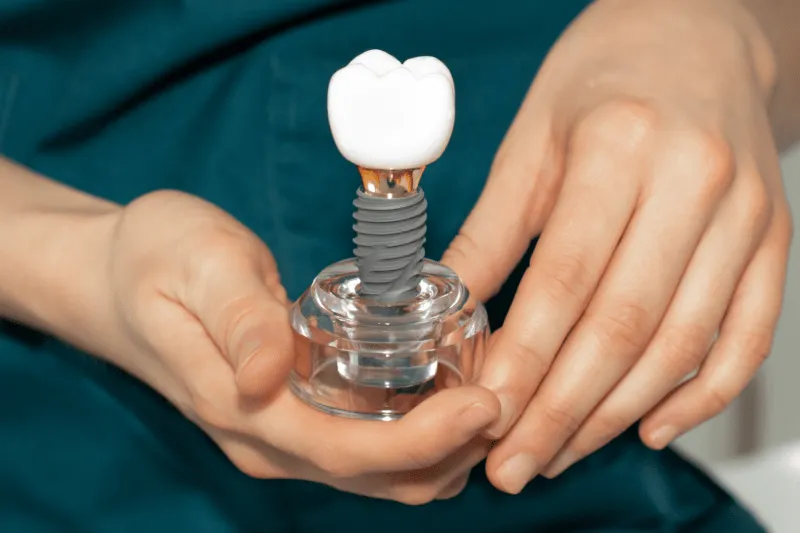
A dental implant is an artificial tooth root, usually made of titanium or zirconium, surgically placed into the jawbone for the purpose of replacing missing teeth. Unlike traditional solutions in dentistry such as bridges or removable dentures, implants aim to restore not only the visible part of the missing tooth (the crown) but also the root structure. Thus, the implant creates a solid, permanent, and independent foundation for the prosthesis placed upon it.
The fundamental scientific principle of implantation is the compatibility of the implant material with the human body and its ability to establish a direct, solid biological bond with the jawbone. This biological process is called osseointegration. Osseointegration allows the implant to become a natural part of the jawbone, which enables the implant to withstand chewing forces like a natural tooth root.
The history of dental implants dates back to primitive methods used in ancient civilizations to replace lost teeth. However, the beginning of modern implantology occurred in the 1950s with the discovery by Swedish orthopedist Dr. Per-Ingvar Brånemark that titanium directly fuses with bone (osseointegration). This discovery made titanium the ideal material for dental implants and laid the foundation for today’s highly successful implant treatments. Implant treatment not only allows patients to regain chewing function and smile aesthetics but also offers a conservative treatment approach by not damaging healthy adjacent teeth, unlike traditional treatments.
Osseointegration: The Fundamental Science of Implant Success
Osseointegration is the most critical process defining the success of dental implant treatment and is a biological phenomenon that enables the implant to be functionally successful. The term is derived from the Latin words “osseo,” meaning “bone,” and “integratio,” meaning “to unite.” Simply put, it is the direct and structural integration of the dental implant with the jawbone cells.
This process begins immediately after the implant is placed and establishes a solid foundation for loading the permanent prosthesis onto the implant after a successful healing period. Osseointegration allows an implant to withstand all functional forces in the mouth, such as chewing and speaking, without moving.
The Mechanism of Osseointegration:
- Surgical Trauma and Initiation of Healing: When the implant is surgically placed into the jawbone, a controlled micro-trauma occurs in the surrounding bone tissue. This initiates the formation of a blood clot and the inflammation process.
- Migration of Bone Cells: Bone-forming cells (osteoblasts) and other healing factors migrate towards the surface of the blood clot.
- New Bone Formation: Osteoblasts begin to attach directly to the surface of the titanium implant (implant surfaces are usually roughened or chemically treated to accelerate osseointegration) and produce new, unorganized bone (woven bone).
- Maturation and Remodeling: Over time, this newly formed bone transforms into denser and stronger lamellar bone (remodeling). When this maturation process is complete, a durable mechanical and biological lock is formed between the implant and the bone at a microscopic level.
The duration of osseointegration varies depending on the patient’s general health, jawbone density, and the implant’s location, generally lasting 3 months in the lower jaw and 4 to 6 months in the upper jaw due to lower bone density. This process must be completed absolutely before the prosthesis is loaded onto the implant. Successful osseointegration is the sole guarantee of the long-term success of implant treatment.
For Whom Are Implant Applications a Necessary Treatment?
Dental implants are suitable for a wide range of patients seeking a permanent and functional solution to the problem of missing teeth. Implant applications fulfill not only aesthetic functions but also vital functions such as protecting adjacent teeth and preventing jawbone loss.
Single Tooth Loss: When a single tooth is missing in the mouth, the traditional solution is to make a bridge. A bridge requires the abrasion of the adjacent healthy teeth to support the missing tooth. An implant, however, is placed directly into the missing area without touching the adjacent teeth. This is the biggest advantage in terms of preserving the natural tooth structure and preventing unnecessary abrasion.
Multiple Tooth Loss: When two or more teeth are missing, implants offer a more solid and long-lasting alternative to bridges. Traditionally, long bridges struggle to withstand the chewing forces placed upon them, whereas a few implants placed at strategic points (e.g., two implants can support a three-unit bridge) provide a more stable and biologically healthier restoration.
Complete Toothlessness (Total Edentulism): In cases where the patient has no teeth left in the upper or lower jaw, implants radically improve the quality of life compared to removable dentures.
- Removable Denture Stabilization: 2 to 4 implants placed in the jawbone stabilize the removable denture, preventing it from moving while eating or speaking. This enhances the patient’s confidence and comfort.
- Fixed Prostheses (All-on-4/6): A completely fixed, full arch of teeth (prosthesis) can be placed on 4 (All-on-4) or 6 (All-on-6) implants placed at strategic angles in the jaw. This solution eliminates the patient’s need to use removable dentures, providing the closest result to the feeling of natural teeth.
Jawbone Preservation: After tooth loss, the jawbone begins to resorb because there is no natural root stimulating the bone. When the implant is placed into the bone, it mimics the functional stress on the bone, halting or slowing down bone resorption. This means that implant treatment is not only aesthetic but also a conservative treatment for bone health.
What is the Superiority of Implants Compared to Traditional Treatment Methods?
Dental implants are considered a turning point in missing tooth treatment because they eliminate many disadvantages of traditional treatments (bridges and removable dentures).
1. Preservation of Healthy Tooth Structure: In conventional bridges, the healthy adjacent teeth on both sides of the missing tooth must be abraded (cut down) and crowned to support the bridge. This causes irreversible loss of healthy tooth structure. Since implants act as an independent root, the adjacent teeth are left untouched. This is the most important application of the principle of conservative dentistry.
2. Increased Chewing Power and Comfort: Patients using removable dentures can only chew with about 10% to 25% of the natural chewing force. This leads to digestion problems and restrictions in food choices. Since implant-supported prostheses are fixed to the bone like natural teeth, patients’ chewing efficiency returns to 80% to 100%. This radically improves the quality of nutrition and comfort.
3. Prevention of Jawbone Resorption: After tooth extraction, the bone resorbs over time because it is not being stimulated. Conventional dentures and bridges do not stop this process; on the contrary, they can accelerate bone resorption by putting pressure on the bone. Implants integrate with the bone, mimicking the bone’s natural function, and prevent bone resorption, which helps prevent facial collapse and an aged appearance.
4. Aesthetics and Naturalness: Unlike metal-supported prostheses, modern zirconium implant-supported crowns offer light transmission similar to natural tooth enamel. Furthermore, because the implants appear to emerge from the natural gum line, the natural look of the prostheses is maximized. Speech impediments caused by removable dentures and the risk of the prosthesis shifting are non-existent with implants.
5. Long-Term Cost-Effectiveness: Although the initial cost may be higher, implants offer durability for many years (15-25 years or longer), making them a more cost-effective solution in the long term compared to the cost of replacing or repairing bridges or removable dentures every 5-10 years.
Dental Implant Application Process: Step-by-Step Treatment Protocol
Dental implant treatment is a meticulously planned, multi-stage process consisting of surgical and prosthetic phases. The duration and stages of the treatment vary according to the patient’s bone structure and the chosen method.
Stage 1: Detailed Diagnosis and Planning
- Examination and Medical History: The dentist evaluates the patient’s general health status, medications used, and medical history (especially uncontrolled diabetes, use of blood thinners, etc.).
- Radiographic Analysis (3D Tomography): The key to successful implantation is detailed planning. The thickness, height, density, and anatomical structures (sinus cavities, nerve canals) of the jawbone are analyzed with millimeter precision using 3D Cone-Beam Computed Tomography (CBCT).
- Digital Implant Planning: The obtained 3D data is virtually planned using specialized software so that the implants are placed in the jawbone at the most ideal angle and position.
Stage 2: Surgical Phase (Implant Placement)
- Anesthesia: The procedure is usually performed completely painlessly under local anesthesia (while the patient is awake). Sedation or general anesthesia options are also available for anxious patients or those requiring multiple implants simultaneously.
- Implant Placement: The gum tissue in the planned area is opened with a surgical incision. A socket of a predetermined diameter and depth is prepared in the jawbone using special burs. The titanium implant is carefully placed into this socket.
- Suturing: After the implant is placed, the gum tissue is closed and sutured.
Stage 3: Healing and Osseointegration
- Waiting Period: During this phase, the implant is expected to integrate with the jawbone (osseointegration). The duration is approximately 3 months in the lower jaw and varies between 4 to 6 months in the upper jaw due to lower bone density. A temporary denture or bridge may be placed on the patient during this period.
Stage 4: Prosthetic Phase (Abutment and Crown Application)
- Placement of the Healing Abutment: After the implant integrates with the bone, the top of the implant is uncovered with a small surgical procedure, and a healing cap is placed to allow the gum tissue to heal healthily around the crown.
- Impression Taking: After the gum heals (usually 1-2 weeks), an impression is taken for the prosthesis (crown) to be placed over the implant. This impression is sent to the laboratory.
- Placement of Abutment and Crown: The abutment, the piece connecting the implant and the crown, prepared in the laboratory, is screwed onto the implant. Finally, the aesthetic zirconium or porcelain crown is permanently cemented/screwed onto the abutment.
Implant Materials: Should Titanium or Zirconium Be Preferred?
The primary materials used in modern implantology are titanium and zirconium. Although both materials are excellent in terms of biocompatibility and durability, there are some critical differences.
Titanium Implants: Titanium is the “gold standard” of implantology. Pure titanium (Grade 4) or titanium alloys (Grade 5) are used.
- Advantages:
- Proven Success: With over 50 years of clinical history, it is the most proven material for osseointegration success.
- Mechanical Strength: Offers excellent durability, especially against chewing forces.
- Cost: Its production and application cost is lower compared to zirconium implants.
- Disadvantages: Due to its metallic grey color, it can cause a slight grey reflection (shadowing) at the gum line, especially in patients with thin gum tissue or in the anterior tooth region.
Zirconium Implants: These ceramic materials based on zirconium dioxide (ZrO2) were developed for patients seeking a “completely metal-free” implant solution.
- Advantages:
- Maximum Aesthetics: Since it is tooth-colored (white), it provides aesthetically flawless results even in patients with thin gum tissue, and there is no risk of grey reflection.
- Allergy Risk: It is an ideal and biocompatible alternative for patients with metal allergies.
- Plaque Resistance: The surface properties of zirconium may lead to less plaque accumulation compared to titanium, which supports gum health.
- Disadvantages: It does not have as long a clinical history as titanium. Due to its one-piece (monolithic) structure, its surgical application may require more precision than titanium, and its cost is higher.
The material selection should be customized according to the patient’s aesthetic expectations, the presence of metal allergy, and the physician’s surgical experience. Titanium is a general preference for function and durability; zirconium may be preferred in regions with high aesthetic demands, such as anterior teeth.
How High is the Success Rate of Implant Treatment and How is Permanence Ensured?
Dental implant treatments are considered one of the most successful treatments in modern dentistry when appropriate conditions are met. Success rates generally range between 95% and 98%.
Key Factors Determining Success:
- Bone Quality and Quantity: The success of implant osseointegration is directly dependent on the density (quality) and sufficient volume (quantity) of the jawbone into which it is placed. In cases of insufficient bone volume, additional procedures such as sinus lifting or bone grafting (bone powder application) may be required before implantation.
- Patient’s Health Status: Uncontrolled diabetes, severe osteoporosis, or diseases that suppress the immune system (e.g., cancer patients undergoing chemotherapy) can negatively affect implant success. Controlling these systemic diseases is critical.
- Oral Hygiene and Smoking: Poor oral hygiene and smoking are the most common causes of implant loss, leading to inflammation of the gum tissue around the implant (peri-implantitis). Smoking slows down the osseointegration process and multiplies the risks.
- Physician Expertise and Planning: Correct planning of implant surgery and prosthetic restoration is the key to a successful outcome. 3D tomography and digital planning ensure the implant is placed in the optimal position, away from anatomical risk areas (nerves, sinuses).
Permanence and Longevity: The implants themselves (the artificial root part) can remain in the mouth for a lifetime with good care. The crown or prosthesis part may require renewal every 10 to 20 years due to wear. Success depends on the patient meticulously cleaning the area around the implant using dental floss and interdental brushes and attending professional check-ups every 6 months.
Is Implant Treatment Painful, and What is the Recovery Process Like?
The biggest concern for patients considering dental implant surgery is generally whether the procedure is painful. In modern dentistry, implant surgery is, contrary to popular belief, a comfortable process that usually causes less discomfort than a simple tooth extraction.
Pain Management During the Procedure: Implant placement is generally performed completely painlessly under local anesthesia. After anesthesia is administered, the patient does not feel any pain or ache during the surgery; they may only feel slight vibration and pressure. For patients experiencing intense anxiety or those requiring multiple implants simultaneously, conscious sedation or general anesthesia options are also available to make the procedure completely comfortable.
Post-Procedure Pain and Swelling: Post-surgical pain and swelling are normal, as in any surgical procedure, but the intensity is generally mild.
- Pain: Pain is easily controlled with non-steroidal anti-inflammatory drugs (NSAIDs) prescribed by the physician. Pain usually subsides rapidly after the first 24 hours.
- Swelling: Applying ice compress to the area intermittently for the first 24 hours after the procedure is recommended to minimize swelling (edema). Swelling generally peaks within 2-3 days and completely disappears within a week.
- Recovery: Sutures are usually removed after 7 to 10 days. Patients can typically return to their daily lives with a soft diet within 1-2 days following the surgery.
In summary, the implant surgery itself is painless thanks to local anesthesia, and post-procedure discomfort is kept minimal with the correct medication and ice application. The real crucial factor is the waiting period required for the bone to integrate with the implant.
What Are the Risks of Implant Failure and Complications?
While dental implant treatments have a high success rate, there is a risk of failure or complications, albeit rarely. It is important that patients are fully informed about these potential risks and do their part to minimize them.
Causes of Failure (Early and Late):
- Osseointegration Failure (Early Failure): The implant fails to fuse with the bone after surgery. Causes may include poor bone quality, overheating during surgery (bone burn), early loading, or infection. In this case, the implant must be removed, and reimplantation should be planned after healing.
- Peri-implantitis (Late Failure): Inflammation of the gum and bone tissue around the implant. Plaque accumulation due to poor oral hygiene and smoking is the main cause. If diagnosed early, it can be treated, but in advanced cases, the bone supporting the implant resorbs, and loss of the implant may become inevitable. Peri-implantitis is the most common late cause of implant loss.
Surgical Complications (Rare):
- Nerve Damage: In the case of implant placement in the lower jaw, damage to the nerve (inferior alveolar nerve/mandibular canal) may occur if working too close to the nerve. This can cause temporary or rarely permanent numbness (paresthesia) in the lip, chin, or tongue area. Correct 3D planning minimizes this risk to almost zero.
- Sinus Perforation: The implant advances towards the sinus cavity (perforation) when placed in the posterior upper jaw. This can lead to a sinus infection. It is usually prevented with a sinus lifting procedure.
- Infection: Infection may develop in the surgical area due to application under non-sterile conditions or inadequate post-procedure care.
To manage risks and ensure long-term success, the patient must quit smoking, be meticulous about implant care, and adhere to a professional check-up routine every 6 months. Implant treatment is a reliable procedure where risks are managed by an experienced physician and modern technology.
Maintenance and Hygiene Rules for the Longevity of Dental Implants
The longevity of dental implants is no different from natural teeth: it requires meticulous and correct oral hygiene. Implant crowns do not decay, but the health of the gum and bone around the implant must be maintained; otherwise, the risk of peri-implantitis arises.
Fundamentals of Daily Hygiene:
- Brushing: Teeth (including implant crowns) should be brushed at least twice a day with a soft-bristled toothbrush and fluoride toothpaste.
- Interdental Cleaning (Vital): Plaque accumulation around the implant and between adjacent teeth is the main cause of peri-implantitis. Special cleaning tools should be used for cleaning these areas instead of standard dental floss:
- Implant Floss (Superfloss): Designed with a thick, spongy structure to clean under and around the implant.
- Interdental Brushes for Implants: Specifically designed to clean the small gaps between the implant and the crown.
- Water Flossers: Highly effective at removing bacterial plaque and food debris from between the implant and gums using high-pressure water. They are increasingly recommended for implant hygiene.
Protective Measures:
- Bruxism Guard: Implant patients with teeth grinding habits must use a protective splint while sleeping to prevent crown fracture and excessive force on the implant.
- Quitting Smoking: Smoking should be strictly stopped before and after implant treatment, as it multiplies the risk of implant loss.
Professional Check-ups: Implant crowns should be checked regularly by the dentist and dental hygienist every 6 months, and professional implant scaling should be performed. These check-ups ensure that peri-implantitis is diagnosed and prevented in its early stages. Adherence to this maintenance protocol is the most reliable way to extend the lifespan of the implants.
Digital Implantology and the Future: How is Treatment Changing?
Dental implant treatment has undergone a revolutionary transformation in recent years due to the integration of digital technologies. Digital Implantology has made treatment more predictable, more precise, and more comfortable for the patient.
1. Computer-Aided Planning and Surgical Guides: Implants were previously placed based only on 2D X-rays (panoramic) or the physician’s visual experience. Today, 3D Tomography (CBCT) data and specialized software are used to determine the most ideal position and angle for the implant placement in the jawbone with millimeter precision. Following this virtual planning, patient-specific “surgical guides” are produced with 3D printers.
Surgical guides guide the physician during implant surgery and prevent the implant from deviating from the planned position. This minimizes surgical risks such as nerve damage and sinus perforation, while ensuring the prosthesis is made more accurately and quickly over the implant.
2. Zirconium Crowns Over Implants (CAD/CAM): The crowns over the implants are now designed and milled from zirconium blocks in a completely digital environment using 3D scanners (intraoral scanner) and CAD/CAM systems, rather than manually in the laboratory. This guarantees the flawless fit and aesthetic perfection of the crowns with the implant.
3. Immediate Loading: While traditionally patients waited 3-6 months for osseointegration, in patients with suitable bone structure, especially in full arch prosthesis applications like All-on-4/6, implants can be immediately loaded with temporary fixed prostheses on the day of placement. This eliminates the patient’s toothless period and instantly improves their quality of life.
Digital implantology is driving the future of implant treatment towards not only functional but also aesthetic and minimally invasive domains, further raising the high success rates.
This page covers one procedure in detail. For prices, what is included and how the whole trip works, see our overview of dental treatment in Turkey.
Sources and how to verify this yourself
- Howe M-S, Keys W, Richards D. Long-term (10-year) dental implant survival: a systematic review and sensitivity meta-analysis. Journal of Dentistry, 2019 — pooled 10-year implant survival 96.4% (95% CI 95.2–97.5%); conservative sensitivity estimate 93.2%. source
- Ministry of Health, Regulation on International Health Tourism and Tourist Health, Official Gazette 26 April 2025, No. 32882 — authorisation requirement for facilities and intermediaries, TÜSKA accreditation, compulsory complication insurance (deadline 31 December 2025 for insurance, 31 December 2026 for accreditation). source
- Ministry of Health, Regulation on Promotion and Information Activities in Health Services, Official Gazette 12 November 2025, No. 33075 — treatment promises and guarantees are prohibited; price and campaign announcements are permitted only within international health tourism. source