
Part of: Non-surgical treatments in Turkey — prices, what is included and country comparison.
Dermal filler applications are one of the most important tools offered by aesthetic medicine. These minimally invasive procedures are used to address subcutaneous volume loss, fill deep wrinkles, define facial features, and achieve a youthful appearance, carrying the potential to create dramatic and natural results without the need for surgical intervention.
Over time, the levels of collagen, elastin, and hyaluronic acid in the skin decrease; fat pads dissolve and shift downwards due to the effects of gravity. This results in volume loss in the face, a tired expression, and the prominence of aging. Dermal Fillers aim to restore the youthful architecture of the face by safely and biologically completing these volume deficits with compatible substances. Dermal filler applications not only address signs of aging but can also enhance the overall proportion and aesthetics of the face by improving the contour of genetically deficient areas (such as the jawline or cheekbones).
In this comprehensive guide, we will delve into the scientific diversity of filler materials, the mechanism of action of the most commonly used Hyaluronic Acid-based fillers, their wide range of applications on the face and body, the intricacies of application techniques, potential risks, and how to manage long-term results.
Scientific Foundations and Classification of Dermal Fillers
Dermal fillers are divided into various types based on their structure, duration of effect, and mechanism of action. However, the most widely accepted and safest type of filler in modern aesthetics is temporary fillers. The main advantage of these fillers is that they are naturally broken down by the body and can be dissolved with a special enzyme (Hyaluronidase) when necessary, which significantly enhances their safety profile.
Types of Filler Materials
- Hyaluronic Acid (HA) Based Fillers:
- This is the most frequently used and safest type of filler today. Hyaluronic Acid is a polysaccharide naturally found in the human body, located in the skin, joints, and eyes. It has the ability to hold water up to a thousand times its own weight. Synthetically produced HA is safely injected under the skin because its risk of allergic reaction is very low. Its purpose is not only to provide volume but also to increase the moisture content of the tissues in the injected area and indirectly support collagen production. They are temporary fillers and are broken down by the body over time. These fillers are produced in different viscosity (density) levels, allowing them to be used across a wide range, from fine wrinkles to deep volume loss.
- Calcium Hydroxylapatite (CaHA) Based Fillers:
- These are semi-permanent fillers that initially provide volume. However, their most important feature is that they stimulate fibroblasts in the body to promote new collagen production (neocollagenesis) in the injected area. This ensures that the filler’s effect is supported by the body’s own collagen over time. They are typically used to create contour in deep wrinkles and areas close to the bone, such as the jawline and cheekbones. Their effect can last longer than HA fillers (12-18 months), but they cannot be reversed with the dissolving enzyme.
- Poly-L-Lactic Acid (PLLA) Based Fillers:
- These are bio-stimulatory fillers whose primary mechanism of action is not to provide volume, but collagen stimulation. The main goal of the treatment is to enable the body to produce its own collagen to replace the volume lost over time. Their effects appear slowly (a few weeks/months) but can last up to 2 years. They are generally used to restore volume lost across the entire face and achieve a younger skin quality.
- Fat Transfer (Autologous Fat Injection):
- This can be considered a permanent filler. It involves using fat harvested from the patient’s own body via liposuction, processing it, and then using it to volumize the face or other parts of the body. Since it contains no foreign substances, it is the most biologically compatible type of filler, but a portion of the injected fat may be reabsorbed over time.
Mechanism of Action of Hyaluronic Acid (HA) Fillers
The reason Hyaluronic Acid is so central to aesthetic medicine is that it is one of the body’s fundamental building blocks and exhibits excellent biological compatibility. HA molecules form a mesh-like structure in the dermis or subcutaneous (fat) layer where they are injected. This structure rapidly binds the surrounding water, instantly increasing volume and lifting the filled area. This mechanism ensures the immediate smoothing of wrinkles and the accentuation of contours. Furthermore, HA itself indirectly contributes to the production of new collagen and elastin fibers by stimulating local fibroblasts. This neocollagenesis effect can help the skin quality remain slightly better even after the filler dissolves.
Comprehensive Areas of Application for Dermal Fillers in Facial Aesthetics
Filler materials are strategically used across a very wide range, from addressing signs of aging to rejuvenating facial features. Modern filler application aims to correct the entire facial architecture and golden ratios (Full Face Dermal Filler), rather than just filling a single wrinkle.
Upper Face Region
- Tear Trough Filler (Under-Eye Light Filler): Performed to address volume loss, which is the main cause of dark circles and a tired expression under the eyes. The hollowness under the eyes, in the region extending from the nose bridge to the cheekbone, is carefully filled, lightening the shadows of under-eye bags and dark circles. This procedure is one of the most delicate and expertise-requiring filler applications.
- Temple (Temporal Region) Filler: Volume loss in the temporal region due to aging can cause the eyebrows to droop, increase skin laxity around the eyes, and make the upper face look skeletonized (sunken). Filling the temples softens the upper contour of the face, slightly lifts the tail of the eyebrow (temporal lift effect), and helps the cheekbones appear more pronounced.
- Glabellar Lines (Frown Lines): Deep frown lines that cannot be completely eliminated with Botox are supported and filled with Hyaluronic Acid fillers after the muscles are relaxed with Botox.
Mid-Face Region
- Cheekbone (Cheek) Filler: Applied to increase the volume and projection of the cheekbones, which are the cornerstone of a youthful and attractive facial appearance. Filler placed in this area lifts the mid-face, softens the nasolabial folds (lines from the nose to the mouth corners), and provides support to the under-eye area, creating a more rested expression.
- Nasolabial Folds (Lines from Nose to Mouth): These lines, which descend from the sides of the nose to the corners of the mouth, give a tired and aged expression. The filler softens these lines by directly filling them. However, the modern approach aims to provide support to the cheeks and cheekbones, which cause these lines, rather than just filling the line itself.
- Marionette Lines (Lines from Mouth Corners to Chin): These lines descend from the corners of the mouth to the chin, often leading to an unhappy or downturned expression. Filling these lines helps the lower part of the face look younger and more positive.
Lower Face Region and Contouring
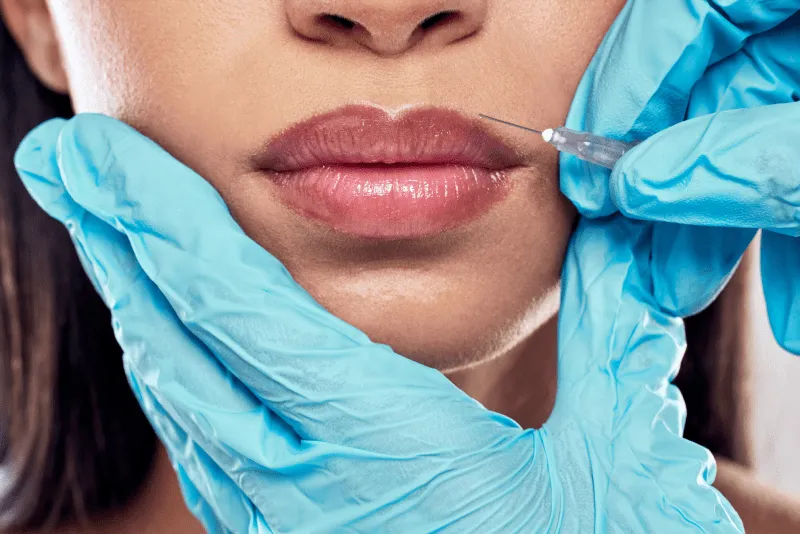
- Lip Filler: Hyaluronic Acid is used to increase the volume, contour, symmetry, and moisture of the lips. The goal is to create full, natural, and proportionate lips for the patient’s face (avoiding excessive volume).
- Jawline and Chin Tip (Mentum) Filler: High-viscosity fillers are used to increase the definition of the lower third of the face and clarify the separation between the neck and jaw. Increasing chin tip projection (chin filler) improves the facial profile and makes the jawline sharper (contoured). This is a critical application for achieving a more angular jawline in male patients and a more elegant, oval jawline in female patients.
- Non-Surgical Rhinoplasty: Used to mask small bumps on the bridge of the nose, lift the nasal tip, or correct nasal asymmetries. Since this is an extremely sensitive and dangerous area, it should only be performed by highly experienced physicians.
Intricacies of Filler Application Techniques and Safety
The success of filler applications depends not only on the quality of the filler used but also on the physician’s mastery of facial anatomy and injection technique.
Injection Depth and Layers
Filler materials are injected into different anatomical depths of the face.
- Superficial Dermis: Used for very fine wrinkles and to improve skin quality.
- Deep Dermis: Used for medium-depth lines and lip contour.
- Subcutaneous Fat Layer (Deep Plane): Used for mid-face lifting, and cheek and temple volume restoration.
- Supraperiosteal (Just Above the Bone): Used in areas requiring contouring and where longevity is desired, such as the jawline, cheekbones, and nose.
Cannula Use and Safety Advantages
While filler applications have traditionally been performed with sharp needles, the use of blunt-tipped cannulas is increasingly common in modern aesthetics.
- Cannula (Blunt-Tipped Needle): Since its tip is not sharp, the risk of puncturing blood vessels is low; instead, it gently pushes the vessels aside. This significantly reduces the risk of the most severe complication, vascular occlusion (blood vessel blockage). It also reduces bruising and swelling. Cannula use has become the gold standard, especially in high-risk areas like the under-eye, temples, and nose.
- Traditional Needle: Preferred for more precise and smaller areas (e.g., the edges of the lip contour) or for filling superficial wrinkles.
Complications, Risk Management, and Reversibility
Although filler applications are generally considered safe, they carry some risks, as with any injection procedure. Being aware of and managing these risks is an integral part of the treatment.
Common and Temporary Side Effects
- Swelling and Edema: The most common side effect after application. It usually peaks within 24-48 hours and largely subsides within a few days. It can be controlled with ice application.
- Bruising (Ecchymosis): Occurs when the needle hits a small blood vessel. It usually resolves within a week.
- Redness and Tenderness: Temporary and resolves within a few hours.
Serious and Rare Complications
- Vascular Occlusion (Blood Vessel Blockage): The most serious but rarest complication. It occurs when the filler material is accidentally injected into an artery, blocking it and cutting off blood flow to the tissue (ischemia). It requires immediate intervention (dissolving the filler with the Hyaluronidase enzyme) and can lead to tissue loss (necrosis) or blindness if left untreated. The physician’s perfect mastery of facial anatomy is essential to minimize this risk.
- Infection: Infections manifesting as redness, pain, and fever in the application area may occur. They are managed by working under sterile conditions and with antibiotic treatment.
- Allergic Reactions: Allergic reactions are very rare because Hyaluronic Acid is naturally found in the body.
Reversibility (Dissolving) Option
The greatest safety advantage of Hyaluronic Acid-based fillers is the possibility of safely and instantly dissolving the filler with the enzyme called Hyaluronidase in case the results are unsatisfactory or in an emergency like vascular occlusion. This enzyme breaks down HA, taking effect within a few hours and rapidly eliminating the filler’s volume. This makes HA-based fillers much safer than other semi-permanent or permanent filler types.
Longevity of Filler Results, Repeat Treatments, and Maintenance
The longevity of filler applications varies depending on the type of filler used, its viscosity, the anatomical area where it is injected, and the individual’s metabolism rate.
Duration of Permanence
- Lips: Since the lips are constantly moving and have high blood flow, the filler’s longevity is generally shorter, lasting an average of 6 to 9 months.
- Mobile Areas (Nasolabial, Marionette): Last an average of 9 to 12 months.
- Static Areas (Chin, Cheekbone, Temples): Since the filler in these areas is close to the bone and less mobile, the duration of effect can extend up to 12 to 24 months. The permanence is significantly greater, especially in applications performed over the bone.
Treatment Frequency and Maintenance
“Touch-up” applications can be performed to maintain the effect before the filler material is completely absorbed by the body. This is usually done with a smaller amount of filler, typically 6 to 12 months after the initial application. This regular maintenance ensures that the face remains continuously youthful and contoured.
- Choosing the Right Physician: This is the most crucial step of the application. Specialists who know not only aesthetic concerns but also anatomical safety limits (Plastic Surgeon or Dermatologist) should be preferred.
- Post-Procedure Care: Avoiding alcohol and intense exercise for the first 24 hours helps minimize swelling and bruising.
The Key Difference Between Botox and Filler: A Complementary Duo
One of the most common confusions in aesthetic applications is mixing up Botox and filler treatments. These two treatments work through different mechanisms and are often used complementarily in facial rejuvenation.
| Feature | Botox (Botulinum Toxin) | Dermal Filler |
|---|---|---|
| Mechanism of Action | Temporarily paralyzes muscles, slowing down muscle movement. | Adds volume and physically fills deep wrinkles. |
| Treatment Area | Dynamic wrinkles (those caused by mimic movements) | Static wrinkles (those present even at rest), volume loss, contouring. |
| Areas Used | Forehead, glabella (between eyebrows), crow’s feet, Masseter, neck. | Lips, cheeks, under-eyes, jawline, nasolabial folds. |
| Main Substance | Protein (Neurotoxin) | Generally Hyaluronic Acid (Sugar molecule in gel form) |
| Reversibility Option | None, one must wait for the effect to wear off. | Can be instantly dissolved with the Hyaluronidase enzyme (for HA fillers). |
The Power of Combination: While Botox prevents the formation of wrinkles, the filler fills the space beneath already formed deep wrinkles and restores lost volume. The combined use of these two applications (controlling mimic movements with Botox and addressing volume loss with filler) forms the basis of the “Liquid Facelift” approach, which offers the most comprehensive and natural results in facial rejuvenation.
Personalized Rejuvenation with Dermal Filler Applications
Dermal filler applications are one of the biggest developments in facial aesthetics over the last 20 years. Their minimally invasive nature, rapid results, and the reversibility option in Hyaluronic Acid-based fillers make these treatments highly popular and reliable. The success of the treatment is closely related to the physician’s mastery of facial anatomy, aesthetic vision, and the creation of a treatment plan suitable for the patient’s individual needs.
Dermal filler applications are an excellent solution not only for those who want to look younger but also for individuals who wish to strengthen their overall body image by accentuating their facial features and improving their contour. It must be remembered that the most natural and safest results are achieved only in expert and experienced hands, using high-quality and approved filler materials. This journey is one of the most important opportunities offered by modern aesthetic medicine for individuals to achieve their aesthetic goals.
This page covers one procedure in detail. For prices, what is included and how the whole trip works, see our overview of dental treatment in Turkey.