
Part of: Cosmetic surgery in Turkey — prices, what is included and country comparison.
The breasts, one of the most central organs of the female body both aesthetically and psychologically, gradually lose their elasticity and sag over time due to various factors such as gravity, pregnancy, breastfeeding, significant weight fluctuations, or the natural aging process. The surgical procedure that corrects the sagging and lax appearance of the breast while preserving or restoring its lost volume is called Breast Lift (Mastopexy). Mastopexy aims to redefine the position and shape of the breast, not to reduce its size; typically, a portion of the breast tissue is not removed but merely reshaped and lifted. This operation enables the breasts to gain a younger, firmer, fuller, and more harmonious silhouette with the overall body contours. It not only addresses aesthetic concerns but also significantly improves the patients’ quality of life by eliminating postural issues and clothing restrictions caused by breasts that cannot be supported even with a bra. Breast lift surgery is a critical procedure that boosts self-confidence and restores physical comfort, especially for women whose breasts are adequate in size but have a distorted and sagging shape. The goal of the surgery is to reshape the breast tissue into a conical form, move the nipple to a higher position, and remove excess, lax skin. This meticulous surgical intervention, combined with the surgeon’s artistic talent and technical skill, yields highly satisfying results.
In this detailed guide, we will comprehensively examine all aspects of breast lift surgery, from candidate selection to surgical techniques, the recovery process, and potential risks.
Anatomy and Causes of Breast Sagging
Breast sagging, or Ptosis, is defined by the disruption of the relationship between the nipple-areola complex (NAC) and the inframammary fold (the crease under the breast). Sagging is present when the nipple descends below the inframammary fold. Breast lift surgery aims to elevate the nipple to the highest point of the breast, above this fold. The degree of sagging plays a critical role in selecting the surgical technique and directly determines the length of the scar after the surgery. Ptosis signifies not only the laxity of the breast but also the accumulation of tissue volume in the lower pole of the breast.
Classification of Breast Sagging (Ptosis Grades)
Breast sagging is generally evaluated by surgeons in three main grades. This grading is of great importance for selecting the correct surgical technique and managing patient expectations:
- Mild Ptosis (Grade 1): The nipple is at the level of the inframammary fold or less than 1 cm below it. The breast only needs slight reshaping. The nipple still points upward within the main contours of the breast. In this stage, a periareolar (around the nipple) or vertical (lollipop) incision may often suffice, resulting in less noticeable scars. Patient satisfaction can increase significantly even with this minimal intervention.
- Moderate Ptosis (Grade 2): The nipple is between 1 cm and 3 cm below the inframammary fold, but still above the lowest margin of the breast tissue. The lower pole of the breast has started to empty, and sagging has become noticeable. Patients at this stage often struggle to wear clothes without a bra. This stage signifies that the breast has begun to sag distinctly and usually requires a vertical (lollipop) incision.
- Severe Ptosis (Grade 3): The nipple is more than 3 cm below the inframammary fold and points towards the lowest margin of the breast. The nipple points downwards, and the tissue in the lower part of the breast has sagged, causing the skin to loosen. This is the stage of extreme breast sagging and often requires the anchor (inverted T) incision technique due to the need for maximum tissue movement.
Main Factors Causing Breast Sagging
The underlying causes of breast sagging are generally physiological and mechanical:
- Pregnancy and Breastfeeding: During pregnancy, the mammary gland and milk ducts enlarge, which stretches the breast skin. After the end of breastfeeding, the mammary gland shrinks, but the stretched skin loses its elasticity, resulting in volume loss and sagging in the breast. This rapid change in breast volume exceeds the skin’s ability to recover.
- Significant Weight Changes: Rapid weight gain and loss change the proportion of fat and glandular tissue in the breast. With the reduction in breast volume, especially the skin on the outer part of the breast loses its ability to recover, leading to sagging. Weight fluctuations cause permanent damage to the collagen and elastin fibers in the skin.
- Aging and Gravity: As age progresses, collagen and elastin production in the skin decrease, the skin loosens and thins. The effect of gravity over the years causes this loosened skin to continuously pull the breast downwards and weakens the natural ligaments connecting the breast to the chest wall (Cooper’s ligaments).
- Genetic Factors: Some women are born with weaker skin elasticity or less strong breast connective tissues (Cooper’s ligaments). This genetic predisposition can cause sagging to appear at younger ages and with fewer external factors (e.g., with only minimal weight changes).
Who is an Ideal Candidate for a Breast Lift?
Ideal candidates for breast lift surgery are individuals who are physically healthy, psychologically mature, and have realistic expectations. This operation is the most suitable solution for women who are generally satisfied with the current size and fullness of their breasts but are experiencing aesthetic and functional problems due to sagging (ptosis).
The fundamental characteristics candidates should possess are:
- Completed Breast Development: Generally, women aged 18 and older, whose breast development has become stable, are the most suitable candidates. Surgeries performed at younger ages, where breast tissue has not yet fully developed, carry the risk of results being compromised by future hormonal changes.
- Realistic Expectations: The patient must accept that the surgery will not make the breast “perfect” but will lift it and leave scars on the breast. A mastopexy operation attempts to restore the breast’s lost youthful shape; however, it does not increase the size and fullness of the breast on its own (unless an implant is added). It is critically important that the patient has a full understanding that the scars will be permanent and will fade over time.
- Maintenance of Stable Weight: Maintaining a stable weight both before and after the surgery is vital for the long-term sustainability of the results. If major weight changes are planned, it is advisable to postpone the surgery, as significant weight loss after surgery can cause the breast to sag again.
- Cessation of Breastfeeding: The patient is expected to have stopped breastfeeding for at least 6-12 months after their last pregnancy. This period allows the mammary gland tissue to shrink and its size to become stable, enabling more accurate surgical planning.
- General Health Status: Individuals without severe chronic diseases that would put the surgery and anesthesia at risk are suitable candidates.
Breast lift surgery yields the most dramatic and satisfying results particularly in women whose nipple level has descended below the inframammary fold and whose breast tissue has accumulated in the lower pole of the breast.
Surgical Techniques: Scar Patterns and Placement
The fundamental principle of breast lift surgery is to elevate the nipple, reshape the breast tissue, and remove excess skin. The technique applied depends on the degree of breast sagging and the amount of skin that needs to be removed. Each technique leaves a different scar pattern on the breast, and the surgeon selects the most appropriate technique by evaluating factors such as the patient’s anatomy, the degree of sagging, and scar acceptance.
Periareolar Incision (Donut/Circle Technique)
- Incision Pattern: Only a circular incision is made around the areola (the colored area around the nipple). The scar is concealed in the transition line between the areola and the breast skin.
- Purpose: Excess skin around the nipple is removed in a circular shape, and the skin around the areola is brought together, creating a slight tension towards the center of the breast. This tension gently lifts the nipple. It is also ideal for reducing an enlarged areola.
- Advantages: Offers the least visible scar pattern as the scar is only around the areola. The recovery time is shorter compared to other techniques.
- Suitability: Used only in cases where the areola is enlarged and the sagging is very mild (pseudoptosis or the lowest limits of Grade 1 Ptosis). Its power to correct greater sagging is limited, and excessive tension in this technique can cause the areola to widen.
Vertical Incision (Lollipop Technique)
- Incision Pattern: A circular incision is made around the areola, and a single vertical incision descends from this incision down to the inframammary fold (resembling a lollipop shape). The scar remains as a vertical line.
- Purpose: Allows for both the lifting of the breast and the narrowing of its lower part to give the breast a more conical (youthful) shape. It is more effective in removing excess skin and reshaping the breast tissue. The vertical incision allows for better control over the volume distribution of the breast.
- Advantages: The scar is shorter than the anchor technique (no horizontal scar) and is generally the most preferred technique because it is easily concealed under the patient’s clothes. Its power to tighten the lower pole of the breast is high.
- Suitability: Used in patients with moderate sagging (Grade 2 Ptosis) and those experiencing noticeable laxity and volume loss in the lower part of the breast.
Anchor Incision (Inverted T or Wise Pattern Technique)
- Incision Pattern: A circular incision is made around the areola, a vertical incision descends from the areola to the inframammary fold, and a horizontal incision extends along the inframammary fold (resembling an anchor or an inverted T).
- Purpose: Allows for the maximum removal of excess skin, the most comprehensive reshaping of breast tissue, and the greatest upward transfer of the nipple. It has the highest power to mobilize breast tissue and skin.
- Advantages: Provides the most dramatic lifting and shaping results in severely sagging (Grade 3 Ptosis) and/or very large breasts. This technique is also necessary in breasts with a very wide base diameter to narrow the breast base.
- Suitability: Used in excessively sagging breasts, when a large amount of excess skin needs to be removed, or when volume reduction is required along with lifting. Although it leaves the longest scars, the achieved functional and aesthetic benefits often facilitate scar acceptance.
Nipple-Areola Complex (NAC) Positioning and Sizing
The success of the aesthetic outcome in breast lift surgery depends on moving the nipple-areola complex (NAC) to a correct and symmetrical position that is appropriate for the breast’s new shape. The nipple is positioned at the highest point of the breast’s new shape. The correct positioning of the nipple makes the breast look younger and more proportionate.
Determining the New Nipple Position
Surgeons generally use anatomical landmarks of the chest wall to determine the new location of the nipple. The ideal position is slightly above the inframammary fold, at the fullest point of the breast, and along a line that is equidistant between the clavicle (collarbone) and the inframammary fold. During the surgery, the nipple is elevated while preserving the tissue stalk (pedicle) that supplies its blood. Preserving this pedicle is vital for maintaining nipple sensation and potential breastfeeding ability. The security of the pedicle is the most important parameter indicating the quality of the surgical technique applied by the surgeon.
Areola Reduction
In sagging breasts, the areola diameter often widens, contributing to the visually sagging appearance of the breast. During mastopexy surgery, excess areola tissue is removed with a circular incision, and the areola is reduced to a smaller diameter proportionate to the breast’s new size (a diameter of 4-4.5 cm is generally considered ideal). This reduction not only gives the breast a youthful appearance aesthetically but also helps to reduce the tension resulting from the lifting procedure.
Combination with Implants (Augmentation-Mastopexy): Lift and Augmentation
Some women complain about both sagging and insufficient breast volume. This dual problem arises especially in cases where the breast has not only sagged but also “emptied” after pregnancy, breastfeeding, or weight loss. In such cases, breast lift surgery is combined with the addition of breast prostheses (implants). This combined procedure is called Augmentation Mastopexy (Lift with Augmentation) and is one of the most frequently performed aesthetic breast surgeries today.
Why is a Combined Procedure Necessary?
Mastopexy alone only reshapes and lifts the breast’s existing tissue. If there is significant volume loss in the breast (e.g., emptying after weight loss or breastfeeding), the breast will stand upright after the lift but may still not achieve the desired fullness, with the upper part appearing flat or under-filled. In this case, adding an implant ensures that the breast is both lifted and voluminous, creating the desired fullness, especially in the décolletage area. The implant takes on the task of restoring lost volume, while mastopexy corrects the sagging.
Challenges of Combination
Augmentation mastopexy is more complex as it combines two surgical procedures and requires surgical experience:
- Recovery Time: The recovery time may be slightly longer than mastopexy alone, and more tension and edema (swelling) may be observed initially.
- Risks: The procedure involves a combination of risks associated with both mastopexy (scars, sensation loss) and implants (capsular contracture, rupture). The surgeon must manage the risks of both procedures simultaneously.
- Surgical Technique: The surgeon must be extremely careful and precise when placing the implant and the lifting sutures to avoid tension and wound healing problems in the breast. The additional volume created by the implant can increase the risk of wound separation by placing extra strain on the already stretched skin.
Implants are usually placed in the dual-plane or submuscular plane to achieve a more natural fullness in the upper pole of the breast. The dual-plane placement is often preferred because it allows the implant to benefit from the muscle’s protection while also allowing the lower part of the breast to droop naturally.
Comprehensive Pre-operative Preparation and Consultation
The success of breast lift surgery is based on a detailed consultation and preparation process. During this process, the patient and the surgeon must reach full consensus on the aesthetic goals to be achieved and risk management issues.
Importance of Comprehensive Consultation
During the initial consultation, the surgeon thoroughly examines the patient’s general health status, medical history, and especially the family history of breast cancer. The patient’s expectations, the desired size, and the level of lift after the surgery are clarified.
- Breast Assessment: The degree of breast sagging (ptosis grade), current breast volume, and tissue elasticity are objectively measured. These measurements provide the fundamental data for determining the incision pattern and the size of the implant (if a combined procedure is to be performed).
- Technique Selection: The most suitable incision technique (periareolar, vertical, or anchor) is determined based on the patient’s anatomy and the degree of sagging, and the patient is given detailed information about the scars this incision will leave.
- Bra Size: The patient’s desired bra size after the surgery is discussed; it is explained that mastopexy only lifts and that the patient will maintain their current size or may decrease slightly due to volume loss. The surgeon may use 3D simulations or sizers (trial implants) to help the patient visualize the results.
Medical Preparations and Risk Management
To ensure the patient’s safety before the surgery, various medical tests are performed:
- Mammography or Ultrasound: A baseline imaging scan is requested from patients over 40 or high-risk patients. This is important for detecting any pre-existing breast abnormalities before the surgery. Furthermore, this imaging creates a reference point for future breast examinations.
- Smoking and Alcohol Prohibition: This is a strictly mandatory rule. Smoking severely impairs wound healing and exponentially increases the risk of necrosis (tissue death) by compromising the blood supply to the nipple tissue. Patients are required to quit smoking at least 4-6 weeks before the surgery. Alcohol can also negatively affect the healing process.
- Medication Restriction: All blood-thinning medications such as aspirin and ibuprofen, as well as certain herbal supplements, must be stopped 10-14 days before the surgery, as directed by the surgeon. This precaution is critical for minimizing the risk of hematoma (blood collection) during and after the surgery.
This meticulous preparation process is a vital step to maximize surgical success and minimize potential complications.
Surgical Process and Anesthesia Management
Breast lift surgery is performed in a hospital setting, in a sterile environment, and usually under General Anesthesia. The duration of the surgery can vary between 2 and 4 hours, depending on the technique applied and whether an implant is added.
Anesthesia Management
Due to the scope and duration of the operation, general anesthesia is preferred to ensure the patient’s complete comfort throughout the surgery. The anesthesiologist closely monitors the patient’s vital functions. At the end of the surgery, long-acting local anesthetics (e.g., liposomal bupivacaine) are applied to the surgical area to significantly alleviate the patient’s initial post-operative pain.
Surgical Steps
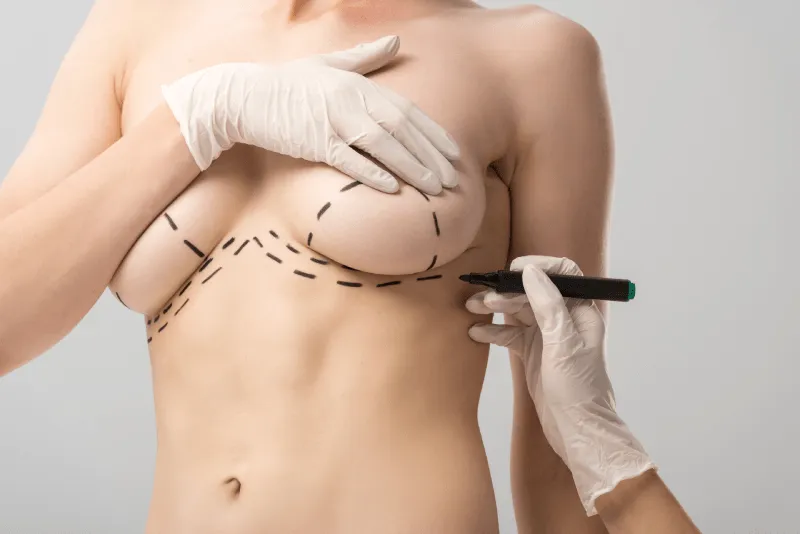
- Pre-operative Marking: While the patient is standing, the surgeon marks the incision lines, the area of excess skin to be removed, and the new nipple position, observing the natural effect of gravity. This marking is the most important moment of the surgical process for symmetry and the final aesthetic look.
- Incision and Excision: The determined incision pattern (vertical, anchor, etc.) is applied. The excess skin area outside the incision is carefully removed.
- Breast Tissue Reshaping: The remaining breast tissue is rearranged and supported with internal sutures to lift the breast and create a new breast cone. These internal sutures act as a scaffold to maintain the breast’s new shape and lift in the long term and delay breast sagging.
- Nipple Transfer: The nipple (NAC) is safely moved to its new, higher position while preserving the pedicle that supplies its blood. At the same time, an enlarged areola is reduced to be proportionate to the breast’s new size.
- Closure: The incision lines are meticulously closed with strong sutures in the deep layers to reduce tension on the breast tissue and with absorbable aesthetic sutures on the skin. Drains may be rarely placed to prevent fluid accumulation.
- Dressing and Bra: A special surgical bra is applied immediately after the surgery to control swelling and support the breast’s new shape.
Post-operative Recovery and Care: Points to Note
The recovery process after breast lift surgery requires patience and diligence due to the length of the scars and the reshaping of the breast tissue. Strict adherence to the surgeon’s instructions directly affects scar quality and the final result.
First Weeks and Pain Management
- Pain: Pain and a feeling of tightness are normal during the first few days after surgery and are easily managed with prescribed painkillers. This pain generally results from the repositioning of the breast tissue and the tension along the incision lines.
- Swelling and Bruising: Swelling (edema) and bruising in and around the breasts are common. This condition usually decreases rapidly within the first 10 days, but it may take 3 to 6 months for the breasts to fully settle and soften.
- Activity Restriction: Lifting the arms above shoulder level, heavy lifting (over 5 kg), and sudden movements must be strictly avoided for the first 2-3 weeks. These restrictions optimize wound healing by reducing tension on the incision lines and ensure the safety of the nipple’s blood supply.
- Surgical Bra: The surgical bra must be worn continuously for 4 to 8 weeks, as advised by the surgeon, to maintain the breast’s new shape and control edema. This bra provides the necessary support to the breast.
Return to Routine Life and Exercise
- Return to Work: Patients in desk jobs can generally return to work within 1 to 2 weeks.
- Exercise: Light walking can be started, but strenuous exercises involving running, jumping, weight lifting, and chest muscles (push-ups, dumbbell press) must be postponed for at least 6-8 weeks. Excessive strain on the chest muscles can stress the internal sutures, which might compromise the breast’s new shape.
- Showering and Wound Care: Showering is permitted when allowed by the surgeon (usually 2-3 days after the drains are removed). Incision lines must be kept clean and dry, and wound healing must be closely monitored. The surgeon will provide detailed instructions on dissolving sutures and scar care.
Potential Risks and Complications
Although breast lift surgery has a high patient satisfaction rate, it carries specific risks, as with any surgical procedure. Patients must thoroughly discuss these risks with their surgeon to make an informed decision.
Surgical and Wound Healing Risks
- Wound Healing Problems: The incision lines are long, especially in vertical and anchor cuts, which increases the risk of delayed wound healing, wound separation (dehiscence), or infection. These risks increase exponentially in patients who smoke.
- Scar Prominence: Incision scars are permanent, and the final quality of the scars depends on the patient’s genetics. There is a risk of keloid (raised) or hypertrophic scar (red and thickened) formation. Strict adherence to the scar care protocol is the only way to minimize this risk.
- Sensory Changes: Temporary or rarely permanent numbness, hypersensitivity, or loss of sensation may develop in the nipple and breast skin. Stretching of the nerve endings during nipple transfer causes this condition, but sensation usually returns over time.
- Asymmetry: Although slight asymmetries present before the surgery are attempted to be corrected, minor differences in size, shape, or nipple height may remain between the breasts due to differences in the healing process.
Nipple and Feeding Risks
- Nipple Necrosis: There is a risk of partial or complete tissue loss (necrosis) of the nipple, particularly in excessively sagging breasts, due to insufficient blood supply to the pedicle nourishing the nipple. This is one of the most serious complications, and smoking dramatically increases this risk.
- Breastfeeding Ability: Breast lift surgery preserves a large portion of the breast’s glandular tissue and attempts minimal intervention to the milk ducts. However, there is a risk of reduced or lost breastfeeding ability due to the tension or damage that occurs during nipple transfer. Although most women can breastfeed successfully, the surgeon cannot guarantee this risk.
Long-Term Results and Permanence
The results of breast lift surgery are long-lasting but not “permanent.” No surgical procedure can stop the natural aging process of the breast, the effect of gravity, and hormonal changes.
Sustainability of Results
- Effect of Gravity: Regardless of how successful the surgery is, the breasts will begin to sag again over time. However, this sagging will never be as pronounced as it was before the surgery. The firmness achieved in the first few years remains at the highest level.
- Weight Management: Maintaining a stable weight after the surgery is the most crucial factor for the longevity of the results. Significant weight fluctuations (especially weight gain and subsequent loss) can cause the skin to stretch again and compromise the breast’s new shape. Weight gain increases the volume of the remaining fat tissue in the breast, leading to renewed sagging.
- Skin Care: Sun protection, moisturizing, and the use of appropriate bras (especially during exercise) help maintain skin elasticity and preserve the results for a longer time.
Likelihood of Revision
A small percentage of women who undergo breast lift surgery may require a revision surgery (e.g., scar revision or a minor touch-up mastopexy), usually after 10 to 15 years, due to natural laxity, capsular contracture (in combined procedures with implants), or scar prominence. This does not mean the surgery failed; it is a consequence of the breast’s natural aging process.
Breast Health Follow-up and Mammography Relationship
Breast lift surgery does not increase or decrease the risk of breast cancer. Routine breast health follow-up and screening should continue as usual after the surgery.
- Mammography: Although mastopexy alters the density of the breast tissue, it does not impede mammography. However, patients must inform their radiologists that they have undergone breast surgery. Special techniques (Eklund Maneuver) may be used during the scan to better visualize the breast tissue.
- Palpation: Since the breast tissue is reshaped, firmness felt in the breast in the early post-operative period can sometimes be a result of sutures or internal tissue hardening. It is important for the patient and doctor to monitor these changes through regular check-ups. Any suspicious mass felt should be immediately reported to the surgeon or relevant specialist.
Innovative and Combined Approaches in Breast Lift
Modern plastic surgery is not limited to classic mastopexy techniques but offers innovative methods and combined approaches for more natural results.
Tissue-Supported (Internal Bra) Mastopexy
- Definition: In this technique, after the breast tissue is reshaped, an “internal bra” or “internal support” system is created using strong, permanent sutures or special synthetic/biological meshes in the inner part of the breast.
- Advantages: Helps the breast maintain its firmness and new position for many years. It provides additional resistance against gravity, delaying the sagging of the lower pole of the breast. It is recommended especially for heavy breasts or in combined procedures involving implants.
Fat Transfer-Assisted Mastopexy (Lipofilling)
- Definition: During breast lift surgery, fat harvested from other areas of the patient’s own body (abdomen, thighs, etc.) is injected into areas that have lost fullness, such as the upper pole of the breast.
- Advantages: Provides a natural volume increase and fullness without the use of a foreign body (implant). It addresses the emptied appearance in the upper part of the breast and softens the overall shape of the breast, thereby helping the lifting scars become less noticeable.
These innovative approaches allow for personalized treatments, enabling the surgeon to achieve the most appropriate and natural results based on the patient’s individual anatomical needs.
Psychological and Quality of Life Impacts
While the physical benefits of breast lift surgery are clear, the procedure’s effects on the patient’s quality of life are often deeper. Physical transformation brings about psychological liberation.
Self-Confidence and Social Comfort
Sagging breasts often create a feeling of shame, a lack of self-confidence, and a need to hide their bodies for many women. A successful mastopexy allows patients to feel comfortable with their bodies. Breasts that are firmer, symmetrical, and aesthetically pleasing lead to:
- Freedom in Clothing Choices: Eliminates the restrictions felt, especially with low-cut, backless, or swimwear garments. Patients report that their clothes fit them better and that they present a younger appearance.
- Physical Comfort: Reduced breast movement during sports and exercise increases physical comfort and encourages the desire to exercise. In cases where even sports bras could not provide adequate support, this surgery offers genuine relief.
- Body Perception: When the breasts become harmonious with the body silhouette, the patients’ overall body image and self-confidence significantly increase. This operation is an act of self-acceptance that helps patients feel more feminine and attractive.
Breast lift not only lifts the breasts; it also removes the psychological burden created by years of sagging, offering patients a new comfort in life and self-confidence, marking a personal transformation journey. The positive cycle created by this decision on the patient’s overall happiness and social interactions is one of the most valuable and long-lasting outcomes of the surgery.
This page covers one procedure in detail. For prices, what is included and how the whole trip works, see our overview of cosmetic surgery in Turkey.
Sources and how to verify this yourself
- Ministry of Health, Regulation on International Health Tourism and Tourist Health, Official Gazette 26 April 2025, No. 32882 — authorisation requirement for facilities and intermediaries, TÜSKA accreditation, compulsory complication insurance (deadline 31 December 2025 for insurance, 31 December 2026 for accreditation). source
- Ministry of Health, Regulation on Promotion and Information Activities in Health Services, Official Gazette 12 November 2025, No. 33075 — treatment promises and guarantees are prohibited; price and campaign announcements are permitted only within international health tourism. source