
Part of: Hair transplant in Turkey — prices, what is included and country comparison.
Throughout history, hair has not only been a tool for physical protection but also one of the most powerful symbols of power, youth, attractiveness, and personal image. The loss of hair, which forms the frame of the face we see when we look in the mirror, brings about not only an aesthetic change but often a deep psychological shake-up as well. “Not looking like before,” shying away from social environments, or the fear of aging are the common denominators of individuals experiencing hair loss.
However, the good news is; hair loss is no longer a destiny. In today’s world, where medicine and technology develop at a dizzying speed, hair transplant procedures have evolved from a surgical operation into an art form where millimetric calculations are made. Especially in this field where Turkey is the world capital, baldness is becoming a thing of the past.
In this giant guide; we will examine everything about the world of hair transplantation in the finest detail, starting from why hair falls out, to the latest technologies like FUE and DHI, from the operation process to the recovery period.
Understanding the Problem – Why Does Our Hair Leave Us?
To solve a problem, one must first understand its source. Although hair loss (Alopecia) does not depend on a single cause, the most common reasons are genetic and hormonal.
Androgenetic Alopecia (Male Pattern Baldness)
More than 95% of hair loss seen in men is of this type. The culprit is a hormone called DHT (Dihydrotestosterone).
- Mechanism: The hormone testosterone converts into DHT via the 5-alpha reductase enzyme. Genetically coded hair follicles (especially those in the forehead and crown areas) are hypersensitive to DHT. This hormone attaches to the hair follicle, constricts the vessels feeding it, weakens the follicle (miniaturization), and eventually stops hair production completely.
- Why Doesn’t the Nape Shed? Hair follicles in the nape and above the ears are genetically immune to the DHT hormone. This is why this area is used as the “Donor Area” in hair transplantation, and the hair taken from here remains permanent for a lifetime where it is transplanted.
Hair Loss in Women
The shedding pattern in women is different from men. Generally, while the front hairline is preserved, a thinning and loss of volume (Ludwig Scale) is observed throughout the hair. Hormonal imbalances (PCOS, thyroid problems), pregnancy, menopause, and iron deficiency are the most common causes.
Other Triggers
- Stress (Telogen Effluvium): Excessive stress, trauma, or major surgeries can disrupt the hair cycle, causing hair to enter the resting phase and shed suddenly.
- Nutritional Deficiencies: Deficiency of Iron, Zinc, Vitamin B12, and protein directly impairs hair quality.
- Incorrect Cosmetic Use: Excessive heat, tight tying (Traction alopecia), and chemical processes damage the roots.
Solutions – Modern Hair Transplant Methods
Old hair transplant methods (FUT) that caused a “grass man” appearance, left suture scars, and did not look natural are now history. The methods used today are minimally invasive technologies (causing less damage), leaving no scars, and aiming for maximum naturalness.
FUE (Follicular Unit Extraction) Method
It is the foundation of modern hair transplantation. It is based on the principle of collecting hair follicles (grafts) one by one from the donor area.
- How is it Done? Very thin “punches” with tips ranging from 0.6 mm to 0.8 mm, called micromotors, are used. The surgeon loosens each hair follicle from the skin and collects it with tweezers.
- Sapphire FUE: This is an upgraded version of the FUE method. The channels (slots) where the collected hair will be placed are opened not with classic metal slits, but with tips produced from precious Sapphire ore.
- Advantage: Sapphire tips are smooth and cause less damage to the tissue. Since channels are opened at a micro level, bleeding is less, healing is faster, and transplant density can be increased.
DHI (Direct Hair Implantation) Method
Also known as “Direct Hair Implantation” or the “Pen Technique.” In this method, the channel opening and implantation phases occur simultaneously.
- Choi Implanter Pen: Collected hair follicles are placed inside special medical pens called “Choi Pens.” When the surgeon inserts the tip of the pen into the skin and presses the piston, the root is left directly under the skin.
- Advantages:
- No-Shave Transplant: It is ideal especially for women or men who do not want to cut their hair completely. Transplantation can be done by shaving only a small part of the donor area.
- Densification: It is the safest method for densifying between existing hair; it does not damage existing roots.
- Fast Recovery: Since no channels are opened, the crusting period is much shorter.
FUE or DHI? Which One Should You Choose?
The answer to this question depends on the patient’s needs:
- If the bald area is very wide (requiring 4000-5000 grafts), Sapphire FUE is faster and more economical.
- If only the front line is to be corrected, densification is to be done, or a no-shave procedure is desired, DHI is preferred.
- Often, for the best result, these two methods are combined (Combined Transplant).
Operation Process – Step by Step Transformation Journey
Hair transplantation is a comfortable process lasting about 6-8 hours, performed under local anesthesia, where the patient is conscious. Here is what awaits you on that day:
Consultation and Hairline Design
It is the most critical aesthetic stage of the procedure. The secret of a “natural” hair transplant is the correct design of the front hairline.
- A straight line is far from natural. The surgeon draws a line with slight indentations and protrusions (micro-macro zigzags) according to the patient’s facial muscles, forehead opening, and age.
- Single grafts (those with a single hair strand) are planted in the very front, and multiple grafts (double-triple) are planted at the back to ensure a natural transition.
Anesthesia (Painless Methods)
The biggest fear of patients is needle pain. Today, with “Needle-Free Anesthesia” (Dermojet) devices, anesthetic substance is injected under the skin using pressurized air. Needle entry is not felt. Additionally, with Sedation (light sleep state), the patient can reach a comfort level where they do not remember the procedure at all.
Harvesting (Collection of Grafts)
While the patient is lying face down, roots are collected homogeneously from the nape area. Homogeneous collection is important so that no thinning or scarring occurs in the nape. Collected roots are kept in special solutions (Organ Transplant Solutions) to remain alive.
Channel Opening and Implantation
If Sapphire FUE is being done, channels are opened, and roots are placed one by one. If DHI is being done, direct implantation is performed with pens. At this stage, the exit direction (angle) of the roots is very important. Hair planted with the wrong angle grows “straight up” and does not look natural.
Recovery Process and Results – Patience Brings Peace
Hair transplantation is not a procedure that ends in one day; it is a process spread over approximately 1 year.
- First 3 Days: The transplanted area should not be touched. There may be slight edema (swelling).
- Day 10 (Scab Shedding): As a result of washes done with special lotions and shampoos, the scabs in the transplant area completely fall off. Now there is a short-haired, clean appearance.
- Months 1-3 (Shock Loss): This is the stage where patients panic the most. Transplanted hair sheds suddenly. This is an expected and normal situation. The roots remain inside; only the hair shafts fall out.
- From Month 3: Shock loss ends, and permanent hair starts to grow. The first emerging hair may be thin and curly; it thickens over time.
- Month 6: 50-60% of the result is visible. Hair starts to take shape.
- Month 12: Final result. Hair has thickened, density has increased, and it has regained its natural form. Full coverage of the Crown (Vertex) area may take up to 18 months.
Supportive Treatments Increasing Operation Success
Supportive treatments are essential to protect existing hair and ensure faster growth of newly transplanted ones after hair transplantation.
PRP (Platelet Rich Plasma)
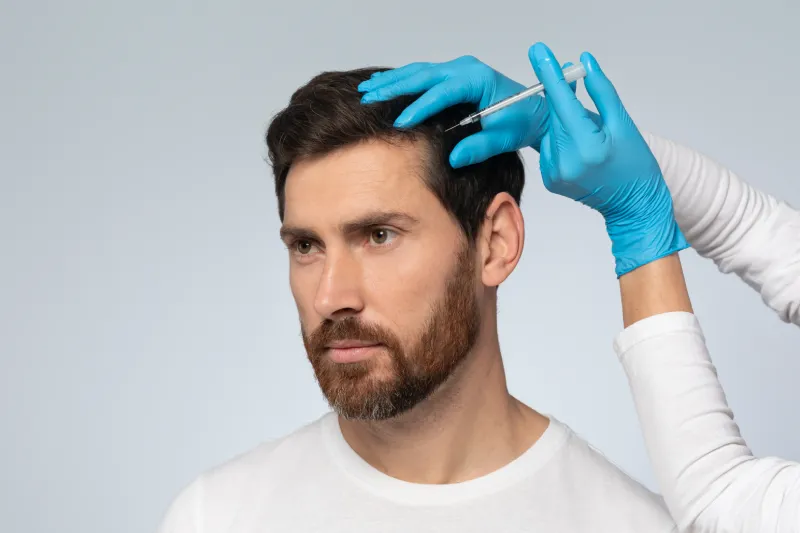
It is the injection of plasma rich in growth factors, obtained from the patient’s own blood, into the scalp. Applied during or after the operation, it accelerates wound healing and increases the retention rate of roots.
Mesotherapy
It is the injection of vitamins, minerals, and amino acids needed by the hair into the skin in the form of a cocktail.
Medical Treatments
Sprays (Minoxidil) or tablets (Finasteride/Biotin) used under doctor control may be recommended to protect existing hair, especially in young patients whose genetic shedding continues.
Choosing the Right Center and Turkey’s Position
Hair transplantation is not a simple cosmetic procedure; it is a surgical intervention. Procedures performed in unauthorized places can result in necrosis (tissue death), infection, an unnatural “grass man” appearance, and irreversible donor damage.
Why is Turkey Number 1?
- Experience: Turkish physicians are much more experienced in terms of case numbers compared to their colleagues in the world.
- Technology: The newest techniques (Sapphire, DHI, Robotic Hair Transplant) first became standard in Turkey.
- Service Quality: The process is turned into a vacation with VIP transfers, luxury accommodation, and translator support.
Frequently Asked Questions (FAQ)
1. Will the transplanted hair fall out again? No. The hair taken from the donor area, the nape, is genetically coded not to fall out. They preserve this feature where they are transplanted and stay with you for a lifetime.
2. Will I feel pain? A very slight burning may be felt while local anesthesia is being administered (if there is no needle-free anesthesia), afterwards, pain is zero throughout the procedure. The patient can listen to music or watch TV.
3. Is hair transplantation done in summer? Yes, it is done. It is only necessary to protect from direct, scorching sunlight and not to enter the sea/pool for the first 2 weeks after the operation.
4. Can a bad hair transplant be corrected? Yes, with “Revision Hair Transplant,” bad front lines can be corrected, or sparse transplants can be densified. However, for this, there must be enough roots left in the donor area.
Do Yourself a Favor
Hair loss is a condition that affects not only your physical appearance but also your mood. However, you do not have to accept this situation. A hair transplant performed at the right time, with the right technique, and in expert hands returns you not only to your old hair but also to the days when you were at peace with mirrors.
Remember, the best hair transplant is the one where no one realizes you had a hair transplant.
This page covers one procedure in detail. For prices, what is included and how the whole trip works, see our overview of hair transplant in Turkey.
Sources and how to verify this yourself
- Comparative study of graft survival by donor site (scalp, beard, chest) at 12 months — roughly 89% for scalp, 95% for beard and 76% for chest hair; survival also falls the longer grafts stay outside the body. source
- Ministry of Health, Regulation on International Health Tourism and Tourist Health, Official Gazette 26 April 2025, No. 32882 — authorisation requirement for facilities and intermediaries, TÜSKA accreditation, compulsory complication insurance (deadline 31 December 2025 for insurance, 31 December 2026 for accreditation). source
- Ministry of Health, Regulation on Promotion and Information Activities in Health Services, Official Gazette 12 November 2025, No. 33075 — treatment promises and guarantees are prohibited; price and campaign announcements are permitted only within international health tourism. source