
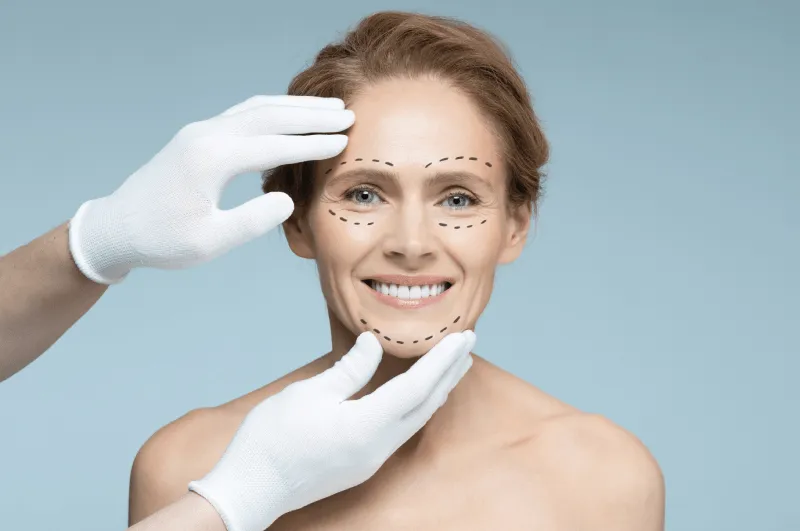
Part of: Cosmetic surgery in Turkey — prices, what is included and country comparison.
Our face is our window to the world, the signature of our identity, and the stage for our emotions. The image we see in the mirror bears the marks of time, gravity, and life experiences. However, sometimes genetic heritage, sometimes trauma, and sometimes simply the aging process create a chasm between the age we feel and the age we look. This is where aesthetic plastic surgery comes into play.
In this massive guide, we are setting aside needle-based procedures that offer temporary solutions. Our focus is on surgical procedures that create permanent results, fundamentally altering or repairing anatomical structures, and repositioning tissues. We embark on a deep journey into the world of aesthetic surgeries performed solely on the face, from rhinoplasty to deep plane facelifts, from almond eye aesthetics to chin surgery.
The Center of the Face – Nose Aesthetics (Rhinoplasty)
When facial aesthetics is mentioned, the first and most common surgical procedure that comes to mind is undoubtedly rhinoplasty. Being located right in the center of the face, even a millimetric change affects the entire expression.
The Philosophy and Techniques of Rhinoplasty
Rhinoplasty does not just mean making the nose smaller; it means harmonizing the nose with the face.
- Open Technique: This involves making a small incision in the “columella” region between the nostrils to lift the nasal skin. It allows the surgeon to establish full dominance over the nasal skeleton (cartilage and bone). It is especially preferred in serious deformities, revision (secondary) surgeries, and cases where detailed shaping of the nasal tip is required.
- Closed Technique: All incisions are made inside the nostrils. There is no externally visible scar (scarless rhinoplasty). The healing process is generally faster, and less edema occurs. However, the surgeon’s field of view is more restricted, so it requires experience.
Piezo Surgery (Ultrasonic Rhinoplasty)
This is a revolutionary technology that replaces old-school hammer and chisel methods. Using sound waves (ultrasonic vibrations), bones are shaped, not broken.
- Advantage: It does not damage soft tissues, blood vessels, or nerves. This keeps post-operative bruising and swelling to a minimum.
- Precision: Bones can be filed or cut with millimetric precision, providing a smoother nasal bridge.
Septorhinoplasty (Functional Aesthetics)
This involves addressing breathing problems (deviation, concha hypertrophy) in the same session alongside aesthetic concerns. It is based on the principle that a beautiful nose is also a nose that breathes well.
Rejuvenating the Gaze – Eye Area Surgery (Oculoplasty)
The eyes are where signs of aging are first seen. The skin is very thin and is in constant motion with mimics.
Upper Eyelid Aesthetics (Upper Blepharoplasty)
Over time, the upper eyelid skin loosens and piles up over the eyelashes. This makes the person look tired, sleepless, and old; in advanced stages, it can even narrow the visual field.
- Procedure: Excess skin and, if necessary, herniated fat tissue are removed through an incision hidden in the eyelid crease.
- Result: This procedure, which takes about 45 minutes, instantly opens up the gaze and gives a more vigorous expression. It can be performed under local anesthesia.
Lower Eyelid Aesthetics (Lower Blepharoplasty)
Applied for under-eye bags and deepened tear troughs.
- Transconjunctival Approach: If only fat bags are to be removed and there is no excess skin, the incision is made inside the eyelid. There is no scar on the outside.
- Skin Excision Approach: If there is excess skin, an incision is made right under the eyelashes to rearrange fats (removing them or spreading them into hollows) and remove excess skin by stretching it.
Almond Eye Aesthetics (Canthoplasty / Canthopexy)
This is the process of pulling the outer corner of the eyes (lateral canthus) upwards and outwards and fixing it.
- Goal: To transform drooping, sad looks into a more slanted, exotic, and energetic form. It is the surgical basis of “Fox Eyes” or “Bella Eyes” trends. Unlike thread lifts, surgical canthoplasty provides permanent results.
Brow Lift and Temple Lift (Temporal Lift)
Eyelid aesthetics alone may not be enough. If the eyebrows are low, no matter how much eyelid skin you remove, the tired expression will not go away.
- Endoscopic Brow Lift: Through tiny incisions made within the scalp, the forehead and eyebrow tissue are released from the bone with the help of a camera and suspended upwards. Scars are hidden within the hair.
- Direct Brow Lift: An older method where skin is removed from directly above the eyebrow; due to the risk of scarring, it is less preferred today, usually reserved for elderly patients with deep wrinkles.
Rewinding Time – Facelift (Rhytidectomy)
Facelift surgeries are the “heavy artillery” of facial aesthetics. They are the gold standard in cases where non-surgical methods are insufficient and there is serious sagging and excess skin.
Facelift Anatomy: Not Just Skin!
Many people think a facelift is just pulling and stitching the skin. However, in modern surgery, the real work is done in the carrier layer under the skin called SMAS (Superficial Musculo-Aponeurotic System). A facelift performed without suspending the SMAS layer creates an artificial look like having entered a “wind tunnel” and its effect is short-lived.
Deep Plane Facelift
This is the most advanced and popular technique today.
- What is the Difference?: It is based on the principle of going under the SMAS layer and releasing the ligaments holding the face. When these ligaments are released, facial tissues are moved to their original (youthful) places naturally without tension.
- Advantages: There is no tension on the skin, healing is faster, results are much more natural, and permanence can last for 10-15 years.
Mini Facelift (MACS Lift)
Preferred in younger patients (early 40s) where sagging has just started only at the jawline.
- Method: It is the recovery of only the lower face region with a shorter incision (limited to the front of the ear). The recovery time is very short, also known as the “weekend lift”.
Neck Lift
An inseparable part of the facelift. The “turkey neck” appearance, jowl sagging, and vertical bands in the neck (platysma bands) are corrected.
- Platysmaplasty: The process of tightening the neck by stitching the neck muscles together like a corset. The jaw angle (cervicomental angle) is sharpened.
Facial Contouring and Sculpting Surgery
Beyond being anti-aging, these are bone and soft tissue surgeries performed to change the structure of the face or bring its proportions closer to the “Golden Ratio”.
Bichectomy (Cheek Thinning / Buccal Fat Removal)
Removal of “Bichat” fat pads located inside the cheeks through a 1 cm incision made inside the mouth.
- Who is it for?: People whose faces look chubby no matter how much weight they lose, and whose cheekbones are not prominent.
- Effect: It creates a slight hollow in the cheek, highlighting the cheekbones and jawline. Known as the “Hollywood Cheek”.
- Warning: Since facial fat tissue naturally decreases in advanced ages, it is not suitable for everyone. Future fat needs should be considered.
Lip Lift
Not an alternative to lip fillers, but a solution to a completely different problem. It is the process of shortening the distance (philtrum) between the base of the nose and the upper lip.
- Problem: In people with a long upper lip distance due to aging or structural reasons, upper teeth are not visible when speaking and the lip turns inward.
- Solution: A strip of skin shaped like a “bullhorn” is removed from the base of the nose. The lip turns up, gains volume, and tooth visibility increases. It provides a permanent and impressive rejuvenation.
Chin Surgery (Genioplasty and Mentoplasty)
A strong jawline is critical for facial balance. A small or recessed chin causes the nose to look larger than it is and the jowls to look saggy.
- Chin Tip Prosthesis (Implant): Placement of implants made of silicone or medpor material on the tip of the chin.
- Advancement Genioplasty: Cutting the chin tip bone, sliding it forward, and fixing it with plates and screws. No foreign body is used; the person’s own bone is used. It is also preferred in problems like sleep apnea as it opens the airway.
Hairline Lowering
Surgical lowering of the hairline in people with broad foreheads. Unlike hair transplantation, it gives instant results. Through an incision made at the hairline, the scalp is advanced forward and excess forehead skin is removed.
Regenerative Surgery – Fat Injections (Lipofilling)
Although fat injection technically looks like a filler procedure, it is a surgical procedure involving liposuction performed under operating room conditions. It is the “mortar” of facial surgery.
Why Fat Instead of Synthetic Fillers?
- Stem Cell Richness: Fat tissue is richer in mesenchymal stem cells than even bone marrow. These cells not only provide volume but also repair the skin, lighten its color, and rejuvenate it.
- Permanence: While synthetic fillers dissolve in 6-12 months, 40-60% of transferred fat is permanent for a lifetime.
- Abundance: Fat taken from another part of the body (abdomen, inner thigh) can be applied abundantly to large areas of the face (full face, temples, forehead, chin).
- Nano-Fat: Mechanical thinning of fat into liquid form. It does not provide volume, but is injected into the dermis as an “elixir of youth” for under-eye dark circles and fine wrinkles.
Combined Surgeries (Profiloplasty)
The best results in facial aesthetics are generally achieved not with a single procedure, but with a holistic approach. Profiloplasty refers to combinations made to balance the patient’s profile view. For example; if a patient wanting only nose surgery (rhinoplasty) has a very recessed chin, the facial balance will not settle no matter how much the nose is reduced. Performing “Rhinoplasty + Chin Implant” on this patient ensures a perfect result. Similarly, fat injections and lip lift performed during facelift surgery increase the synergy of the result.
Recovery Process and What You Need to Know
Surgical interventions require a recovery period (downtime). This process requires patience.
First Week: “Social Isolation”
- The period when swelling (edema) and bruising are most intense.
- Generally, there is a feeling of tension rather than pain. The process is comfortable with modern painkillers.
- Keeping the head elevated and applying ice is critical.
Second Week: “Return to Life”
- Stitches are usually removed on days 5-7.
- Bruises turn yellow and become concealable with makeup.
- Return to work is generally possible between days 10-14.
First 3 Months: “Settling Process”
- Gross swelling on the face has subsided, but fine edema continues.
- Tissue hardness may be felt; these soften over time.
- Numbness is normal; sensation returns with tingling as nerves heal.
1 Year: “Final Result”
- Especially in rhinoplasty and facelift surgeries, it takes 1 year to see the full result, for all edema to subside, and for tissues to take their final shape.
Surgery is Art
Facial aesthetic surgery is the highest point where medicine meets art. Every face is unique like a fingerprint, and there is no standard template. A successful facial surgery is not the one that makes people say “It’s obvious you had plastic surgery,” but the one that makes them say “You have a beauty about you, you look very rested, did you just come back from vacation?”
If changes in your face are making you resent mirrors or your structural features are damaging your self-confidence, surgical options can be a safe beginning to reach the best version of yourself, not a frightening end.
This page covers one procedure in detail. For prices, what is included and how the whole trip works, see our overview of cosmetic surgery in Turkey.
Sources and how to verify this yourself
- Ministry of Health, Regulation on International Health Tourism and Tourist Health, Official Gazette 26 April 2025, No. 32882 — authorisation requirement for facilities and intermediaries, TÜSKA accreditation, compulsory complication insurance (deadline 31 December 2025 for insurance, 31 December 2026 for accreditation). source
- Ministry of Health, Regulation on Promotion and Information Activities in Health Services, Official Gazette 12 November 2025, No. 33075 — treatment promises and guarantees are prohibited; price and campaign announcements are permitted only within international health tourism. source