
Part of: Cosmetic surgery in Turkey — prices, what is included and country comparison.
Although trends in the world of beauty and aesthetics are constantly changing, the desire for full, shaped, and youthful-looking lips has never changed. For years, lip fillers were seen as the only way to meet this desire. However, with the development of aesthetic surgery and patients demanding more permanent, natural results far from the “duck lip” look, a new star has emerged on the stage: Lip Lift.
In this comprehensive guide, we will answer every question that comes to mind, from what Lip Lift surgery is to who it is applied to, the day-by-day details of the recovery process, and the differences between it and lip fillers. If you think your upper lip is too long when you look in the mirror, your teeth are not visible when you smile, or lip fillers no longer satisfy you, this article is for you.
What is a Lip Lift?
In its simplest definition, a Lip Lift is a surgical procedure that shortens the distance between the base of the nose and the pink part of the upper lip (vermilion border), lifting the upper lip upwards. This procedure aims to make the lip look fuller, more defined, and younger by ensuring the outward rotation (eversion) of the pink part of the lip.
Lip Lift changes the tissue position rather than adding volume. No foreign substance is injected into the lip; only the location and angle of the existing tissue are changed. In this way, instead of the “protruding” artificial look often caused by lip fillers, an aesthetic stance is obtained where the vertical height of the lip increases and the teeth are more visible.
This operation not only enlarges the lips but also balances the proportions in the lower 1/3 of the face, making the entire facial expression more attractive and fresh.
Facial Anatomy: Why is the Philtrum Important?
To understand the Lip Lift procedure, one must first understand the concept of the Philtrum. The philtrum is the vertical groove extending from directly under your nose to the curved peak point in the middle of your upper lip (Cupid’s Bow).
According to aesthetic ratios and “Golden Ratio” principles, the ideal philtrum length is generally accepted to be between 11 mm and 13 mm for women, and between 13 mm and 15 mm for men. However, when this length exceeds 15-18 mm, the face can look older, tired, and disproportionate than it is.
A long philtrum causes:
- The pink part of the upper lip to turn inward and look thin.
- The upper teeth to be completely covered when smiling or speaking (a sign of aging).
- The middle and lower parts of the face to look sagging.
Lip Lift surgery aims to restore ideal proportions by intervening exactly in this distance.
Why Do Our Lips Change As We Age?
Aging is not just the formation of wrinkles on the skin; it is also the melting of bone structure, displacement of fat pads, and loosening of connective tissues. Lips also get their share of this process.
- Gravity Effect: Over the years, gravity pulls the skin down. The skin under the nose stretches and elongates.
- Collagen and Elastin Loss: The decrease in these proteins, which provide skin tightness, causes the upper lip skin to lose its elasticity and sag.
- Decrease in Lip Volume: Tissues inside the lip thin out and the lip curls inward. The pink part, which is full when young, almost hides inside the mouth with age.
- Loss of Tooth Visibility: In a youthful facial expression, when the mouth is slightly parted, the tips of the upper front teeth (incisors) are visible by 2-3 mm. As the lip lengthens with age, these teeth remain “behind the curtain.”
Many patients come with the complaint, “My lips used to be thicker, now only a thin line remains.” In fact, the lip tissue has not completely disappeared, it has just turned down and inward due to the elongating skin. Lip Lift is the most effective method to reverse this process.
Who Are Suitable Candidates for Lip Lift?
Not everyone is a suitable candidate for a Lip Lift. Proper patient selection is vital for a successful result.
Ideal Candidates:
- Those with Long Philtrum Distance: People with a distance of more than 15 mm between the base of the nose and the lip.
- Those with Low Tooth Visibility: Those whose upper teeth are not visible at all when speaking or smiling.
- Those with Thin Upper Lips: Those whose pink part of the lip is very thin or turned inward.
- Those Experiencing Filler Fatigue: Those who are tired of constantly getting fillers or do not like the swollen (procurvation) look created by fillers.
- Young People with Genetically Long Lips: Not only older people, but also people in their 20s with a genetically long lip structure can choose this surgery.
Unsuitable Candidates:
- Those with a Gummy Smile: If a Lip Lift is performed on people whose gums are already very visible when smiling, the gums may become even more visible. This can lead to an aesthetically undesirable result (However, it can be corrected by combining with Botox).
- Those with Very Short Philtrums: The surgical area is very limited in people whose distance is already around 10-11 mm.
- Smokers: Smoking seriously prevents wound healing by impairing microcirculation. In surgeries like Lip Lift where the incision scar is in a visible place, smoking increases the risk of bad scarring. Smoking should be stopped at least 4 weeks before and after the surgery.
Lip Lift Techniques and Types
Lip Lift does not consist of a single method. The surgeon can use different techniques according to the patient’s facial structure and needs.
A. Bullhorn Lip Lift / Subnasal Lip Lift
It is the most common and popular technique.
- How is it done? An incision resembling a “bullhorn” shape is made, hidden in the natural folds of the nasal base. Excess skin is removed and the lip is suspended upwards.
- Advantage: Hides the scar in the natural shadow of the nose. It is the method that lifts the lip midline best.
B. Italian Lip Lift
- How is it done? Similar to the Bullhorn technique, but instead of a single continuous incision, two separate small incisions are made under both nostrils.
- Advantage: Leaves less scarring.
- Disadvantage: The lifting effect is not as strong as Bullhorn. Suitable only for those wanting a very slight correction.
C. Corner Lip Lift
- How is it done? Small triangular incisions are made only at the corners of the mouth (commissures).
- Purpose: To correct the “sad” or “sullen” expression. It does not lift the middle part of the lip, only carries the downward-turned corners up. It is usually combined with the Bullhorn technique.
D. Direct Lip Lift (Gullwing)
- How is it done? The incision is made directly from the skin border above the pink part of the lip (vermilion line).
- Advantage: Shapes the lip very effectively.
- Disadvantage: Since the scar remains right on the lip, it is very prominent. It is rarely preferred today due to the difficulty of hiding the scar.
The Surgery Process: What Awaits You?
If you have decided to have Lip Lift surgery, the process generally works as follows:
Preparation
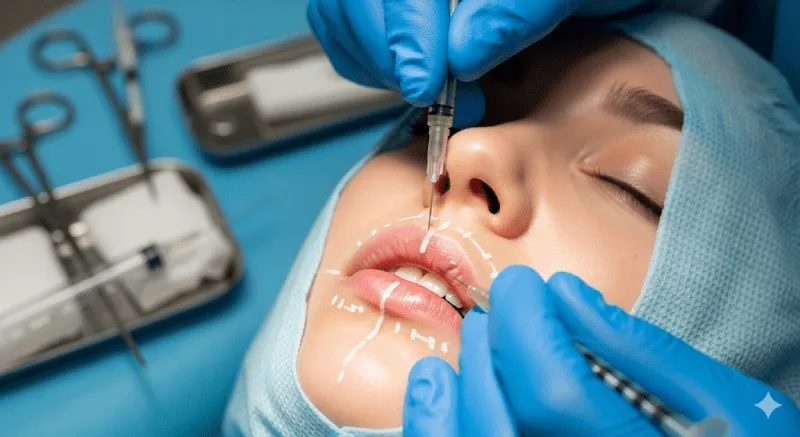
Your doctor measures the amount of skin to be removed with millimetric precision and draws on your nasal base with a surgical pen. This stage is the most critical moment for the symmetry of the result. Generally, a shortening of 1/3 of the philtrum length is targeted (for example, if it is 18 mm, 5-6 mm can be removed).
Anesthesia
Lip Lift is usually performed under local anesthesia. Just like at the dentist, only the area is numbed, the patient is awake but feels no pain. Sedation (light sleep state) can also be added for very excited patients. The procedure takes an average of 45 minutes to 1 hour.
Surgical Procedure
- After numbness is achieved, skin and (if necessary) some subcutaneous tissue are removed over the planned drawing.
- Bleeding control is performed (with cautery).
- The most important stage, the “suturing” part, begins. Sutures are placed in multiple layers. First, deep tissues (muscle fascia or deep dermis) are suspended to strong tissues at the base of the nose (periosteum or septum). This takes the tension off the skin and prevents the scar from widening.
- Then the skin surface is closed with aesthetic stitches as thin as a hair strand.
Critical Differences Between Lip Lift and Lip Filler
The question patients ask most is: “Why should I have surgery instead of filler?” Here is a comparative analysis:
| Feature | Lip Filler (Hyaluronic Acid) | Lip Lift (Surgical) |
|---|---|---|
| Permanence | Temporary (6-12 months) | Permanent (Lifetime, even as aging continues) |
| Mechanism of Action | Inflates by adding volume. | Shortens by suspending tissue upwards. |
| Tooth Visibility | Can cover teeth more (weight effect). | Increases tooth visibility (rejuvenation). |
| Profile Appearance | Risk of “duck lip” when overdone. | Flattens the lip, keeps projection natural. |
| Lip Distance | Does not shorten the philtrum, can even elongate it with weight. | Physically shortens the philtrum. |
| Recovery | 1-2 days edema. | 1 week social isolation, months of scar healing. |
| Cost | Low per procedure, high in the long run. | High one-time cost. |
Summary: If your lip distance is short and you just want volume, Filler. If your lip distance is long and your teeth are not visible, Lip Lift.
Recovery Process: Day by Day Calendar
The recovery process after Lip Lift requires patience. Here is what awaits you:
- First 24 Hours: The area may be bandaged. You may feel a slight throbbing as the anesthesia wears off. Applying ice compresses (15 minutes per hour) is essential to reduce edema.
- Days 2 and 3: Swelling (edema) reaches its peak level. Your upper lip may look excessively large and numb. This “Simpsons character” look is completely normal and temporary. You should sleep with your head elevated (with double pillows).
- Days 5 to 7: It is time for stitches to be removed. You feel relief after the stitches are taken out. Most of the swelling has gone down but is still present. Redness becomes coverable with makeup.
- Week 2: You can return completely to social life. Your lip may still feel a bit hard and tight. Smiling might feel strange.
- Month 1: Tissue begins to soften. The scar is in the form of a pink/red line.
- Months 3 to 6: The color of the scar begins to fade and turn to skin color. The lip takes its final shape.
- Year 1: The scar has now become almost invisible (in a good healing process).
Nutrition: Movements requiring opening the mouth wide, such as biting an apple or eating a hamburger, should be avoided for the first week. You should eat small bites using a fork and knife, and a straw should not be used (suction movement strains the stitches).
Scar Management and Healing
The biggest disadvantage of Lip Lift surgery and the biggest fear of patients is the scar at the base of the nose. However, with the right technique and good care, this scar can become unnoticeable from “social distance”.
Tips to Improve Scar Quality:
- Sun Protection: For the first 6 months after surgery, high factor (SPF 50+) sunscreen must be applied to the incision area. The sun causes darkening of the scar (hyperpigmentation).
- Silicone Gels: After the stitches are removed and the wound is closed, applying silicone-containing scar gels recommended by your doctor with massage twice a day prevents the scar from raising.
- Laser Treatments: In the later stages of healing, if redness or raising remains in the scar, the scar can be erased with applications such as Fractional Laser or V-Beam laser.
- Avoiding Tension: Avoiding facial expressions that stretch the suture line, such as laughing out loud or yawning, in the first weeks prevents scar widening.
Risks and Complications
Like every surgical procedure, Lip Lift has risks:
- Poorly Healing Scar (Hypertrophic Scar): The scar may remain raised in those with genetic predisposition or smokers.
- Asymmetry: The human face is congenitally asymmetric. After surgery, one side may be millimetrically higher than the other.
- Changes in Nose Shape: This is one of the most important risks. If the sutures are not fixed to the deep tissue, the weight of the lip skin can pull the nostrils down or widen the nasal wings sideways. An experienced surgeon minimizes this risk with “alar base sutures”.
- Loss of Sensation: Temporary numbness is normal, but permanent loss of sensation may rarely occur.
Frequently Asked Questions
Q: Can a Lip Lift be done at the same time as nose surgery (Rhinoplasty)? A: Yes, it can be done. However, if the nasal tip and base are to be manipulated a lot during rhinoplasty, some surgeons may prefer to wait 3-6 months between the two surgeries so as not to disrupt blood circulation. This depends entirely on the surgeon’s technique.
Q: Will my lips not close after Lip Lift? A: In the first weeks, lips may not close completely due to edema (“incompetent lips”). As the edema goes down, the lips regain their normal closing function. However, if excessive skin is removed (aggressive surgery), there is a risk of the lips remaining permanently apart. Therefore, a “conservative” (protective) approach is always better.
Q: Are the results permanent? A: Yes, the removed skin does not come back. However, since the aging process continues, the skin may loosen a bit again after 10-15 years. Still, it never returns to its pre-surgery state.
Q: Can men also have a Lip Lift? A: Absolutely. It is a very rejuvenating procedure, especially for men who lose tooth visibility with age. Since the incision scar remains in the mustache area in men, it is even easier to hide.
Q: What do prices depend on? A: Lip Lift prices vary according to the surgeon’s experience, the technique applied (deep plane vs. skin only), whether the surgery is performed with local or general anesthesia, and the hospital’s equipment.
Conclusion: Invest in Your Smile
Lip Lift is a powerful procedure that creates a “magic touch” effect in facial aesthetics when performed in the right hands. It changes not only the lips but the entire facial expression, adding a more feminine (in women), younger, and more attractive air to the person.
However, it should not be forgotten that this is a surgical procedure that is difficult to reverse. Filler can be dissolved, but cut skin cannot be put back. Therefore, before embarking on this journey, you should keep your expectations realistic, analyze your philtrum distance correctly, and definitely consult with a Plastic Reconstructive and Aesthetic Surgery specialist experienced in this field
This page covers one procedure in detail. For prices, what is included and how the whole trip works, see our overview of cosmetic surgery in Turkey.