
Part of: Dental treatment in Turkey — prices, what is included and country comparison.
What is E-max Veneer and Why is it So Popular?
E-max, which stands for “Maximum Aesthetics,” is a material made from lithium disilicate glass-ceramic that has brought a revolutionary innovation to dentistry. This special ceramic is designed to overcome the aesthetic and durability limitations of traditional porcelain veneers. E-max veneers are ultra-thin porcelain shells (laminates) applied only to the front surface of the tooth. Their thickness usually ranges between 0.3 mm and 1.0 mm, which is comparable to the thinness of a contact lens.
The most important factor underlying E-max’s popularity is the material’s high translucency. Natural tooth enamel has a unique ability to reflect and transmit light. E-max successfully mimics these natural optical properties, preventing the teeth from looking opaque or artificial. Light passes through the veneer and integrates with the underlying tooth structure, making it almost impossible to distinguish the veneer from the natural tooth. This biomimetic feature is an indispensable solution for patients seeking aesthetic perfection, especially in the anterior region, the most noticeable part of a smile.
Furthermore, the lithium disilicate content of E-max ensures that the material has high mechanical strength. This means that despite its thin structure, it is highly resistant to chewing forces. The fact that it offers a functional solution, not just an aesthetic one, has elevated E-max to the peak of modern aesthetic dentistry. This durability and aesthetic integrity allow patients to use their veneers safely for many years. E-max, being an all-ceramic (metal-free) structure, does not cause the grey or black discoloration often seen along the gum line with traditional metal-supported veneers.
This feature is one of the fundamental elements that ensures the most natural and healthy aesthetic results. The deep and vibrant look, a highly sought-after characteristic in aesthetic dentistry, is achieved through the microcrystalline glass-ceramic matrix structure of E-max. These fine details elevate E-max from a simple restorative material to a solution where the art of dentistry meets digital technology. E-max not only conceals existing imperfections but also imparts a natural radiance and a healthy appearance to your teeth. This innovative approach boosts patients’ self-confidence and positively contributes to their social lives.
Scientific Foundations of Lithium Disilicate Glass Ceramic: What Makes E-max Unique?
The secret to E-max’s success lies in its primary component: the lithium disilicate glass-ceramic material. This material possesses significantly superior mechanical and optical properties compared to standard feldspathic porcelains. Lithium disilicate has a special crystalline structure consisting of microscopic crystals interlocked within the material’s matrix. This crystalline structure significantly increases the veneer’s fracture resistance. Compared to the fragility of traditional ceramics, E-max can achieve a flexural strength of approximately 360 to 500 Megapascals (MPa), which is quite high for aesthetic veneers. This high strength is vital for the longevity of particularly thin veneers.
These crystals, homogeneously distributed within the glass-ceramic matrix, also determine the material’s optical properties. As light passes through these crystals, it refracts and scatters, giving E-max the natural translucency and opalescence characteristic of natural tooth enamel. Opalescence is the material’s ability to reflect short-wavelength (blue) light while transmitting long-wavelength (orange-red) light. This ensures that the tooth looks natural and vibrant even under different lighting conditions; for instance, teeth appear with a natural depth rather than a solid block, even under disco lights. Especially at the edges where the veneer meets the gum tissue, this optical harmony creates an aesthetic transition by almost completely hiding the presence of the restoration. The chemical composition of the material also makes E-max highly biocompatible. It does not react in the oral environment, is non-toxic, and does not irritate the gums. This biological superiority demonstrates E-max’s effectiveness in preserving gum health.
The laboratory fabrication of E-max is typically performed using CAD/CAM (Computer-Aided Design/Computer-Aided Manufacturing) technologies or a special pressing technique (IPS e.max Press). The pressing technique creates a denser, void-free ceramic structure, further maximizing durability, while CAD/CAM uses digital measurements provided by the dentist to ensure the veneer is manufactured with millimetric precision. These technological manufacturing methods guarantee that E-max veneers are long-lasting, biocompatible, and have perfect marginal adaptation. The most crucial property of lithium disilicate is its high fracture resistance against the tensile and flexural stresses vital for ceramic restorations. This scientific structure makes E-max a reliable material both aesthetically and functionally.
What Are the Aesthetic Advantages of E-max Veneers?
The aesthetic advantages offered by E-max veneer restorations set them apart from all other dental restoration options, establishing them as a standard in aesthetic dentistry. These benefits not only enhance a smile but also create a completely personalized result that matches the patient’s facial features and personality.
The Closest Appearance to Natural Tooth Translucency: E-max, thanks to its most striking advantage—translucency—is highly capable of mimicking the light characteristics of natural tooth enamel. When light hits the surface, instead of a dull reflection, depth and vitality are achieved, just like in natural teeth. This prevents the veneers from looking like “white and flat” blocks and gives the teeth a deep, sparkling character. The increased translucency towards the incisal edge (cutting edge) of the tooth is a hallmark of young, healthy teeth, and E-max successfully reproduces this gradient.
Absence of Metal Substructure and Gum-Friendly Structure: Unlike traditional porcelain restorations, E-max is fully ceramic, meaning it contains no metal substructure. Metal substructures can cause a grey or dark shadow, especially near the gum line, which makes the veneer look artificial. Since E-max is metal-free, the gum line remains entirely natural, and undesirable conditions like grey discoloration or staining of the gums do not occur. Moreover, the surface properties of lithium disilicate resist plaque accumulation, which reduces the risk of gingivitis and helps preserve pink aesthetics (the appearance of the gums).
Color Stability and Durability: Due to its smooth and dense surface structure, E-max is highly resistant to external factors. It is less permeable and more resistant to staining substances like coffee, tea, red wine, or tobacco compared to even natural teeth. This means it will retain its initial brilliance and color for years after application. Patients can continue their daily lives without aesthetic concerns. Color pigments cannot penetrate the internal structure of the veneer, which is the most critical chemical feature guaranteeing E-max’s long-lasting whiteness.
Customization Potential and Aesthetic Depth: E-max is available in different opacities. This variety gives the clinician the flexibility to use a more opaque block when needing to mask the dark color of the underlying tooth, or to provide maximum translucency for natural teeth. Through characterization techniques (mimicking natural cracks and bumps) and polishing applied to the veneers, each E-max restoration becomes a unique work of art in perfect harmony with the patient’s other teeth.
In Which Cases Should E-max Veneers Be Preferred?
E-max veneers are considered the gold standard for correcting a wide range of aesthetic and minor functional issues. The suitability of the treatment is determined by a detailed examination and analysis by the dentist, based on the patient’s oral health status and aesthetic expectations. These indications demonstrate the broad utility of E-max.
Color Irregularities and Stubborn Stains: Severe discoloration present from birth (e.g., tetracycline stains) or dark color changes in endodontically treated (root-canalled) teeth that cannot be resolved with bleaching procedures can be successfully concealed with E-max veneers. E-max’s special opacity options prevent the underlying dark color from detracting from the aesthetics, while the external surface of the veneer maintains a natural tooth appearance. Especially in cases of chronic discoloration, E-max provides great relief as a permanent solution for patients who constantly require bleaching.
Shape and Size Abnormalities: Congenital anomalies in the size or shape of teeth (such as microdontia, meaning abnormally small teeth), minimal fractures resulting from trauma, or wear due to age or friction can be corrected with E-max. The veneers ensure that the teeth achieve ideal proportion and symmetry, creating a more harmonious and youthful smile. Aesthetic adjustments, such as lengthening or widening the teeth, are possible with E-max through minimal preparation.
Spaces Between Teeth (Diastema): Mild to moderate gaps between teeth, particularly the gap between the two front teeth (diastema), can be closed quickly with E-max veneers without the need for orthodontic treatment. This is a fast and aesthetic solution, usually completed in just a few appointments. The dentist designs the veneers to bridge the gaps, allowing the teeth to appear naturally aligned.
Mild Crowding and Misalignments: Slight anterior tooth crowding and alignment problems that do not require comprehensive orthodontic treatment can be corrected with E-max veneer application, sometimes referred to as “Instant Orthodontics.” The minimal preparation performed on the front surface of the teeth brings the appearance of the teeth into ideal alignment. This makes E-max an ideal aesthetic alternative for patients who do not wish to undergo lengthy brace treatments.
Replacement of Old and Suboptimal Restorations: Worn, discolored, ill-fitting, or leaking old composite fillings, porcelain veneers, or crowns on anterior teeth can be replaced with E-max veneers. This offers a healthier and more long-lasting solution, both aesthetically and biologically, to the smile.
What Are the Key Differences Between E-max and Zirconium Veneers?
E-max and Zirconium are the two main all-ceramic materials most frequently used in aesthetic dentistry. Both are metal-free and possess high durability, but their structural differences make them ideal for different applications. Understanding this distinction is crucial for guiding the patient toward the most appropriate treatment option.
| Feature | E-max (Lithium Disilicate) | Zirconium (Zirconium Dioxide) |
|---|---|---|
| Core Material | Lithium disilicate glass ceramic. Translucent crystalline structure. | Zirconium dioxide ceramic. Polycrystalline structure (more opaque). |
| Aesthetics/Light Transmittance | High translucency and opalescence. Deep, natural-looking appearance, closest to the natural tooth. | More opaque (low light transmittance). Transmits less light, thus can appear duller. |
| Durability (Strength) | 360-500 MPa. Sufficient and excellent for anterior teeth. | 900-1200 MPa. Much higher durability, known as “ceramic steel.” |
| Area of Application | Anterior teeth, single crowns, and short bridges where aesthetics are paramount. | Posterior molar teeth and long, toothless spans requiring bridges, where high chewing force is present. |
| Tooth Preparation | Minimal tooth preparation (0.3 – 0.7 mm). Most of the tooth structure is preserved. | Requires more tooth preparation (1.0 – 1.5 mm). |
| Masking Dark Color | Low ability to conceal underlying dark color (due to high translucency). | Masks underlying dark colors (stains, metal) much better due to high opacity. |
Aesthetics and Light Management: E-max has a refractive index very similar to natural tooth enamel. This creates a perception of depth and makes the tooth appear three-dimensional. Zirconium, on the other hand, is structurally more opaque and may appear duller. Due to its high opacity, the way it reflects light may be less natural compared to E-max. Therefore, E-max is preferred, especially in the anterior section of the smile line, where light is heavily refracted and reflected. Although more aesthetic (translucent zirconium) versions of Zirconium have been developed, achieving E-max’s level of natural translucency is still challenging.
Mechanical Durability and Use Case: Zirconium is mechanically much superior to E-max in terms of strength. This super durability makes Zirconium ideal for areas exposed to intense chewing forces, such as posterior molar teeth, or for bridges required to span long edentulous (toothless) gaps. E-max, with its thin structure, offers sufficient durability against the shearing forces on anterior teeth and is unequivocally the number one choice for aesthetics in the front region. The dentist’s decision will be carefully based on the location of the restoration, the patient’s biting forces, and whether habits like bruxism (teeth grinding) are present.
How Does the E-max Veneer Application Process Work Step-by-Step?
E-max veneer treatment is a process that requires meticulous planning, typically spanning 2 to 3 appointments. Success depends on the aesthetic vision of the dentist, the technical skill of the laboratory, and the precision of the digital planning.
Initial Examination and Detailed Planning (Smile Analysis): Before starting treatment, the patient’s general oral health is evaluated. If problems like decay, gum disease, or joint issues are present, they must be treated first. Subsequently, the dentist analyzes the patient’s facial shape, lip movements, gum levels, and the current condition of the teeth. Digital photography, video recordings, and radiographic examinations are used during this stage. The patient’s aesthetic expectations are listened to and recorded in detail. This data forms the foundation of a personalized treatment plan.
Digital Design and Mock-Up (Preview): In this stage, which has become standard in aesthetic dentistry, digital impressions of the patient’s teeth are taken (with an intraoral scanner) or traditional impressions are acquired. This data is sent to the laboratory, where the digital design of the new smile is created (Digital Smile Design – DSD or Wax-Up). The design is transferred to a temporary material (Mock-Up) that can be easily applied to the patient’s mouth. The patient wears this model without any preparation done to their teeth, allowing them to clearly see and feel how their new teeth will look in the mirror or during a photo/video session. This trial is critical for obtaining patient approval and making final adjustments (length, shape). The Mock-Up approved by the patient serves as the final guide for the permanent veneers.
Tooth Preparation and Impression Taking: Once the Mock-Up stage is approved, the dentist performs a minimal invasive preparation, removing a very small amount of tooth structure (0.3 mm – 0.7 mm) from the tooth surface. This preparation ensures that the veneer fits perfectly onto the tooth and does not create excess bulk. The preparation is only to create space for the veneer. Afterward, final impressions (with traditional paste or digital scanner) are taken for the veneers to be manufactured with millimetric precision. These impressions are sent to the laboratory. To prevent sensitivity and preserve the aesthetic appearance, the prepared teeth are immediately covered with temporary veneers, either produced from the Mock-Up or specially fabricated.
Laboratory Fabrication: In the laboratory, customized E-max veneers are manufactured using CAD/CAM systems or the pressing technique, based on the final impressions or digital data. This stage involves artistic and technical skills, such as coloring the veneers, applying natural color transitions (grading), mimicking enamel layers, and adjusting the polish. The manufacturing process typically takes 4 to 7 days, depending on the laboratory’s workload.
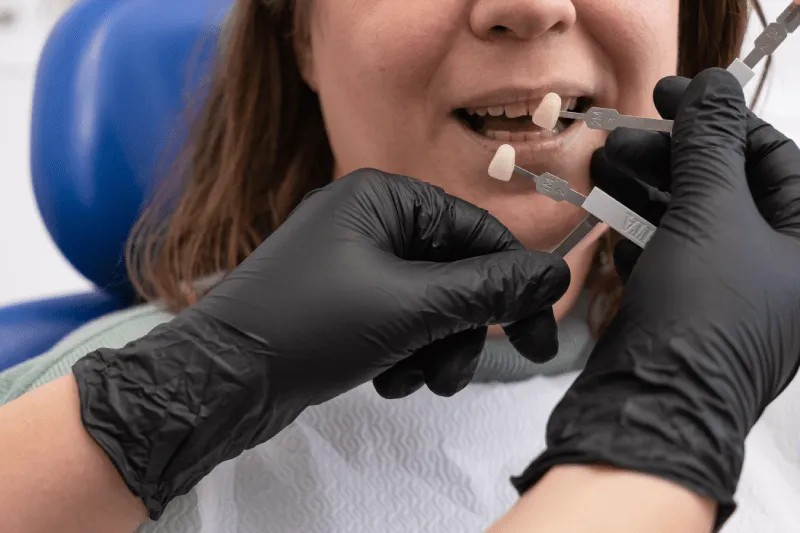
Try-In and Cementation (Bonding): The prepared veneers are tried in the patient’s mouth. Color, shape, and fit are checked for the last time. When the dentist and patient reach full agreement on the aesthetic perfection of the veneer, the cementation procedure begins with a special bonding protocol. During this process, the tooth surface and the internal surface of the veneer are prepared with specific chemical agents. Then, the veneer is bonded to the tooth using a special, strong resin-based adhesive (cement). This bonding procedure ensures the veneer chemically links to the tooth, achieving maximum durability. Excess cement is meticulously removed to prevent gum irritation, and the treatment is finalized with polishing.
Tooth Preparation: What is the Importance of the Minimal Invasive Approach?
The greatest philosophical cornerstone and advantage of E-max veneer treatment is its minimal invasiveness. The minimal invasive approach in dentistry aims to remove the smallest possible amount of tooth structure, preserving the natural tooth anatomy as much as possible. This approach is critically important for the long-term health of the patient’s teeth.
While traditional full crown restorations require the removal of a significant amount (1.5 mm – 2.0 mm) of tooth structure from all surfaces surrounding the tooth, the amount for E-max veneers is only 0.3 mm to 0.7 mm from the front surface. This thinness ensures that the veneer sits on the tooth’s outer surface like a thin shell.
Preservation of Natural Tooth Structure: The preservation of tooth enamel is vital for the long-term health of the tooth. Enamel is the hardest substance in the body and serves as the tooth’s protective shield against external factors. Minimal preparation keeps the majority of this shield intact. This not only maintains the biological integrity of the tooth but also significantly reduces the risk of hot/cold sensitivity that might occur after the restoration. In some cases, if the tooth’s position and shape are suitable, a “No-Prep” veneer application may even be performed, meaning the veneer is placed without any surface grinding.
Stronger Bonding and Integrity: Porcelain veneers achieve the highest retention and durability when bonded to tooth enamel. As long as the dentist can bond the veneer to the enamel layer, the cement bond remains extremely strong. This chemical bonding to the enamel makes the veneer an integral part of the tooth, minimizing the risk of detachment or leakage. Descending into the dentin layer beneath the enamel can both increase the risk of sensitivity and reduce the bond strength. Minimal invasive preparation preserves the enamel layer, maximizing the strong chemical bond that allows E-max veneers to last for many years.
The minimal invasive approach is possible due to the high durability stemming from E-max’s lithium disilicate composition. This durable material can provide sufficient strength even in a thin layer, thus eliminating the need for a thick structure and requiring less cutting of the natural tooth. This supports a philosophy of preservation and biological focus in aesthetic dentistry.
What is the Role of CAD/CAM Technology Used in E-max Treatment?
The perfect fit and aesthetics of E-max veneer restorations are largely indebted to CAD/CAM (Computer-Aided Design/Computer-Aided Manufacturing) technology, which is widely used in modern dentistry. This digital workflow increases both precision and speed compared to traditional methods and standardizes the quality of the final restoration.
Precise Impression and Digital Model: Instead of traditional impression trays and materials, intraoral scanners are used to capture optical impressions of the teeth. This scanning process instantly creates a three-dimensional digital model of the teeth, gums, and jaw relationships. This digital model virtually eliminates impression errors (bubbles, deformation) and can be immediately transferred to the laboratory. This increase in impression accuracy is a critical factor ensuring the veneer fits precisely at the tooth margin.
Personalized Design (CAD): The acquired digital data is loaded into computer-aided design (CAD) software. In this software, the dentist or technician designs the veneer’s shape, size, length, and contours with millimetric precision. The software also takes into account the occlusal (bite) relationships with the opposing tooth (antagonist), optimizing functional harmony. This design process transfers the aesthetic approval received from the patient during the Mock-Up stage into the digital environment.
High-Quality Production (CAM – Milling): Once the design is complete, this data is transferred to a manufacturing unit (milling machine – CAM). The milling machine uses high-speed diamond burs to carve out the veneers from solid E-max blocks (lithium disilicate blocks), precisely matching the digital design. This automated production process eliminates human error and ensures the veneer has a perfect fit (marginal adaptation) to the tooth. Excellent marginal adaptation maximizes the seal between the veneer and the tooth, minimizing the risk of secondary decay and gum problems.
Speed and Single-Visit Possibility (CEREC): While the laboratory phase in traditional methods can take days for impression casting, model creation, and manual veneer fabrication, the CAD/CAM technology significantly speeds up this stage. In fact, in some clinics, for suitable cases, the design, milling, and cementation can be completed within the same day (single-visit dentistry). This offers a great advantage in convenience and speed for patients with tight schedules or those traveling from abroad for treatment.
What Factors Affect the Longevity of E-max Veneers?
E-max veneers are extremely long-lasting restorations, often usable for 10 to 20 years or even longer, provided they are in ideal conditions and correctly maintained. However, this lifespan can vary depending on a number of biological, mechanical, and behavioral factors.
Clinician Skill and Cementation Protocol: The cornerstone of longevity is the veneer’s perfect fit on the tooth and its robust chemical bonding to the enamel using special resin-based adhesives (cements). The dentist’s experience, the quality of the tooth preparation, and meticulous adherence to the cementation protocol (isolation, etching, bonding agents) minimize the risk of detachment or marginal leakage. A strong and sealed bond ensures the veneer becomes an inseparable part of the tooth.
Patient Oral Hygiene and Gum Health: Although E-max veneers are resistant to staining and decay, the health of the underlying natural tooth and the surrounding gum tissue directly depends on the patient’s care. Regular and correct brushing (at least twice a day), use of dental floss or interdental brushes prevent plaque accumulation at the veneer margins and ward off gingivitis. Preserving gum health prevents the aesthetic margin of the veneer from being exposed and inhibits the formation of decay.
Usage Habits and Occlusion (Bite): Habits like biting on overly hard foods (nuts, ice, hard candies), nail-biting, or chewing on pens can impose localized high stress on the veneers, leading to fracture. Crucially, the bite (occlusion) must be correctly adjusted by the dentist. The veneers must receive chewing forces in a balanced manner, and the absence of premature contact points is a mechanical requirement for longevity.
Bruxism (Teeth Grinding/Clenching) Management: Patients with nocturnal teeth grinding or clenching habits (bruxism) exert much higher, horizontal, and damaging pressure on the veneers than normal. Over time, this can lead to E-max fatigue, chipping, or veneer detachment. For these patients, the use of a custom-made, hard acrylic protective clear splint (night guard) after treatment is mandatory to extend the veneers’ lifespan.
Regular Dental Check-ups: Regular dental check-ups every six months are critical for evaluating the marginal fit, polish, and surrounding gum health of the veneers. Minor issues detected early (e.g., minimal occlusal wear or slight cement excess) can be resolved before escalating into major problems, thereby extending the restoration’s lifespan.
Are There Any Potential Disadvantages of E-max Veneer Application?
While E-max veneers offer numerous aesthetic advantages, as with any medical procedure, there are some potential drawbacks or limiting factors. Patients should be aware of these points before deciding on treatment for transparent communication.
Higher Cost: E-max veneers generally incur a higher cost than traditional porcelain veneers or composite veneers. This higher cost stems from the high quality of the material (lithium disilicate glass-ceramic), the advanced technology used in the manufacturing process (CAD/CAM or pressing), and the meticulous, expert work required from the dentist and laboratory. This high cost should be balanced against the aesthetic, biocompatible, and long-lasting results achieved.
Irreversibility Requirement: Since minimal tooth preparation is necessary (except in No-Prep cases), the treatment is an irreversible procedure. Once the veneer is applied, the patient must always protect that tooth with a restoration. However, because only the enamel layer is minimally affected, this is a much less aggressive form of irreversibility compared to conventional crowns, and the tooth’s vitality is preserved.
Limitation in Masking Severe Discoloration: The high translucency of E-max, which is the foundation of its natural appearance, can occasionally be a disadvantage. If the underlying tooth is very dark (e.g., severe tetracycline staining or old metal-supported restorations), the thin structure of the E-max veneer may not fully conceal this dark color. Due to high transparency, the dark underlying color can reflect onto the veneer’s aesthetics, resulting in a grey-blue appearance. In such cases, the clinician may need to recommend alternatives, such as more opaque E-max crowns or zirconium-supported restorations.
Bruxism and Poor Habits: Uncontrolled severe teeth clenching or grinding habits increase the risk of E-max veneer fracture. This is less a disadvantage and more a necessity that must be addressed and managed with a night guard before treatment. If bruxism cannot be controlled, Zirconium crowns, which have higher mechanical strength, or alternative treatment methods should be considered instead of E-max. Continuing these habits post-treatment will significantly shorten the veneer’s lifespan.
How Should E-max Veneers Be Maintained and Oral Hygiene Be Performed?
The longevity of E-max veneer restorations depends not only on the quality of the application but also on the patient’s diligence in post-treatment care. E-max veneers can be cleaned as easily as your natural teeth, and their maintenance is achieved through standard oral hygiene routines, but there are a few nuances to consider.
Standard Hygiene Procedures:
- Correct Brushing Technique: Brush at least twice a day using a soft or medium-bristled toothbrush and a fluoridated, non-abrasive (low RDA value) toothpaste. Abrasive kinds of toothpaste (e.g., those labeled “for smokers”) can dull the veneer’s polish over time. The brushing technique should involve circular or sweeping movements, from the gum to the tooth.
- Cleaning the Veneer Margins: Particular care should be taken to meticulously brush the marginal areas where the veneer meets the gum line to prevent plaque accumulation. This area is the starting point for secondary decay and gingivitis.
- Use of Dental Floss and Interdental Brushes: The use of dental floss is vital for cleaning the contact points between veneers and natural teeth. Plaque accumulation in these areas can lead to decay and gum inflammation. Floss should be used gently to avoid damaging the veneer margins. Your dentist may recommend special dental floss (e.g., Superfloss) or interdental brushes used for bridge and implant cleaning.
- Mouthwashes: Fluoride-containing or antiseptic mouthwashes can provide additional protection as recommended by the dentist. However, continuous use of antiseptic mouthwashes is not advisable as it can disrupt the oral flora.
Special Protective Habits:
- Avoid Hard Objects: Just like natural teeth, E-max veneers can fracture or chip under excessive and unexpected forces. Habits such as cracking nuts with teeth, opening bottle caps, chewing ice, or biting on hard candy must be strictly avoided. These types of localized shocks can cause the veneer to fracture.
- Night Guard Use (in cases of Bruxism): If bruxism has been diagnosed by the dentist, regular use of a night guard is mandatory. It distributes chewing forces evenly, reducing the stress on the veneer surface and minimizing the risk of fracture.
- Regular Professional Maintenance: During routine dental visits every six months, your dentist or dental hygienist will perform professional cleaning using special silicone tips, plastic instruments, and polishing pastes that will not harm the veneers. Direct contact of traditional ultrasonic scalers with the veneer surface is generally not recommended.
What Are the Possible Sensitivities and Solutions After Treatment?
E-max veneer application is generally a painless procedure, requiring minimal tooth preparation, and does not cause permanent discomfort. However, some patients may experience temporary sensitivity post-treatment.
Temporary Thermal Sensitivity: Since a portion of the enamel layer is removed during tooth preparation, the underlying dentin layer may become more sensitive to external factors. This can cause temporary sensitivity, especially to cold or hot foods and drinks. This sensitivity usually decreases within a few days after cementation and completely disappears within a couple of weeks as the dentinal tubules naturally seal themselves.
Effect of the Bonding Procedure: The etching applied to the tooth surface during cementation is necessary to prepare the enamel and dentin for the bonding agent. These chemical procedures can rarely cause a temporary reaction in the tooth nerve.
Managing and Resolving Sensitivity:
- Desensitizing Toothpastes and Gels: The dentist may recommend desensitizing toothpastes or gels containing special potassium nitrate or strontium chloride, which help reduce sensitivity. These agents block the dentinal tubules, reducing the transmission of stimuli to the nerve endings.
- Clinical Fluoride Applications: If sensitivity persists, the dentist can apply high-concentration fluoride varnishes in the clinic to strengthen the tooth surface and help the tubules close.
- Occlusal (Bite) Adjustment: Sensitivity may be caused by the veneer being slightly too high, leading to excessive force during chewing. In this case, the dentist can perform a simple adjustment by checking the occlusal contacts with very thin articulating paper, thereby reducing the stress on the veneer.
If the sensitivity lasts longer than two weeks, increases in severity, or turns into throbbing pain, the patient should immediately consult the dentist to determine if the issue is related to the underlying tooth nerve (pulp). Most E-max patients experience minimal or no sensitivity after the procedure and enjoy the comfort of their new smiles.
Why Might the Cost of E-max Veneers Be Higher Than Other Options?
The cost of E-max veneer treatment is positioned at a higher level compared to some other aesthetic dentistry solutions. Behind this higher cost are several justifiable and logical reasons, ranging from the quality of the material used to the precision of the technology applied.
Superior Material Technology and Quality: E-max is different from standard materials like ordinary porcelain or metal-supported porcelain crowns. Lithium disilicate glass ceramic requires a special manufacturing and crystallization process. This material is produced with patented technology to deliver the highest level of performance in terms of both durability and aesthetics. This raw material, which offers high strength and unique translucency, naturally increases its cost.
Advanced Laboratory Craftsmanship and Technology: E-max veneers require extremely meticulous laboratory work due to their thin structure. The manufacturing of the veneers is usually done using expensive and high-precision CAD/CAM (Computer-Aided Design/Manufacturing) equipment or special pressing furnaces. These processes are carried out by highly trained dental technicians and digital design specialists. This digital workflow and significant high-tech investment, which are absent in traditional veneers, are important factors influencing the final price.
Clinician Expertise and Extended Clinical Time: The bonding of the veneer to the tooth with minimal invasive preparation and special resin-based cements requires a high level of expertise, attention, and time from the clinician. This bonding procedure is performed under strict isolation (moisture control) and specific protocols. The dentist’s meticulous and time-consuming work is a guarantee of high quality and is reflected in the cost.
The Value of the Minimal Invasive Approach: Paradoxically, removing minimal tooth structure requires more skill and attention from the clinician. The dentist must create a perfect surface preparation for the veneer to fit precisely while removing the least amount of tooth structure. The value of preserving the biological structure of the tooth (enamel) is immeasurable in terms of long-term dental health and the low risk of sensitivity.
Longevity and Guarantee: E-max does not change color and can last for 10-20 years with proper care. This long-term investment eliminates the need for frequent replacement. The high initial cost is balanced by the aesthetic, comfort, and functional benefits gained over the veneer’s lifespan, ultimately offering a more economical solution in the long run.
In conclusion, the cost of E-max veneers is not just the price of a material, but the total cost of guaranteed maximal aesthetic results, biological compatibility, minimal tooth loss, and a long-term solution.
What is the Role of E-max Veneers in Smile Design and How Does the Customization Process Work?
E-max veneers are the cornerstone of the modern Smile Design concept. Smile design aims for a holistic approach that goes beyond merely correcting the color and shape of the teeth, seeking to achieve perfect harmony with the patient’s facial features, lips, gums, and personality. E-max plays a central role in this process thanks to the superior customization possibilities it offers.
Detailed Face and Smile Analysis: The dentist analyzes the patient’s face shape (oval, square, round), lip movements, gum levels, the amount of tooth visibility during speech, and the current condition of the teeth. These analyses help determine the aesthetic ratios (golden ratio, width-to-length ratio of teeth, etc.).
Mock-Up and Aesthetic Trial for Approval: The most vital part of the customization process is the Mock-Up (preview) stage. In this stage, the new tooth design is transferred to the patient’s mouth using a temporary material without any irreversible procedures. The patient observes themselves in the mirror, smiles, talks, and evaluates this appearance by seeking feedback from their social circle. This is an interactive process where the dentist and the patient jointly decide on the final outcome. The Mock-Up approved by the patient becomes the definitive guide for the permanent E-max veneers.
Tooth Shape and Characterization: E-max allows for the detailed design of every desired tooth shape (rounder, squarer, younger, more mature). Micro-cracks, reflection areas, and color undulations (characterization) are added to the veneer surface, just like in natural teeth, completely eliminating the artificial appearance.
Management of Optical Properties: E-max’s different opacities and translucency levels allow the clinician to control the light management in each tooth. The incisal edges are designed to be more translucent (blue-grey tones), while the tooth body is designed to be more opaque (yellow-brown tones) to achieve a natural depth and a youthful appearance. This layering technique ensures that E-max works with light, not just color.
E-max veneers are not merely a technical application but a work of art where the craft of dentistry meets digital technology, prioritizing aesthetics and personalization. This central role in smile design places E-max in a unique position in modern aesthetic dentistry. The applied veneers create a smile that surpasses patient expectations, perfectly suits the face, and reflects the patient’s personality.
This page covers one procedure in detail. For prices, what is included and how the whole trip works, see our overview of dental treatment in Turkey.
Sources and how to verify this yourself
- Howe M-S, Keys W, Richards D. Long-term (10-year) dental implant survival: a systematic review and sensitivity meta-analysis. Journal of Dentistry, 2019 — pooled 10-year implant survival 96.4% (95% CI 95.2–97.5%); conservative sensitivity estimate 93.2%. source
- Ministry of Health, Regulation on International Health Tourism and Tourist Health, Official Gazette 26 April 2025, No. 32882 — authorisation requirement for facilities and intermediaries, TÜSKA accreditation, compulsory complication insurance (deadline 31 December 2025 for insurance, 31 December 2026 for accreditation). source
- Ministry of Health, Regulation on Promotion and Information Activities in Health Services, Official Gazette 12 November 2025, No. 33075 — treatment promises and guarantees are prohibited; price and campaign announcements are permitted only within international health tourism. source