
Part of: Cosmetic surgery in Turkey — prices, what is included and country comparison.
When you look in the mirror, do you see that stubborn belly fat, the protrusion on your hips, or the excess under your chin that won’t go away no matter how much you diet? Do specific areas of your body resist shaping despite spending hours at the gym and counting calories? If your answer is yes, you are not alone. Our genetic codes, hormonal structure, and aging process determine our fat storage habits, and sometimes it is impossible to empty these stores without external intervention.
This is where aesthetic surgery’s most powerful weapon comes into play: Liposuction.
Known colloquially as “fat removal,” Liposuction has undergone a major evolution since its invention in the 1970s. It no longer means just “sucking out fat,” but shaping the body like a sculptor, defining muscles, and recreating the silhouette.
In this giant guide, we will answer every question you might have, from what Liposuction is and isn’t, to the differences between technologies like Vaser and Laser, and the finest details of the recovery process. Grab your coffee and start examining the map of the journey to your dream body.
What Is Liposuction and What Is It Not?
The first rule of understanding Liposuction is to understand what it is not.
Liposuction is NOT a weight loss surgery.
If your goal is to lose 20-30 kilos on the scale, you need obesity surgery (gastric sleeve, etc.) or dietitian support. Liposuction is a Body Contouring surgery. Its purpose is not to reduce weight, but to give the body an hourglass, athletic, or slimmer form by removing disproportionate fat deposits that distort body lines.
- Ideal Scenario: You won’t see a huge change on the scale (maybe 3-4 liters of fat are removed, which corresponds to about 2-3 kilos), but your body size can drop by 2 sizes. Because fat is more voluminous but lighter than muscle and water. Volume goes, shape comes.
Biology of Fat Cells: Why Do We Gain Weight?
To understand why Liposuction is a permanent solution, we must look at the working principle of fat cells (adipocytes) in our body.
The number of fat cells in the human body increases until the end of puberty and then stabilizes. When we gain weight in adulthood, we do not produce new fat cells; existing fat cells grow in volume (expand). When we lose weight, these cells shrink and become smaller, but they do not disappear. They just wait there like a “deflated balloon.”
The difference with Liposuction is: In this procedure, fat cells are not shrunk, they are completely removed from the body.
For example, if you have 1000 units of fat cells in your abdominal area and genetically this is the first place that swells when you gain weight, this number can be reduced to 300 units with Liposuction. Even if you gain weight in the future, since the number of cells that will swell in that area has decreased, there will not be disproportionate fat accumulation as before. Weight is distributed more evenly in the body.
Who Is a Suitable Candidate for Liposuction?
Not everyone who says “I want to get fat removed” may be suitable for this procedure. Patient selection is critical for a successful result.
Ideal Candidate Profile:
- Body Mass Index (BMI): Below 30, meaning those close to their ideal weight or slightly overweight.
- Skin Elasticity: This is the most important factor. After the fat is removed, the skin needs to retract and adapt to the new form. If fat is removed from under skin that is full of stretch marks, sagging, and has lost its elasticity, the skin will sag even more (like a balloon losing air). In this case, Lift Surgeries (Tummy tuck, arm lift) are required, not Liposuction.
- Regional Fat: Those who have localized problems saying “my hips won’t go,” “my belly won’t melt,” rather than general obesity.
- Health Status: Those without serious health problems such as diabetes, heart disease, or blood clotting disorders that would affect healing.
- Realistic Expectations: Those who do not think that cellulite will completely disappear or that their life will change completely.
Liposuction Technologies and Types
Today, surgeons do not use only cannulas and manual power; energy-based devices get involved to perfect the results.
A. Traditional (Tumescent) Liposuction
It is the oldest method. A fluid (tumescent solution) that stops bleeding and numbs the area is administered. Then, the fat is mechanically broken down and vacuumed by making back-and-forth movements with metal tubes (cannulas).
- Disadvantage: It is traumatic, bruising and swelling are greater, and recovery is long. It is rarely preferred alone today.
B. Vaser (Ultrasonic) Liposuction
It is today’s “Gold Standard.” It uses sound waves (ultrasound).
- How Does It Work? Ultrasound energy is delivered to the fat tissue. This energy selectively explodes and liquefies the fat cells (emulsification). However, it does not damage blood vessels, nerves, and connective tissue.
- Advantages: Less bruising, less bleeding, faster recovery. Most importantly, it provides some tightening by heating the skin and allows for “High Definition” (muscle-look) sculpting.
C. Laser Liposuction (Laser Lipo)
It melts fat using laser energy (heat).
- Advantage: It is one of the best methods for tightening the skin due to the heat effect. It is very effective in small areas where the skin is loose, such as the jowl or underarm.
- Disadvantage: It may not be as fast and effective as Vaser in very large areas and high-volume fat removal. The risk of burns is higher in inexperienced hands.
D. Power-Assisted Liposuction (PAL)
It is a system where the tip of the cannula moves with a vibrating motor.
- Advantage: It requires less arm strength from the surgeon, so the surgeon does not get tired and can work more precisely. It is very effective especially in areas with fibrous and hard fat tissues such as the back. It is usually combined with Vaser.
Which Areas Can It Be Applied To?
Liposuction can be applied to almost every point of the body:
- Abdomen and Waist: The most popular area. “Love handles” and belly fat are removed.
- Back: Bra fat rolls and the “buffalo hump” on the neck can be corrected.
- Thighs (Legs): Inner thighs rubbing against each other is prevented, outer thigh (saddlebag) protrusions are corrected to make the leg look longer.
- Arms: Underarm fat, known as “bat wings,” is removed.
- Jowl (Under Chin): It is one of the small touches that rejuvenates the face the most. The jawline becomes defined.
- Breast (In Men): Used in the treatment of gynecomastia.
- Inner Knees and Ankles: Fine details of leg aesthetics.
High Definition (Hi-Def) and Lipo 360 Concepts
What do these terms you frequently hear on social media in recent years mean?
Lipo 360
It is shaping the entire torso (abdomen, waist, sides, entire back) all around by thinking of it like a cylinder, not just the abdomen. This method does not just correct the front and leave the love handles at the back; it gives the patient an hourglass appearance from every angle. Lipo 360 forms the basis of BBL (Brazilian Butt Lift) surgeries.
High Definition (Hi-Def) Liposuction
This is an advanced art form. The surgeon does not just remove the fat; they “carve” the fat over the abdominal muscles (six-pack), chest muscles, and obliques in accordance with muscle anatomy. The skin adheres to the muscle underneath, providing a muscular and athletic appearance. That “shredded” look that cannot be achieved despite years in the gym is created.
Surgery Process: Step by Step Journey
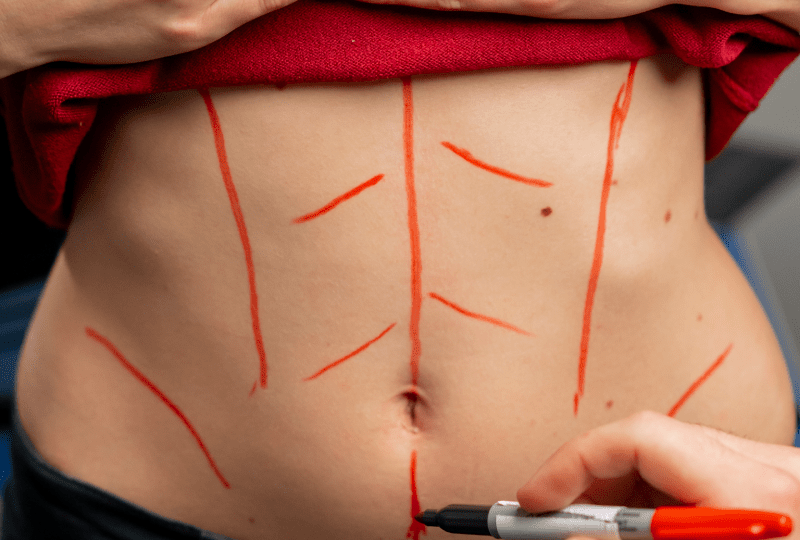
1. Consultation and Marking: Your surgeon draws on your body like a map while you are standing. It is determined from which areas fat will be removed (peaks) and which areas will not be touched (transition zones). This drawing is the plan of the surgery.
2. Anesthesia: Small areas (like just the jowl) can be done with local anesthesia, but extensive procedures like Lipo 360 are performed under General Anesthesia for your comfort.
3. Infiltration (Fluid Administration): Liters of a special fluid are administered to the areas where fat will be removed. This fluid contains Lidocaine (painkiller) and Epinephrine (vasoconstrictor). This way, bleeding is almost non-existent and postoperative pain is reduced.
4. Procedure: Fats are broken down with the selected technology (Vaser, Laser, etc.) and removed from the body with thin cannulas.
5. Closing: Incision sites are usually 3-4 mm in size and whether they require stitches depends on the surgeon. Usually, one stitch is placed. The patient is dressed in their special corset while on the operating table.
Recovery Process and Corset Use
When you come out of surgery, you will have a tight corset on. Here is the week-by-week recovery:
- First 3 Days: This is the hardest part. There are aching pains, but they can be controlled with painkillers. Pink fluid leakage from incision sites (expulsion of tumescent fluid) is very normal and good (reduces edema).
- Week 1: Return to social life and desk jobs begins. Edema is at its highest level, you may feel swollen and heavy. This can be psychologically challenging but is temporary.
- Week 3: Most bruises pass. 60% of the edema goes down. Body lines begin to become apparent.
- Week 6: Corset use is usually terminated in this period (can be worn only at night). Heavy sports can be started.
- Month 6: The result (“Final Result”) is seen. The skin settles completely, hardness passes.
Why is the Corset Essential? When the fat under the skin is emptied, a gap forms between the skin and the muscle. The pressure of the corset ensures that the skin adheres to its new place and prevents fluid from filling that gap (seroma). Not wearing a corset can cause a wavy and sagging result.
Importance of Lymphatic Massage
After Liposuction, your doctor will definitely refer you to “Manual Lymphatic Drainage Massage.” This is not an arbitrary spa massage; it is part of the treatment.
Surgery temporarily blocks lymph channels. The body cannot expel edema (water) and hardness (fibrosis) begins to form under the skin. Lymphatic massage performed by a professional expert:
- Accelerates the expulsion of edema through urine.
- Dissolves clumps and hardness under the skin.
- Shortens the recovery time by half. It is usually started 3-4 days after surgery and 10-15 sessions are recommended.
Relationship Between Liposuction and Cellulite
One must be honest about this: Liposuction is not a cellulite treatment.
In fact, if superficial fats right under the skin are removed, the appearance of cellulite may worsen. However, with technologies like Vaser and some tissue release techniques, the appearance of cellulite can be alleviated. If your main complaint is cellulite, additional treatments such as “Cellulite Mesotherapy,” “AWT,” or “Subcision” should be planned along with Liposuction.
Risks and Complications
Although Liposuction is very safe in competent hands, it is a surgical procedure and has risks:
- Contour Irregularities: The most common problem. Rippling and depressions may occur on the skin. This is usually related to the surgeon’s technique or corset usage error.
- Seroma: Fluid accumulation under the skin. It may need to be drawn with a syringe.
- Infection: Rare, prevented with antibiotics.
- Fat Embolism: A very rare but serious condition. It is a fat particle entering the vein and going to the lung. Experienced surgeons and atraumatic techniques minimize this risk.
- Sensory Loss: There may be temporary numbness in the area, it improves within months as nerves heal.
Permanence of Results: Do Fats Come Back?
Patients’ biggest fear: “I paid so much money, what if it comes back?”
As we mentioned before, removed fat cells do not come back. If you maintain your weight (or fluctuate by 3-5 kilos), your results are permanent for a lifetime.
However, if you eat unhealthily and gain excessive weight after surgery (like 10-15 kilos):
- The few remaining fat cells in the treated area expand.
- However, the body becomes more inclined to store fat in areas not treated. For example, if you had abdominal liposuction and gained a lot of weight; your belly won’t swell as before, but your back or legs may thicken more.
Therefore, you should see Liposuction as a “clean slate” and adopt a healthy lifestyle.
Frequently Asked Questions
Q: When can I return to work after Liposuction? A: 3-5 days are sufficient for office workers. For jobs requiring physical strength, 2 weeks should be waited.
Q: Will there be scars? A: The holes where the cannulas enter are very small (3-4 mm). These scars are hidden in the underwear line or the natural folds of the body. They fade over time to skin color and are very hard to notice.
Q: Will my result be spoiled if I get pregnant? A: Liposuction is not an obstacle to pregnancy. Your belly will naturally grow during pregnancy. When you lose weight after birth, returning to your old form will be easier thanks to the infrastructure shaped by liposuction compared to someone who has not had the procedure. However, the ideal is to perform this procedure after completing family planning.
Q: Can I have other surgeries at the same time? A: Yes. Liposuction is most frequently combined with “Breast Augmentation/Reduction” and “Tummy Tuck” (Mommy Makeover). Also, removed fats can be injected into the face or buttocks (BBL).
Final Word: The Best Investment for Yourself
Liposuction is not only a physical change but also a great investment in self-confidence. Freely displaying your body that you have hidden for years, enjoying shopping for clothes, and making peace with your reflection in the mirror is priceless.
But remember, no matter how much technology develops, the most important factor is your surgeon’s experience and aesthetic vision. Research well who you entrust your body to.
Your dream silhouette could be one decision away.
This page covers one procedure in detail. For prices, what is included and how the whole trip works, see our overview of cosmetic surgery in Turkey.
Sources and how to verify this yourself
- Ministry of Health, Regulation on International Health Tourism and Tourist Health, Official Gazette 26 April 2025, No. 32882 — authorisation requirement for facilities and intermediaries, TÜSKA accreditation, compulsory complication insurance (deadline 31 December 2025 for insurance, 31 December 2026 for accreditation). source
- Ministry of Health, Regulation on Promotion and Information Activities in Health Services, Official Gazette 12 November 2025, No. 33075 — treatment promises and guarantees are prohibited; price and campaign announcements are permitted only within international health tourism. source