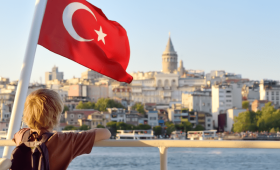
Imagine a city on the shores of the Aegean, leaning its back against majestic mountains and turning its face to the deep blue sea and Greek islands. A place where ancient marble columns shine with the first lights of the morning, ice-cold cave waters cool you down in the noon heat, and life flows through cobblestone streets in the late afternoon… This is Kusadasi.
For most vacationers, Kusadasi is just a “sea-sand-sun” destination or a stopover for giant cruise ships. However, this beautiful port city is just the tip of the iceberg. Kusadasi is a gateway to the most important metropolises of the Ancient Age, a shelter where mythological gods hid, and a cultural center where Aegean village life is still vividly lived.
In this guide, we will ask you to put your towel aside and put on your sneakers. Because we are drawing a giant discovery route of at least 2000 words, extending from the glory of Ephesus to the wine cellars of Sirince, from the hidden cave of Zeus to the walls of Guvercinada.
If you are ready, we start discovering Kusadasi in the real sense!
The Heart and Symbols of the City
The energy that welcomes you when you step into Kusadasi center is an interesting mixture of modern tourism and Ottoman heritage. To explore the city, one must start from the very center, from the iconic structures.
1. Guvercinada Kalesi (Pigeon Island)
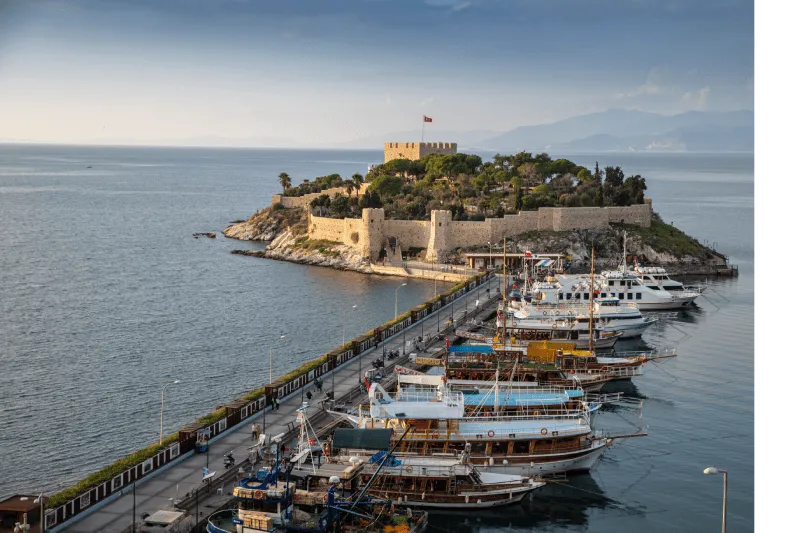
The symbol of Kusadasi, which is the subject of postcards, is undoubtedly Guvercinada. Formerly accessible only by boats, this small island is connected to the mainland by a stylish causeway today.
- Traces of History: Built during the Byzantine period and strengthened during the Ottoman period (especially during the Morea Revolt), the castle served as an “outpost” protecting the region against pirate attacks from the sea. The inner castle, which also bears traces of the famous sailor Barbaros Hayrettin Pasa, was included in the UNESCO World Heritage Tentative List in 2020.
- Why Go? The inside of the castle is almost an open-air museum. While walking on the walls, a panoramic view of Kusadasi city lies on one side, and the endless Aegean Sea on the other. It is the best point in the city to watch the sunset, especially as the sun goes down behind Samos Island.
- Experience: You can walk around the island, see the lighthouse inside, and if you are lucky, feed the pigeon flocks that give the island its name. Entrance is free.
2. Okuz Mehmet Pasa Caravanserai
Rising right in the heart of the city, directly across the port, this magnificent structure was built by Grand Vizier Okuz Mehmet Pasa in 1618.
- Architectural Genius: It is one of the most beautiful examples of classical Ottoman caravanserai architecture. With its thick stone walls, courtyard, and lead-covered roof, it has a mystical atmosphere completely isolated from the outside world. Formerly a place where trade caravans and sailors stayed, this structure is used as a hotel and event venue today.
- Atmosphere: When you enter through its massive wooden door, the city noise cuts off instantly. Drinking a Turkish coffee in its courtyard makes you feel like a merchant in the 17th century. If you are lucky, you might come across “Turkish Night” events or concerts held here on summer evenings.
3. Kaleici Streets and Mosque
The region right behind the Caravanserai is Kaleici, reflecting Kusadasi’s “Old Town” texture.
- Street Labyrinth: Narrow streets, old Greek and Turkish houses with bay windows, walls covered with ivy… This place is a paradise for photography enthusiasts. Souvenir shops, leather goods shops, carpet sellers, and antique dealers stretching along the streets keep the bazaar culture alive.
- Kaleici Mosque: Built in the 17th century again by Okuz Mehmet Pasa, this mosque forms an integrity with the caravanserai. It is worth seeing with its simple but impressive Ottoman architecture.
4. Sevda Tepesi (Gazibegendi)
If you want to look at the city from above, your route should be Sevda Tepesi. This point, where Ataturk looked at the view and said “What a beautiful place” (Gazi Begendi) when he visited Kusadasi, is the most popular observation terrace of the city today. It is the only place where you can see the entire bay, the port, Guvercinada, and the setting sun in a single frame.
In the Shadow of History – Ancient Cities
The biggest advantage of using Kusadasi as a base is that it is adjacent to the most important metropolises of the Ancient Age. You can teleport thousands of years back with just a 20-30 minute journey from the city center.
1. Efes Antik Kenti (Ephesus)
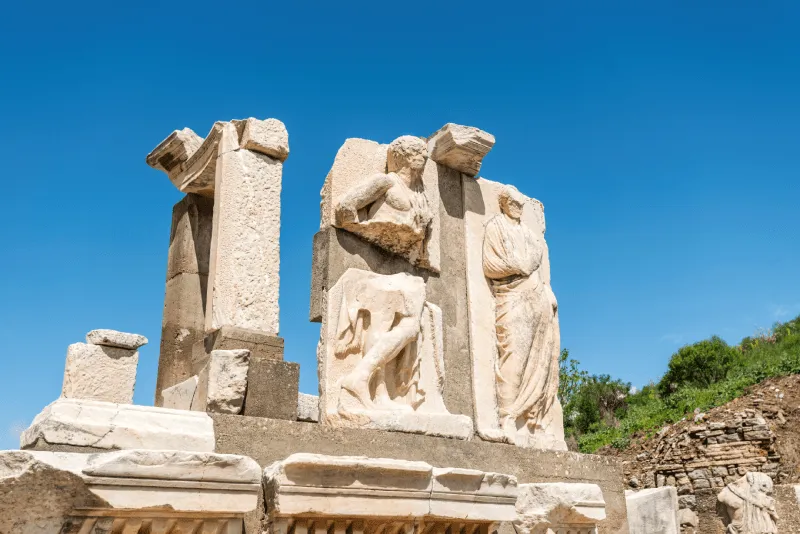
It is a major deficiency to come to Kusadasi and not see Ephesus. Included in the UNESCO World Heritage List, Ephesus was the capital of the Asian province of the Roman Empire and the largest port city of its period.
- Celsus Library: It is the most iconic structure of Ephesus. It is fascinating with its two-story facade, columns, and statues of “Wisdom, Destiny, Knowledge, and Virtue” inside (although the originals are in Vienna).
- Great Theatre: This massive theater with a capacity of 25,000 people has witnessed both gladiator fights and St. Paul’s sermons. Its acoustics are so perfect that a whisper on stage can be heard from the topmost steps.
- Terrace Houses (Yamac Evler): It is the “rich neighborhood” of Ephesus. You must definitely enter here (with an extra ticket) to see the luxurious life of the Roman period, floor mosaics, wall frescoes, and even the underfloor heating systems of that period. This is the best-preserved and most colorful part of the ancient city.
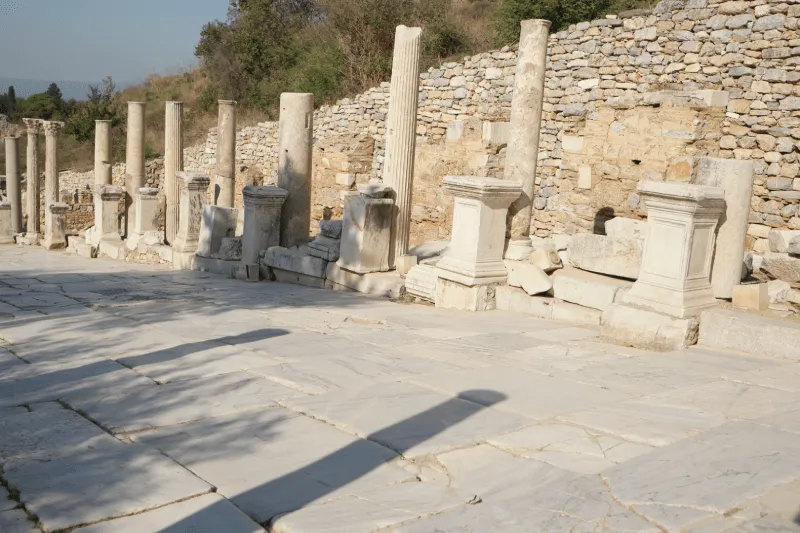
- Curetes Street: Walking along this marble street stretching from the Gate of Heracles to the library, you will see masterpieces like the Temple of Hadrian, Trajan Fountain, and Scholastica Baths on your right and left.
2. Meryem Ana Evi (House of Virgin Mary)
Hidden among pine trees at the summit of Bulbul Mountain, this small stone structure is a holy pilgrimage center for the Christian world. According to belief, after Jesus was crucified, Apostle John (St. John) brought Virgin Mary here for her safety, and Virgin Mary spent her last days here.
- Mystical Atmosphere: Regardless of your religious belief, it is impossible not to be affected by the peaceful atmosphere here. The simplicity inside the house and the tens of thousands of napkins and pieces of paper tied to the “Wish Wall” outside make you feel the spiritual burden of this place.
- Visit Tip: Especially on August 15th (Assumption of Mary), this place gets very crowded and special masses are held.
3. Temple of Artemis
Unfortunately, only a single column remains from this temple, which is one of the Seven Wonders of the World. However, even that single column is enough to imagine the grandeur of the massive structure (it was even larger than the Parthenon) that once rose here. The area where the temple is located is a sad but impressive stop on a wetland where storks make their nests.
4. St. John Basilica and Ayasuluk Hill
It is located at the foot of the Selcuk Castle (Ayasuluk) right next to Ephesus. It is believed that the tomb of St. John, the author of the Gospel, is here. This massive basilica built by Emperor Justinian was one of the most important pilgrimage centers of the Middle Ages. The magnificent harmony of brick and stone workmanship is evident even among the ruins.
Aegean Spirit – Villages and Vineyards
For those who want to get away from history a bit and dive into that slow, calm, and delicious Aegean village life, Kusadasi’s surroundings are full of surprises.
1. Sirince Village
Sirince, an old Greek settlement famous as “the village where the apocalypse will not break out”, resembles Safranbolu with its architecture, but its spirit is completely Aegean.
- Architecture and Streets: It is a complete fairytale village with its white-washed houses with wooden windows and narrow stone streets. Climbing to St. John Baptist Church at the top of the village to watch the view is a classic.
- Fruit Wines: The first thing that comes to mind when Sirince is mentioned is fruit wines. Blackberry, melon, peach, strawberry, pomegranate… You can taste and buy wine of every fruit you can think of here.
- Nesin Mathematics Village: Established right next to Sirince by Ali Nesin, son of Aziz Nesin, this village is a place like no other in the world. You must definitely see this modern madrasah based entirely on volunteerism, where science and philosophy are discussed, and young people are blended with mathematics.
2. Kirazli Village
Although not as touristic as Sirince, Kirazli is the right address for those looking for a “real” Aegean village experience.
- Breakfast Paradise: This place is especially famous for its weekend breakfasts. Tables set with tomatoes, peppers grown in the villagers’ own gardens, homemade jams, and warm flatbreads do justice to “mixed breakfast”.
- Ecological Market: In the ecological market set up on Sundays, you can find natural products sold by village women.
In the Lap of Nature and Mythology
The natural beauties of Kusadasi are as fascinating as its history. Here, nature is intertwined with mythology.
1. Zeus Magarasi (Cave of Zeus)
Hidden inward from the main road at the entrance of Dilek Yarimadasi National Park, this cave is the coolest point of Kusadasi in the summer heat.
- Legend: According to mythology, when the Sky God Zeus angered his brother, the Sea God Poseidon, he took refuge in this cave to escape his wrath and the storms he created and rested here.
- Experience: The inside of the cave is a natural pool. This water, where fresh water coming from the mountain and salt water coming from the sea mix, tastes like mineral soda and is around 5 degrees Celsius in summer and winter. Jumping into these blue-green waters (or daring to enter) while it is 40 degrees outside is an unforgettable experience. It is also believed that the mud of the cave is good for the skin.
2. Dilek Yarimadasi National Park (Canyon and Trekking)
We mentioned its coves in the previous guide, but the National Park is not just about the sea.
- Olukludere Canyon: Located inside the park, this canyon offers a magnificent 15-kilometer track for trekking lovers. During the walk, you can see endemic plants unique to the region, come across waterfalls, and if you are quiet, you can see Wild Horses or Fallow Deer.
- Flora and Fauna: This place is an oxygen depot. The park, said to be one of the last places where the Anatolian Leopard was seen, has been declared a “Flora Biogenetic Reserve Area” by the Council of Europe with its rich vegetation.
Culture and Art Stops
When “museum” is mentioned in Kusadasi, only ancient stones should not come to mind. The region is also ambitious in cultural tourism with private museums opened in recent years.
1. Oleatrium Olive and Olive Oil History Museum
Located on the Davutlar road, this private museum looks like a factory from the outside, but the inside is a world-class exhibition area.
- Time Travel: It tells the 2500-year journey of olive oil. How olive oil was produced from the Ionian period to Rome, from Byzantium to the Ottoman Empire, the lives of workers, the tools used, wax sculptures, and reenactments are explained so realistically that you feel like you are on a movie set. Don’t forget to taste organic olive oils at the museum exit.
2. Ibramaki Art Gallery
This venue, gained by restoring an old hospital building in Kusadasi center, is the heart of the city’s culture and art. It hosts painting exhibitions, photography screenings, and music recitals throughout the year.
Kusadasi Cuisine – What to Eat?
We traveled, we got tired… So where and with what will we satisfy our hunger? Kusadasi cuisine is a wonderful synthesis of Aegean and Cretan cuisine.
- Olive Oil Dishes and Herbs: Sevketi bostan, radish greens (turp otu), sea beans (deniz borulcesi), stuffed zucchini flowers (kabak cicegi dolmasi)… When you go to a tradesman restaurant or a tavern, definitely look for these greens on the appetizer tray.
- Cop Sis: It is impossible to come to Kusadasi and not visit the famous cop sis (shish kebab) places on the Selcuk or Soke road. These small pieces of meat arranged on small reed pieces, blended with cumin and thyme, are a feast of taste with roasted peppers and onions on the side.
- Seafood: You can eat fresh seasonal fish (sea bream, sea bass, red mullet) at the restaurants around Kusadasi Fish Market or in the port area. Fried calamari and grilled octopus are indispensable for the Aegean table.
- Incir Uyutmasi: For dessert, definitely try incir uyutmasi, a milky and light dessert made from the famous figs of Aydin.
Practical Information and Tips
- Best Time: The ideal times for cultural tours and ancient city trips are April-May and September-October. Since July and August are very hot, visiting shadeless areas like Ephesus can be challenging.
- MuseumCard: Definitely get a MuseumCard during your Kusadasi holiday. It will save you significant money and time at Ephesus, St. John, Guvercinada (sometimes for exhibitions), and other ruins.
- Transportation: The dolmus (minibus) network is very developed in Kusadasi. You can easily go everywhere with “Sehirici” dolmuses, to the National Park and Zeus Cave with “Davutlar/Guzelcamli” dolmuses, and to the Ephesus and Virgin Mary side with “Selcuk” dolmuses.
Kusadasi is one of the rare places that generously offers you everything you expect from a holiday. You can follow the footsteps of Roman emperors on the marble streets of Ephesus Ancient City in the morning, sip your wine in the cool shade of Sirince at noon, experience a mythological coolness in Zeus Cave in the late afternoon, and end the night with a beautiful Aegean table facing Guvercinada.
This is the place where the dusty pages of history are cleaned with sea salt. Kusadasi is waiting for you, have a good trip!
Free Consultation
Fill out the form below to get your free medical travel plan and price quote.