Cost and planning note (2026)
The figures below are indicative market ranges for 2026, not a quote: your own price depends on the clinic, the surgeon and your clinical assessment.
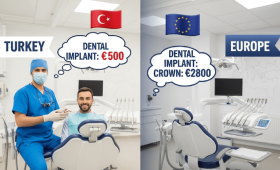
Indicative price range: Implant High End: 500 – 1,200 USD | All On 4: 4,000 – 7,000 USD per arch | Zirconia Crown: 200 – 400 USD | Veneers Emax: 250 – 450 USD
Facility standards: In Türkiye, any facility treating international patients must hold the Ministry of Health’s international health tourism authorisation; hospitals and medical centres must also be accredited by TÜSKA, and complication insurance is compulsory for procedures carried out in an operating theatre (Regulation of 26 April 2025). Ask us for the authorisation of the facility you are matched with.
Currency: USD / EUR / GBP accepted.
Cost and planning note (2026)
The figures below are indicative 2026 market ranges, not a quote.
Indicative costs in Türkiye: Implant high end 500 – 1,200 USD · All on 4 4,000 – 7,000 USD per arch · Zirconia crown 200 – 400 USD · Veneers emax 250 – 450 USD |
Facility standards: In Türkiye, any facility treating international patients must hold the Ministry of Health’s international health tourism authorisation; hospitals and medical centres must also be accredited by TÜSKA, and complication insurance is compulsory for procedures carried out in an operating theatre (Regulation of 26 April 2025).
Orthopedic Innovation 2026: The Rise of 3D Printed Custom Joint Implants in Turkey
Introduction
Turkey is rapidly emerging as a global hub for medical tourism, attracting patients seeking high-quality orthopedic care at competitive prices. In 2026, a significant driver of this growth is expected to be the increased adoption of 3D printed custom joint implants. This article will detail the burgeoning landscape of this technology within Turkey, encompassing the technical standards, cost considerations, and logistical advantages driving patient interest.
Traditionally, joint replacement involved utilizing a limited range of implant sizes. This often necessitated compromise during surgery, potentially affecting long-term functionality and patient satisfaction. 3D printing, however, allows for the creation of implants perfectly tailored to an individual’s anatomy, promising improved fit, reduced recovery times, and enhanced overall outcomes.
Technical Standards and Implementation
The implementation of 3D printed custom joint implants in Turkey is underpinned by a stringent regulatory framework. All medical facilities providing these services are subject to oversight by the Turkish Ministry of Health and increasingly, are seeking accreditation from the Joint Commission International (JCI). JCI accreditation signifies a commitment to international best practices in patient safety and quality of care.
Several key technologies are being integrated into the workflow for producing these custom implants:
- CBCT 3D Imaging: Cone Beam Computed Tomography (CBCT) provides highly detailed 3D images of the patient’s joint, serving as the foundation for implant design.
- Digital Smile Design (DSD): While primarily utilized in dentistry, the principles of DSD – leveraging digital planning and visualization – are being adapted for orthopedic applications, allowing surgeons to preview the implant’s fit and function before surgery.
- CEREC Same-Day: Though originally developed for dental restorations, the CEREC technology (Chairside Economical Restoration of Esthetic Ceramics) showcases Turkey’s expertise in rapid prototyping and customized solutions, demonstrating a capability extending to orthopedic implant fabrication.
The process typically involves:
- High-resolution CBCT scanning of the patient’s joint.
- Digital design of the implant using specialized software.
- 3D printing of a biocompatible implant, often utilizing titanium alloys or polymers.
- Sterilization and quality control checks.
- Surgical implantation by an experienced orthopedic surgeon.
While the cost of a high-end implant in Turkey currently ranges from 500 – 1,200 USD, this figure encompasses not only the implant itself but also the necessary imaging, design, and surgical procedures. This price point is considerably lower than comparable costs in many Western European countries and the United States.
Currency & Logistics
For international patients, the primary currencies accepted for medical services in Turkey are USD, EUR, and GBP. The ease of financial transactions, coupled with a relatively straightforward visa process – with e-visas available for most citizens of the UK, US, and EU allowing for a 90-day stay – further enhances Turkey’s appeal.
Popular recovery hubs are emerging, catering to different preferences:
- Istanbul (City/Boutique): Offers a blend of medical facilities and cultural experiences.
- Antalya (Resort/Beach): Provides a relaxing seaside recovery environment.
- Izmir (Aegean/Thermal): Combines medical care with thermal spa treatments for enhanced rehabilitation.
Cost and planning note (2026)
The figures below are indicative 2026 market ranges, not a quote.
Indicative costs in Türkiye: Implant high end 500 – 1,200 USD · All on 4 4,000 – 7,000 USD per arch · Zirconia crown 200 – 400 USD · Veneers emax 250 – 450 USD |
Facility standards: In Türkiye, any facility treating international patients must hold the Ministry of Health’s international health tourism authorisation; hospitals and medical centres must also be accredited by TÜSKA, and complication insurance is compulsory for procedures carried out in an operating theatre (Regulation of 26 April 2025).
Orthopedic Innovation 2026: The Rise of 3D Printed Custom Joint Implants in Turkey
Turkey is rapidly becoming a leading destination for medical tourism, and in 2026, it’s poised to be at the forefront of orthopedic innovation, specifically in the field of 3D-printed custom joint implants. This article details the procedure, the anticipated patient journey, and what makes Turkey a compelling choice for this cutting-edge treatment.
The Growing Need for Custom Implants
Traditional, off-the-shelf joint implants, while effective for many, don’t always perfectly match a patient’s unique anatomy. This can lead to reduced longevity of the implant, discomfort, and the potential need for revision surgery. 3D printing offers a solution by allowing for the creation of implants tailored to each individual, maximizing fit, function, and patient satisfaction. This is particularly beneficial for complex cases involving bone defects, trauma, or prior failed surgeries.
Procedure Steps: From Consultation to Recovery
The process for receiving a 3D-printed custom joint implant in Turkey involves several key steps:
- Initial Consultation & Assessment: The patient undergoes a thorough medical evaluation, including a review of their medical history, physical examination, and detailed imaging. CBCT 3D Imaging plays a crucial role in obtaining a precise model of the affected joint. Digital Smile Design principles, while typically associated with dentistry, are increasingly being adapted for pre-surgical planning to visualize the optimal implant placement.
- Custom Implant Design: Utilizing the CBCT scans, orthopedic surgeons and biomedical engineers collaborate to design a custom implant that precisely matches the patient’s anatomy. Advanced software allows for fine-tuning of the implant’s dimensions, shape, and porosity.
- 3D Printing & Material Selection: The implant is then 3D-printed using biocompatible materials like titanium alloy or cobalt-chromium. The choice of material depends on the patient’s specific needs and the load-bearing requirements of the implant.
- Surgical Implantation: The custom implant is carefully implanted during a surgical procedure, performed by experienced orthopedic surgeons. Minimally invasive techniques are often employed to reduce recovery time.
- Post-Operative Rehabilitation: Following surgery, patients undergo a structured rehabilitation program to regain strength, range of motion, and function. This typically involves physiotherapy and occupational therapy.
Patient Persona: Meet Ayşe
Ayşe, a 62-year-old retired teacher from London, struggled with severe osteoarthritis in her right knee for years. Traditional knee replacement options were presented, but her anatomy was unusual due to a previous injury, making a standard implant a less-than-ideal fit. She researched options and discovered the advancements in 3D-printed custom implants in Turkey. She was particularly drawn to the potential for a more natural feeling and longer-lasting solution.
- Motivation: To regain mobility and independence, allowing her to continue gardening and traveling.
- Concerns: Surgical risks, recovery time, and the cost of the procedure.
- Expectations: A pain-free knee, improved range of motion, and a return to her active lifestyle.
Ayşe chose a Ministry of Health–authorised hospital in Istanbul, attracted by the combination of advanced technology, experienced surgeons, and competitive pricing. The total cost of her procedure, including the implant (estimated at 500 – 1,200 USD), hospital stay, and rehabilitation, was significantly lower than comparable options in the UK. She also appreciated the ease of obtaining an e-visa for her 90-day stay.
Recovery Hubs & Cost Considerations
Turkey offers diverse recovery environments to cater to different patient preferences. Istanbul provides a vibrant city experience with access to boutique hotels and medical facilities. Antalya offers a resort setting with opportunities for beachside recovery. Izmir, located in the Aegean region, is known for its thermal spas and tranquil atmosphere.
While the high-end cost of a custom joint implant in Turkey is estimated between 500 – 1,200 USD, patients should factor in additional expenses such as travel, accommodation, and post-operative care. Many hospitals offer package deals that bundle these costs together, providing greater transparency and value. Currency exchange rates (USD, EUR, GBP) should also be considered when budgeting.
Technological Advantages
Turkish hospitals are increasingly adopting advanced technologies to support custom implant procedures, including:
- CBCT 3D Imaging: For precise anatomical modeling.
- Digital Smile Design (adapted for orthopedic planning): for pre-operative visualization.
- CEREC Same-Day technology (although primarily for dentistry, it demonstrates the country’s capability in rapid prototyping and digital manufacturing that supports implant creation).
Cost and planning note (2026)
The figures below are indicative 2026 market ranges, not a quote.
Indicative costs in Türkiye: Implant high end 500 – 1,200 USD · All on 4 4,000 – 7,000 USD per arch · Zirconia crown 200 – 400 USD · Veneers emax 250 – 450 USD |
Facility standards: In Türkiye, any facility treating international patients must hold the Ministry of Health’s international health tourism authorisation; hospitals and medical centres must also be accredited by TÜSKA, and complication insurance is compulsory for procedures carried out in an operating theatre (Regulation of 26 April 2025).
Orthopedic Innovation 2026: The Rise of 3D Printed Custom Joint Implants in Turkey
Turkey is rapidly becoming a leading destination for medical tourism, particularly in the field of orthopedic surgery. Driven by advancements in 3D printing technology and a commitment to high medical standards, the country is poised to see a significant increase in patients seeking custom joint implants. This article outlines the expected recovery timelines and associated costs for this cutting-edge procedure in Turkey as of 2026.
Recovery Timeline
Recovery from a 3D printed custom joint implant, like any joint replacement surgery, is a phased process. While individual experiences will vary depending on the joint affected (hip, knee, shoulder, etc.) and the patient’s overall health, a general timeline can be expected:
- Phase 1 (0-2 Weeks): Immediate post-operative care focuses on pain management and preventing infection. Patients typically require a hospital stay of 3-7 days. Initial mobility is limited, with assistance from physical therapists.
- Phase 2 (2-6 Weeks): Continued physical therapy is crucial, gradually increasing range of motion and strength. Patients will likely still require assistance with daily activities, but can begin walking with crutches or a walker.
- Phase 3 (6-12 Weeks): Increased independence and function. Physical therapy becomes more focused on regaining full strength and endurance. Most patients can return to low-impact activities.
- Phase 4 (3-6 Months): Continued rehabilitation and gradual return to normal activities. Full recovery and optimal function are typically achieved within 6 months, though some minor discomfort may persist.
The precision offered by 3D printing is expected to contribute to faster recovery times compared to traditional implants, as the custom fit minimizes the need for extensive tissue adjustment and promotes better integration with the patient’s anatomy.
Costs in Turkey (2026)
One of the primary drivers for medical tourism to Turkey is the cost-effectiveness of procedures without compromising quality. For 3D printed custom joint implants, the costs can vary depending on the complexity of the case, the materials used, and the hospital chosen.
- Implant Cost: The high-end cost for a 3D printed custom joint implant is estimated to be between 500 – 1,200 USD. This covers the design, printing, and materials of the implant itself.
- Surgery & Hospital Stay: Surgical fees and a 3-7 day hospital stay will add approximately 2,000 – 4,000 USD to the total cost.
- Pre-operative Assessment & Imaging: CBCT 3D Imaging and thorough medical evaluations are essential and contribute around 300 – 600 USD.
- Physical Therapy: A comprehensive physical therapy program, spanning several months, will cost approximately 500 – 1,000 USD.
- Total Estimated Cost: A complete package, including the implant, surgery, hospital stay, imaging, and physical therapy, is expected to range from 3,300 – 6,800 USD.
It’s important to note that these are estimates and can be influenced by individual circumstances. Patients should always obtain detailed quotes from multiple providers.
General Standards & Logistics
Turkey maintains high standards of medical care. Facilities offering these advanced procedures are typically JCI (Joint Commission International) Accredited and regulated by the Ministry of Health, ensuring patient safety and quality of care. Modern diagnostic technologies like CBCT 3D Imaging and surgical planning tools such as Digital Smile Design (used for pre-surgical visualization and planning) are becoming increasingly common. Furthermore, many clinics utilize CEREC Same-Day technology to expedite implant creation when applicable.
For international patients, Turkey offers a convenient travel experience. An E-visa is available for most citizens of the UK, US, and EU, allowing for a 90-day stay. Popular recovery hubs include Istanbul (offering city and boutique hotel options), Antalya (known for its resort and beach access), and Izmir (situated in the Aegean region with thermal spas).
Currency accepted includes USD, EUR, and GBP, providing flexibility for international patients.
Free Consultation
Fill out the form below to get your free medical travel plan and price quote.
Sources and how to verify this yourself
- Howe M-S, Keys W, Richards D. Long-term (10-year) dental implant survival: a systematic review and sensitivity meta-analysis. Journal of Dentistry, 2019 — pooled 10-year implant survival 96.4% (95% CI 95.2–97.5%); conservative sensitivity estimate 93.2%. source
- Ministry of Health, Regulation on International Health Tourism and Tourist Health, Official Gazette 26 April 2025, No. 32882 — authorisation requirement for facilities and intermediaries, TÜSKA accreditation, compulsory complication insurance (deadline 31 December 2025 for insurance, 31 December 2026 for accreditation). source
- Ministry of Health, Regulation on Promotion and Information Activities in Health Services, Official Gazette 12 November 2025, No. 33075 — treatment promises and guarantees are prohibited; price and campaign announcements are permitted only within international health tourism. source