Cost and planning note (Mommy Makeover 2026)
The figures below are indicative market ranges, not a quote: your own price is confirmed after a clinical assessment.
Indicative price range: Standard Package: 4,500 – 7,500 USD | Advanced Combination: 8,000 – 12,000 USD | Tummy Tuck: 3,000 – 5,000 USD | Breast Lift: 2,500 – 4,500 USD | Liposuction Per Area: 500 – 1,500 USD | Bbl Fat Transfer: 3,500 – 5,500 USD
Facility standards: In Türkiye, any facility treating international patients must hold the Ministry of Health’s international health tourism authorisation; hospitals and medical centres must also be accredited by TÜSKA, and complication insurance is compulsory for procedures carried out in an operating theatre (Regulation of 26 April 2025).
Recovery Focus: Post-pregnancy body restoration & safety first.
Currency: GBP, EUR, USD accepted.
The Role of Mental Health in Cosmetic Surgery: Finding your “Why”
The Anatomical Reality of Post-Pregnancy Physiological Changes
The transition through motherhood involves a profound physiological metamorphosis that extends far beyond the temporary changes of pregnancy. For many women, the postpartum period leaves lasting anatomical alterations that cannot be rectified through diet or conventional exercise alone. The most significant of these changes often involve the structural integrity of the abdominal wall and the loss of glandular tissue density in the breasts.
A primary concern in post-pregnancy restoration is Diastasis Recti. This condition is characterized by the lateral displacement of the rectus abdominis muscles, creating a gap along the linea alba. When the abdominal fascia loses its tension, the midsection may appear protruded or “soft,” regardless of the patient’s body fat percentage. Advanced surgical correction for this condition is highly specialized; Diastasis Recti repair involves internal corset suturing of the abdominal fascia, effectively re-approximating the muscle bellies to restore midline stability and abdominal wall tension. This procedure is foundational to achieving the “flat” aesthetic desired in a comprehensive Mommy Makeover.
Reconstructive Excellence: Tummy Tuck and Abdominal Contouring
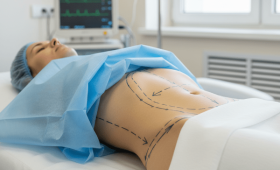
Achieving a streamlined abdominal profile requires a nuanced approach to skin excision and subcutaneous fat management. Depending on the degree of skin laxity and the distribution of adipose tissue, surgeons offer various tummy tuck options: Full, Mini, or Extended (3/60). A Mini Abdominoplasty focuses on the infra-umbilical area, whereas an Extended (360) approach addresses the flanks and the entire circumference of the waist, providing a holistic contouring effect.
To complement skin tightening, modern aesthetic medicine utilizes Vaser Liposuction, which is used for high-definition contouring with minimal bruising. Unlike traditional liposuction, which can be more traumatic to the surrounding tissue, Vaser technology uses ultrasound energy to selectively emulsify fat cells, allowing for precise sculpting of the flanks and hips. This is often paired with BBL (Brazilian Butt Lift) fat transfer, where processed adipose tissue is strategically re-injected into the gluteal region to enhance projection and curvature.
“The goal of abdominal reconstruction is not merely aesthetic; it is the restoration of the structural harmony between the skin, the musculature, and the underlying fascia.”
Restoring Breast Symmetry and Volumetric Integrity
Post-pregnancy, the breasts often undergo significant changes in volume and position, a process known as ptosis. The stretching of the Cooper’s ligaments during lactation and pregnancy can lead to a loss of structural support, resulting in a downward projection of the nipple-areola complex (NAC). A breast lift (Mastopexy) is the surgical standard for addressing this, involving the repositioning of the nipple and the removal of excess glandular skin to recreate a youthful, elevated contour.
For patients who have experienced significant volume loss, augmentation is often integrated into the restorative plan. The choice of implant is critical for long-term safety and aesthetic naturalism. Surgeons prioritize high-performance, JCI-approved implants, such as Mentor, Motiva, or Polytech, which are engineered to mimic the movement and feel of natural breast tissue. Whether a patient requires a simple lift or a combined lift and augmentation, the precision of the surgical technique ensures that the new breast contour is both symmetrical and anatomically sound.
The Economic Landscape: Value in Global Aesthetic Medicine
Turkey has emerged as the preeminent global hub for Mommy Makeovers, offering a unique convergence of high-tier surgical expertise and significant cost advantages. This is not a matter of “low-cost” surgery, but rather the optimization of resources. The ability to combine multiple procedures—such as a tummy tuck, breast lift, and liposuction—into a single surgical event allows for a streamlined recovery and a more efficient allocation of surgical fees.
Understanding the investment required is essential for-post pregnancy planning. The cost of individual procedures varies based on complexity, but the following benchmarks represent the standard market rates in Turkey:
- Tummy tuck: 3,000 – 5,000 USD
- Breast lift: 2,500 – 4,500 USD
- Liposuction per area: 500 – 1,500 USD
- BBL (Fat transfer): 3,500 – 5,500 USD
For patients seeking a comprehensive transformation, the standard package, typically involving one or two primary procedures, ranges from 4,500 – 7,500 USD. For those opting for a total body reconfiguration, the advanced combination (often including a full abdominoplasty, mastopexy, and liposuction) is valued between 8,000 – 12,000 USD. These figures represent a significant reduction compared to Western European or North American pricing, without compromising the technical caliber of the surgical outcome.
Safety Benchmarks and Post-Operative Recovery
Safety is the non-negotiable pillar of any reconstructive journey. When selecting a destination for post-pregnancy restoration, patients must look for surgeons who adhere to strict international accreditation standards. The use of JCI-approved medical devices and the presence of board-certified specialists ensure that the surgical environment meets the highest global benchmarks for patient care and sterility.
The recovery trajectory is a critical component of the surgical plan. Patients should prepare for a structured period of convalescence. The immediate post-operative phase involves 7-10 days in Turkey, a period during which the patient remains in a controlled, low-stress environment to manage swelling and monitor wound healing. However, the biological healing of deep tissues, particularly the internal corset suturing of the abdominal wall, requires more time. It is generally recommended that patients allow 6 weeks for a full return to strenuous exercise and high-impact activities.
Logistical Seamlessness: The Patient Experience
The “Mommy Makeover” experience in Turkey is designed to minimize the logistical burden on the patient, allowing them to focus entirely on healing. The infrastructure for medical tourism in Turkey is highly sophisticated, offering a premium-tier experience that mirrors luxury hospitality.
Upon arrival, patients are typically met at major international hubs, such as Istanbul (IST) or Antalya (AYT). The transition from the airport to the recovery setting is managed via VIP private transfers, ensuring privacy and comfort. For the duration of the recovery, patients are accommodated in 5-star recovery suites, which are specifically designed to provide a serene environment; many of these packages are even designed to include a companion stay, recognizing the importance of emotional support during the healing process.
Furthermore, the preliminary stages of the surgical journey can be initiated from the comfort of one’s home. Cure Holiday specialists facilitate free online video assessments with board-certified plastic surgeons. These digital consultations allow for an initial evaluation of skin elasticity, body mass index (BMI), and anatomical requirements, ensuring that by the time the patient arrives in Turkey, the surgical roadmap is already precisely defined.
The Psychological Foundation: Identifying the “Why”
In the realm of aesthetic medicine, the most profound transformations often begin long before the first incision is made. While the physical results are what the world sees, the catalyst for surgery is almost always deeply rooted in psychological alignment. This is what we refer to as the “Why.” For many patients, the decision to undergo a procedure is not driven by superficial vanity, but by a desire to reconcile their external physical appearance with their internal sense of self. This psychological state—often a pursuit of self-actualization following major life milestones—is the cornerstone of a successful patient journey.
When a patient undergoes a significant transformation, such as a combination surgery, the “Why” acts as a stabilizer during the recovery process. Whether the motivation is reclaiming confidence after pregnancy or addressing long-standing anatomical dissatisfaction, a clear, well-researched purpose helps mitigate the post-operative anxiety often associated with medical travel. At Cure Holiday, we emphasize that understanding this psychological driver is as vital as the surgical technique itself.
“A successful aesthetic outcome is measured not just by the symmetry of the contour, but by the restoration of the patient’s psychological equilibrium.”
Case Study: Reclaiming Identity Post-Pregnancy
To understand the intersection of mental health and surgical precision, consider the journey of a 34-year-old mother of three from Ireland. Following three successive pregnancies, she presented with significant anatomical changes that had profoundly impacted her body image. Her primary concerns were not merely aesthetic; they were functional and psychological. She experienced significant abdominal distension and a loss of core stability due to Diostasis Recti (the separation of the rectus abdominis muscles).
For this patient, the “Why” was the desire to feel “at home” in her body again. Her surgical plan required an advanced combination approach, which typically ranges from 8,000 – 12,000 USD. This was not a single-site procedure but a comprehensive restructuring of the midsection and lower body contours.
The Technical Execution: The Mechanics of Transformation
The surgical journey for such a complex case involves a multi-layered approach, integrating advanced technology with meticulous surgical skill. For a patient presenting with the clinical profile of our Irish case study, the procedure often involves several integrated steps:
- Diastasis Recti Repair: This is a critical functional component. It involves internal corset suturing of the abdominal fascia. By tightening the underlying muscular wall, the surgeon restores the structural integrity of the abdomen, reducing the “bulging” effect.
- Extended Tummy Tuck (360): Depending on the degree of skin laxity, options include a Full, Mini, or Extended (360) abdominoplasty. For our case study, an extended approach was necessary to address the flanks as well as the anterior abdominal wall. A standalone tummy tuck generally ranges from 3,000 – 5,000 USD.
- Vaser Liposuction: To complement the abdominoplasty, Vaser technology is utilized. This ultrasonic technique allows for high-definition contouring with minimal bruising and less trauma to the surrounding adipose tissue. The cost for liposuction per area typically falls between 500 – 1,500 USD.
- BBL/Fat Transfer: To create a harmonious silhouette, harvested fat from the abdomen is processed and re-injected into the gluteal region. This BBL/fat transfer procedure is valued between 3,500 – 5,500 USD.
When these procedures are combined into a single session, the patient benefits from a streamlined recovery and a more cohesive aesthetic result. A standard package involving less invasive procedures typically ranges from 4,500 – 7,500 USD, whereas the multi-site reconstruction is more intensive.
JCI Standards and the Architecture of Safety
A significant barrier to the “Why” is the fear of the unknown—specifically, the safety of surgical outcomes in a foreign destination. This is where international accreditation becomes the bridge between intention and action. The use of JCI (Joint Commission International) approved standards ensures that the surgical environment, sterilization protocols, and anesthesia monitoring meet the highest global benchmarks.
Safety extends to the materials used in the theatre. For patients requiring augmentation, the use of JCI approved implants, such as Mentor, Motiva, or Polytech, is non-negotiable. Furthermore, the precision of the surgical plan—whether it is a breast lift (ranging from 2,500 – 4,500 USD) or a complex abdominal reconstruction—relies on the rigorous adherence to these medical protocols to minimize the risk of complications such as seroma or hematoma.
The Patient Journey: From Digital Consultation to VIP Recovery
The transformation journey is designed to be a seamless transition, minimizing the logistical stress that can often cloud the psychological benefits of surgery. The process begins with free online video assessments with board-certified plastic surgeons, allowing for an initial clinical evaluation and the establishment of trust before the patient even leaves their home country.
Upon arrival, the logistics are managed with a focus on luxury and convalescence:
- Arrival: Seamless transitions through Istanbul (IST) or Antalya (AYT) airports.
- Transfers: VIP private transfers are provided from the airport directly to the clinic or recovery suite, ensuring privacy and comfort.
- Accommodation: Post-operative care takes place in 5-star recovery suites with companion stay included, providing a serene environment for the healing process.
The recovery timeline is a period of intense physiological healing. Patients should anticipate 7-10 days in Turkey for the initial post-operative phase, focusing on wound care and wound stability. However, it is important to note that full exercise return typically requires 6 weeks to ensure the structural integrity of the repaired fascia and the stability of the transferred fat is maintained. By managing expectations through this structured timeline, we ensure that the physical transformation is matched by a steady, supported psychological recovery.
The Psychological Foundation of Surgical Success: Defining Your “Why”
Cosmetic surgery is frequently discussed in terms of physical outcomes, yet the psychological preparation—finding your “why”—is the most significant predictor of long-term satisfaction. The “why” serves as the emotional anchor during the inevitable physiological fluctuations of the post-operative period. When a patient’s motivation is rooted in internal empowerment rather than external validation, they are significantly better equipped to navigate the “post-op blues,” a common period of emotional vulnerability that occurs during the initial inflammatory phase of healing.
The cognitive process of preparing for a transformation involves assessing one’s mental readiness for the period of convalescence. Clinical studies suggest that patients who have undergone a thorough psychological “pre-habilitation”—understanding that the immediate post-operative result is often obscured by edema (swelling) and ecchymosis (bruising)—experience lower levels of post-surgical anxiety. This mental fortification is essential when managing the logistics of a complex recovery in a foreign destination.
“The success of a surgical procedure is not merely measured by the symmetry of the incision or the contour of the adipose tissue, but by the patient’s ability to integrate their new physical identity into their psychological self-concept.”
Optimising the Post-Operative Environment: Luxury Recovery Logistics
The physiological healing process is deeply intertwined with the patient’s environmental stressors. In the context of medical tourism in Turkey, the logistical framework is designed to mitigate these stressors through high-end, controlled recovery environments. For many, the transition from the operating theatre to a clinical setting can be jarring; therefore, the implementation of 5-star recovery suites with companion stay included is a critical component of the aftercare strategy.
These recovery villas are not merely luxury accommodations; they serve as clinical extensions of the surgical care plan. A low-cortisol environment—one characterized by comfort, privacy, and professional support—is essential for wound healing and reducing the risk of post-operative complications. The logistical flow is meticulously managed, starting from VIP private transfers from the airport, specifically via Istanbul (IST) or Antalya (AYT), ensuring that the patient’s first experience post-surgery is seamless and devoid of the navigational stress typical of international travel.
For many international patients, a primary concern is the management of family responsibilities. The logistics of childcare logistics and the coordination of domestic life during the 7-10 days in Turkey must be addressed pre-operatively. Cure Holiday specialists recommend a structured “tapering” plan, where the patient’s domestic responsibilities are delegated well in advance of the fly-home timeline, allowing the focus to remain entirely on physiological restoration.
Clinical Precision: The Technical Architecture of Healing
The technical sophistication of modern surgical techniques plays a pivotal role in reducing the psychological and physical burden of recovery. Advanced technologies are now standard in high-end Turkish surgical centers, specifically designed to minimize tissue trauma and accelerate the return to normalcy.
- Vaser Liposuction: Utilising ultrasonic energy to emulsify fat cells, this method is used for high-definition contouring with minimal bruising, significantly reducing the inflammatory response and the subsequent period of physical discomfort.
- Abdominal Reconstruction: For patients undergoing more complex procedures, Diastasis Recti repair involves internal corset suturing of the abdominal fascia, providing structural integrity and a more stable foundation for the skin envelope.
- Tummy Tuck Variations: Surgical planning is tailored to the individual, with options including Full, Mini, or Extended (360) techniques to address varying degrees of skin laxity and muscle separation.
- Implant Integrity: To ensure long-term safety and aesthetic naturalism, surgeons utilise only JCI approved implants, specifically Mentor, Motiva, or Polytech.
While the initial period in Turkey is focused on acute healing, the broader timeline is essential for mental and physical recalibration. While the physical stay is brief, patients should plan for a 6 weeks for full exercise return. This period of restricted activity requires significant mental discipline and a pre-planned itinerary that avoids strenuous movement while allowing for light, restorative walking to prevent deep vein thrombosis (DVT).
2026 Financial Projections: Navigating the Global Cost Variance
The decision to undergo surgery abroad is often driven by the significant cost differential between Turkey and traditional Western hubs like the UK or USA. However, a sophisticated financial plan must account for the “all-inclusive” nature of the Turkish model, which integrates surgical fees, 5-star accommodation, and VIP logistics into a single, transparent figure.
As we look toward the 2026 landscape, the following cost breakdown illustrates the value proposition of the Turkish surgical model. These figures represent the estimated surgical and package costs, providing a benchmark for long-term budgetary planning:
| Procedure/Package Type | Estimated 2026 Cost (USD) |
|---|---|
| Standard Package (Comprehensive) | 4,500 – 7,500 USD |
| Advanced Combination (Multi-area) | 8,000 – 12,000 USD |
| Tummy Tuck (Full/Extended) | 3,000 – 5,000 USD |
| Breast Lift (Mastopexy) | 2,500 – 4,500 USD |
| Liposuction (Per Area) | 500 – 1,500 USD |
| BBL (Fat Transfer) | 3,500 – 5,500 USD |
When comparing these figures to the UK or USA, it is vital to note that the Turkish quotations often encompass the “logistical peace of mind” discussed earlier. This includes free online video assessments with board-certified plastic surgeons, which allow for an initial clinical screening long before any travel occurs. By integrating clinical excellence with a highly structured recovery framework, the Turkish model allows patients to focus on the most important aspect of their journey: the psychological and physical realisation of their “Why.”
Considering a Mommy Makeover in Turkey? Get a Free Quote for your The Role of Mental Health in Cosmetic Surgery Transformation with cureholiday.com
Free Consultation
Fill out the form below to get your free medical travel plan and price quote.
Sources and how to verify this yourself
- Ministry of Health, Regulation on International Health Tourism and Tourist Health, Official Gazette 26 April 2025, No. 32882 — authorisation requirement for facilities and intermediaries, TÜSKA accreditation, compulsory complication insurance (deadline 31 December 2025 for insurance, 31 December 2026 for accreditation). source
- Ministry of Health, Regulation on Promotion and Information Activities in Health Services, Official Gazette 12 November 2025, No. 33075 — treatment promises and guarantees are prohibited; price and campaign announcements are permitted only within international health tourism. source