Is There An Ideal Age Limit For Hair Transplantation?
Although the legal requirement for hair transplant operations is to be of legal age, talking about a medically “ideal” age is more complex. Experts generally approach individuals in their early 20s with caution because the hair loss pattern has not yet stabilized. The ideal age limit is considered to be 25 and older, which is the period when hair loss stabilizes and the quality of hair in the donor area becomes clear. However, this is a dynamic process that varies according to each patient’s genetic map and rate of loss.
What Are The Risks Of Getting A Hair Transplant At A Young Age?
Hair loss in individuals between the ages of 18 and 22 usually follows a very aggressive course. A hair transplant performed during this period may fill the existing gaps, but as the existing hair continues to fall out, it can lead to an unnatural appearance called the “island look” within a few years. Unplanned transplants performed at a young age lead to inefficient use of grafts in the limited donor area and result in insufficient hair follicles for revision transplants that may be needed in the future.

What Should Those Experiencing Hair Loss In Their 20s Do?
If you are in your early 20s and feeling significant hair loss, your first step should be medical treatments to slow down the loss rather than surgical intervention. Medications used under expert control, such as finasteride and minoxidil, or supportive treatments like PRP and mesotherapy, help you wait for the “maturity” period required for surgical intervention by controlling the rate of loss. During this process, diagnosing your hair loss type with a dermatologist will increase the success of a future operation.
At What Age Should One Wait For Hair Loss To Stop?
Male pattern baldness (androgenetic alopecia) is technically a process that can last a lifetime, but the most severe shedding usually occurs between the ages of 25 and 35. By the time one reaches 35-40, the rate of loss generally slows down and the hair loss line takes a distinct shape. It is not necessary to wait for the shedding to stop 100% for the operation; however, it is vital for the rate of shedding to have decreased to a minimal level on an annual basis in order to maintain the harmony of the transplanted hair with the surrounding natural hair.
Why Are The 30s Considered The Golden Age For Hair Transplantation?
The 30s are a period when both hormonal balance reaches a more stable level and the character of the person’s hair loss is fully understood. At these ages, the permanence of the hair in the donor area has been more clearly tested, and the surgeon can plan the hairline more realistically to adapt to the person’s aging process. In addition, the tissue healing rate of patients in their 30s is still high, which ensures a comfortable convalescence period after the operation and allows the results to be seen quickly.
Does The Success Rate Of Hair Transplant Operations Change With Age?
Advancing age does not directly reduce the technical success of the operation; however, biological factors can affect the result. Very successful hair transplants are also performed in patients in their 50s and 60s. The important issue here is the quality of the grafts and the general health status of the person. The fact that blood circulation is slightly slower in older ages compared to younger people may prolong the healing time by a small amount, but thanks to modern FUE and DHI techniques, the retention rate of follicles is quite high in elderly patients as well.
How Does Donor Area Quality Change With Age?
The donor area, which is the area between the two ears and the nape, contains hair follicles resistant to the DHT hormone. However, as we age, “senile alopecia,” which is age-related thinning, can also affect the donor area. If the hair density in the donor area has decreased significantly due to age, sufficient grafts to be transferred to the transplant area may not be found. For this reason, the age range of 30-45, when the donor area is still rich, is the most suitable time window to reach the maximum number of grafts.
Do Transplants Performed At An Early Age Require Revision Later?
Yes, a great majority of hair transplants performed between the ages of 20-25 result in the need for a second session, namely a revision, within 5-10 years. The reason for this is not that the transplanted hair falls out, but that the original hair behind the transplanted area continues to fall out. This situation causes a bunch of dense hair to remain in the front of the hair while the back opens up. Those who have a transplant at an early age should know that they will have a “completion” operation in the future and should save their donor capacity accordingly.
How Does A Family History Of Hair Loss Affect The Age Of Operation?
Genetic heritage acts as a compass in hair transplant timing. If there is a history in your father or uncle where hair was completely lost at the end of their 20s (Norwood level 6-7), you are also likely to experience similar aggressive loss. In this case, experts recommend waiting for the shedding to reach its peak or at least for this trend to slow down. Instead of early intervention, monitoring the course of genetic shedding allows the donor hair to be distributed in the most efficient way.
What Factors Besides Age Are Critical When Deciding On A Hair Transplant?
Although age is an important criterion, the type of hair loss, the thickness of the existing hair, the density of the donor area, and the patient’s expectations are equally critical. For example, the surgical suitability of a 22-year-old patient whose shedding has reached a standstill and a 30-year-old patient who still has intense shedding are evaluated differently. In addition, lifestyle factors such as the person’s smoking use, stress level, and nutritional habits are also parameters that affect the survival rate of the grafts and the timing of the operation.
How Should The Relationship Between The Norwood Scale And Age Be Evaluated?
The Norwood scale determines the stages of male pattern baldness. Generally, hair transplantation is considered starting from Stage 3 and beyond. Performing a transplant on individuals who are young and still at the Stage 2 level (slight opening only at the temples) is generally not recommended because it is uncertain how far the shedding will progress. In a patient who has reached Stage 4 or 5 in their 30s, it is much safer and more predictable to design and achieve permanent results since the area is clear.
What Are The Advantages Of Those Who Have A Hair Transplant After Age 40?
Patients over the age of 40 are usually the “safest” patient group. At these ages, hair loss has already approached its final pattern, and the probability of the surgeon encountering surprise shedding is low. In addition, the hairline design made over the age of 40 is determined according to the mature facial features of the person, so the aesthetic results are much more natural and satisfying. The expectations of patients in this age group are generally more realistic and their adaptation to the post-operative process is high.
Is Hair Transplantation A Safe Procedure In Old Age?
Hair transplantation is a minimally invasive procedure performed under local anesthesia; therefore, it is quite safe even for individuals in their 60s and 70s as long as their general health status permits. Control of chronic diseases such as blood pressure and diabetes is sufficient for the operation. Patients who have a transplant in old age state that they feel much younger and more dynamic. The only limiting factor here is the vitality and number of hair follicles in the donor area.
What Is The Most Suitable Age Range For Hair Transplantation In Women?
Female pattern hair loss follows a different course than that of men; it is usually seen as a general thinning all over the head. In women, hormonal tests and the cause of shedding (menopause, thyroid, iron deficiency, etc.) are more prominent than age criteria. The 50s may be a suitable period for women due to the stabilization of shedding in the post-menopausal period. However, in women with androgenetic shedding, a transplant can be planned at any age starting from the ages of 25-30.
Do Seasonal Cycles And Age Factors Affect The Operation Result?
Although seasons do not have a direct effect on hair transplant results, they can create a difference in comfort during the healing process when combined with age. For example, since the circulatory systems of older patients may be more sensitive in extremely hot or extremely cold weather, choosing the spring months may help the edema during the healing period to dissipate faster. Young patients generally show fast recovery in every season. The important thing is to protect the scalp from direct sun and excessive sweating for the first 15 days after the operation.
Does Graft Capacity Decrease Depending On Age?
Depending on the general aging process of the body, the quality of the hair follicles and the number of hair strands contained in the grafts may decrease over time. While an average of 3-4 hair strands come out of a graft in the 20s, this rate may drop to 1-2 strands in the 60s. This is a factor that affects the density of the transplant. However, this is not a rule; many older patients may still have an extremely lush donor area. For this reason, it is essential for the specialist physician to measure the graft quality with micro-camera analysis.
What Is The Effect Of Age On The Healing Process In Hair Transplantation?
Since cell renewal is much faster in young organisms, the scabbing in the donor and transplant areas of patients in their 20s and 30s falls off completely within 7-10 days. In older patients, this process can extend up to 12-14 days. Since wound healing slows down with age, older patients need to follow post-operative care instructions (washing, lotion use, etc.) much more meticulously. Nevertheless, since the damage modern techniques cause to the tissue is minimal, comfortable healing is possible at any age.
Does A Hair Transplant Performed At The Wrong Age Lead To Unnatural Results?
Absolutely yes. Especially at a very young age, designing the hairline of someone who has just emerged from puberty in a very forward and straight way can create a very absurd image when the person reaches the age of 40. As we age, facial features change and the forehead widens. The hair transplant specialist should also imagine the patient’s state 20 years later, taking the patient’s age into account, and make a design accordingly. Transplants performed at the wrong age and with the wrong design invite aesthetic errors that will make the patient unhappy for a lifetime.
When Should Young People Diagnosed With Androgenetic Alopecia Have A Transplant?
In young people diagnosed with androgenetic alopecia, a “wait and see” strategy is the healthiest. The rate of shedding should be measured and attempts should be made to control the shedding with medical treatment for at least 1-2 years. If the rate of shedding has slowed down by the age of 23-24 and the person’s psychology is seriously affected by this situation, a “conservative” (cautious) hair transplant can be planned that protects the donor area and takes future shedding into account.
Do Chronic Diseases Pose An Obstacle To Hair Transplantation In Later Ages?
The biggest concern for those considering a hair transplant in later ages is diabetes, hypertension, or heart conditions. However, a hair transplant is an aesthetic procedure rather than a surgical operation. If your sugar level is regulated (HbA1c values are normal) and your blood thinner medication use is organized under doctor control before the operation, there is no harm in having a transplant. The important thing is that the team performing the operation has full command of the patient’s medical history and takes the necessary precautions.
Is The Age Factor Important In Blood Tests Performed Before The Operation?
Blood tests are mandatory for every age, but their focus points change according to age. While infectious diseases and vitamin deficiencies are mostly scanned in young people, clotting times, liver functions, and glucose levels are examined more carefully in older patients. Since biochemical balances in the body become more sensitive as age advances, a detailed check-up performed before the operation is a critical preliminary preparation for both anesthesia safety and the success of graft retention.
Do PRP And Mesotherapy Postpone Hair Transplantation In Age-Related Shedding?
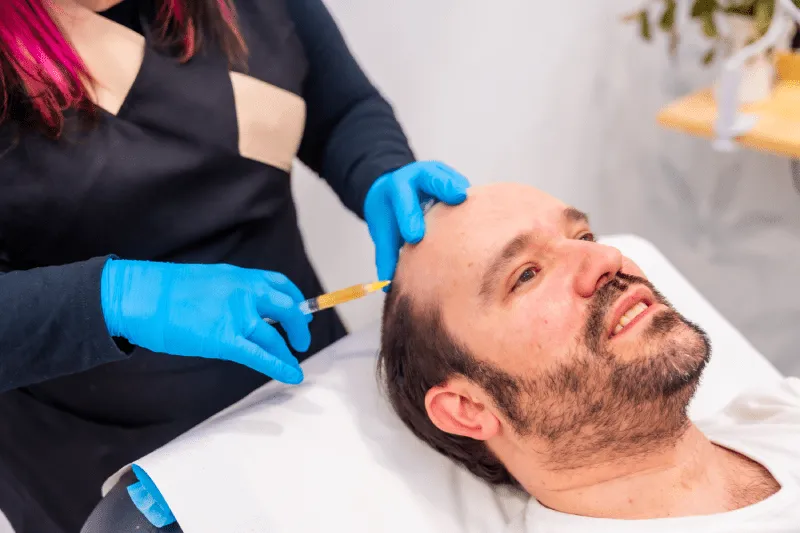
PRP (Platelet Rich Plasma) and hair mesotherapy are methods that nourish hair follicles and thicken hair strands. Regular application of these treatments, especially at the end of the 20s and beginning of the 30s, can seriously reduce the rate of shedding. This can enable the patient to postpone the hair transplant operation for 5 or even 10 years. The later you have a hair transplant (after the shedding stabilizes), the more the permanence and naturalness of the result you get will increase.
What Happens If Age-Related Shedding Continues After A Hair Transplant?
The transplanted hair does not fall out because it is taken from areas that are genetically coded not to. However, your original hair in the areas where the procedure was not performed may continue to fall out due to the aging and genetic process. This situation causes a “gap” to form, especially in those who have a transplant at a young age. To minimize this risk, experts recommend continuing protective treatments in the post-transplant process as well. If the shedding continues and the appearance deteriorates, the problem can be solved with a small tightening transplant in later ages.
What Kind Of Role Does Age Play While Designing The Hairline?
The hairline is the most prominent aesthetic indicator of age. The hairline of a 20-year-old and the line of a 50-year-old should not be the same. While a more aggressive and full line can be worked on in young people, a more “mature” hairline design, where the temples are left slightly open, looks much more natural in middle-aged and older patients. A hairline that is not suitable for one’s age evokes the feeling that the hair is “transplanted” when viewed from the outside, which is an undesirable situation from an aesthetic point of view.
Do DHI And FUE Methods Differ According To Age?
The choice of method is related to the type and amount of shedding rather than age. However, the DHI (Direct Hair Implantation) method is very successful in the young-middle age group who want to tighten the gaps between existing hair and whose shedding is not completely finished, because it allows for a transplant without damaging existing hair. The FUE method, on the other hand, usually offers a faster solution for the older age group or patients who have experienced full shedding, who have a very wide opening and need maximum grafts in a single session.
Are The Age Criteria For Eyebrow And Beard Transplantation The Same As Hair Transplantation?
It is generally recommended to wait until the ages of 22-25 for a beard transplant because beard growth can continue until the mid-20s. An early beard transplant can create asymmetry with beards that grow naturally later. For eyebrow transplantation, the age criterion is more flexible as it is usually done for traumatic losses (scars, etc.) or genetic thinning. However, in both procedures, it is preferred to have completed the age of 20 and to have the facial features settled in terms of aesthetic maturity.
Is Hair Loss During Adolescence Suitable For Transplantation?
Absolutely no. Hair loss experienced during adolescence usually stems from hormonal fluctuations, stress, nutritional disorders, or seasonal transitions. The shedding in this period may not be permanent or may change very quickly. Performing a hair transplant on a young person in adolescence is considered a medical error. Young people in this age group should be referred to a dermatologist and the actual cause under the shedding (vitamin deficiency, thyroid, etc.) should be investigated.
How Does The Stabilization Of The Hair Loss Pattern Increase Operation Success?
When the hair loss pattern stabilizes, it becomes clear which areas of the scalp will completely fall out and which areas will remain resistant. This situation gives the surgeon the chance to work like an architect. He/she distributes the limited number of grafts in the donor area strategically to the areas that will create the most visual impact and be permanent, rather than to places where shedding is certain in the future. This strategy transforms the success of the operation from a “temporary improvement” to a “lifelong satisfaction.”
Why Are Young Patients Who Receive Wrong Planning Unhappy?
Young patients usually want immediate results and imagine very dense hair. However, if a patient who spends all of his limited donor capacity on the front area at the age of 20 cannot find hair to transplant when his crown area opens up by the age of 35, he may experience a serious psychological collapse. For this reason, the main reason for unhappiness in young patients is not the failure of the operation, but the lack of planning for the future. A correct consultancy should honestly tell the patient what is possible and what is not.
Does The Age Factor Directly Affect Hair Transplant Costs?
Age is not a factor that directly determines the cost; however, it may have an indirect effect as it determines the scope of the operation. In young people, the shedding area is usually narrower, but high grafts may be required for tightening. In later ages, since the area is wide, larger sessions can be planned. The technique used (DHI or FUE) and the session duration are the main elements determining the cost. No matter what your age is, the most accurate pricing will be determined according to the number of grafts determined after a specialist examination.
Why Is A Specialist Doctor’s Examination Mandatory At Every Age?
The information on the internet offers general guidance, but every individual’s anatomy, genetics, and hair quality are unique. Just as there are cases where a 25-year-old is too late for a hair transplant, there are also scenarios where a 45-year-old is not yet suitable for a transplant. A specialist doctor is the only authorized person who will decide whether the “right time” for you is now or a few years later with trichological analyses and medical history questioning. You should not leave your health and aesthetic future to chance.
How Is Hair Transplant Planning Done With Cure Holiday?
Cure Holiday organizes your hair transplant process not just as a medical procedure, but as a flawless experience from start to finish. In the planning phase, your age, hair loss type, and expectations are evaluated with digital analysis methods. The process, specially designed for patients coming from all over the world, is carried out meticulously, starting from the first online consultation to personal operation design and healing follow-up. The expertise of Cure Holiday ensures that you take action at the most correct age and with the most correct method for you.
What Are The Age-Specific Solutions Offered By Cure Holiday To Its Patients?
Every age has different needs and Cure Holiday is aware of this. While protective protocols to stop shedding and “strategic graft protection” techniques are applied for our young patients, more natural, age-compatible hairline designs and fast healing-oriented DHI techniques are highlighted for our mature patients. For our older age group patients, the whole process is carried out in a comfortable and stress-free environment at the highest level of medical safety standards.
Why Should Cure Holiday Be Preferred For A Safe Hair Transplant?
Cure Holiday differentiates itself not only with its high-tech clinics but also with the importance it gives to ethical values. If your age or donor status is not suitable for the operation, we express this to you with all clarity and guide you for the right time. Our goal is not just to perform an operation, but to offer you natural results that will give you lifelong happiness. With our expert physician staff and patient-oriented service approach, we enable you to complete your hair transplant journey in a holiday comfort.
What Is The First Step To Reach The Hair Of Your Dreams With Cure Holiday?
To turn back time and regain your old self-confidence, the only thing you need to do is to contact Cure Holiday. With our free hair analysis and professional consultancy service, let’s create the most suitable treatment plan for your age and needs together. The “best age” for a hair transplant is the age you feel most ready for change, and we are here to guide you on this path. Get one step closer to the lush and natural hair of your dreams with the difference of Cure Holiday.
Free Consultation
Fill out the form below to get your free medical travel plan and price quote.
Sources and how to verify this yourself
- Comparative study of graft survival by donor site (scalp, beard, chest) at 12 months — roughly 89% for scalp, 95% for beard and 76% for chest hair; survival also falls the longer grafts stay outside the body. source
- Ministry of Health, Regulation on International Health Tourism and Tourist Health, Official Gazette 26 April 2025, No. 32882 — authorisation requirement for facilities and intermediaries, TÜSKA accreditation, compulsory complication insurance (deadline 31 December 2025 for insurance, 31 December 2026 for accreditation). source
- Ministry of Health, Regulation on Promotion and Information Activities in Health Services, Official Gazette 12 November 2025, No. 33075 — treatment promises and guarantees are prohibited; price and campaign announcements are permitted only within international health tourism. source