Breast augmentation surgery is one of the most popular aesthetic surgery procedures worldwide, increasing women’s self-confidence and defining body contours. However, this operation is not just about gaining volume; it is the art of choosing the type of silicone that best suits the person’s anatomy, lifestyle, and aesthetic goals. In this guide, we will examine the technical differences between round and teardrop (anatomical) implants, selection criteria, and modern surgical approaches in the finest detail.
Why Is Implant Selection Important In Breast Augmentation Surgery?
Breast augmentation surgery is not a simple procedure performed only to increase breast volume, but a complex surgical art that rebalances body proportions. Choosing the right implant directly determines how natural the result obtained after surgery will look, how long it will be preserved, and the level of complication risks. A wrong choice can lead to results that do not fit the person’s body type, look artificial, or sag over time. For this reason, the combination of the surgeon’s experience and the patient’s expectations, specifically regarding the shape, volume, and surface structure of the implant, is the cornerstone of the operation’s success.
What Are Round Silicone Implants?
Round silicone implants, as the name suggests, are prostheses in a symmetrical circular form that provide equal fullness in both the upper and lower poles of the breast. These implants are considered indispensable for classic breast augmentation aesthetics because they provide a homogeneous volume increase in the area where they are placed. Usually filled with highly cohesive silicone gels, these models tend to maintain their form even under the influence of gravity over time. It is one of the most ideal options, especially for women who desire a significant fullness in the cleavage area and whose upper breast tissue is emptied.
What Are Teardrop (Anatomical) Silicone Implants?
Teardrop or anatomical silicone implants are types of prostheses designed to mimic the natural breast structure, being thinner at the top and fuller at the bottom. This structure simulates the natural drooping profile and “teardrop” shape of the breast, providing an extremely realistic appearance after the operation. Anatomical implants are often preferred in reconstructive surgeries where breast tissue is very low or the breast needs to be completely reconstructed. Since they need to be placed in a certain direction due to their design, surgical precision is of much greater importance during the placement phase.
What Are The Main Differences Between Round And Teardrop Implants?
The most basic difference between round and teardrop implants lies in the distribution of volume and aesthetic posture. Round implants make the upper part of the breast (upper pole) appear more prominent and full, while teardrop implants make the upper part flatter and the lower part more projected (protruding), creating a natural slope. Technically speaking, round implants do not have a “direction,” meaning that even if they rotate inside the body, no shape deformity is noticed from the outside. However, teardrop implants have a “top-bottom” relationship because they are anatomical, and asymmetry may occur in the breast shape in case of a possible rotation.
Which Body Type Is Better Suited For Round Implants?
Round implants give excellent results in women with wide rib cages and relatively sufficient breast tissue. If the patient’s goal is a cleavage that creates a “push-up” effect, round models fully meet this expectation. In addition, in athletic women whose shoulder width and hip width are proportional, round implants can better emphasize the curves of the body. In individuals whose breast tissue has not sagged but has lost volume, these implants fill the upper half of the breast, providing a more youthful and upright appearance.
Which Implant Type Should Be Chosen For A Natural Look?
When natural appearance is mentioned, teardrop (anatomical) implants come to mind first because these models mimic the natural effect of gravity on breast tissue. However, “naturalness” does not only depend on the shape of the implant; the thickness of the patient’s existing breast tissue also plays a critical role in this situation. If a woman’s own breast tissue is thick enough, a round implant placed under the muscle can also look extremely natural. Still, in individuals with very thin body structures and weak breast skin, anatomical teardrop implants generally offer a safer and more natural transition to prevent the edges of the implant from being obvious.
What Should Those Who Want Fullness In The Cleavage Area Do?
The fullness and attractiveness of the cleavage area is the main motivation for many women in breast augmentation surgery. Round silicone implants are undoubtedly the best option to provide this effect. Round implants help to create a full appearance even without a bra by adding extra volume to the upper pole of the breast. If you feel that the upper part of your breasts is empty and you want to fill this area, you should definitely discuss the projection levels (low, medium, high) of the round model with your surgeon. A high-projection round implant will provide you with the ambitious cleavage you dream of.
Why Do Teardrop Implants Offer A More Natural Anatomy?
Teardrop implants have the closest geometric shape to the biological form of the human breast. A real breast has less volume at the top and more volume at the bottom while standing. Teardrop implants maintain this asymmetric distribution, providing the needed fullness to the lower part of the breast while keeping the transition at the top softer and more sloping. In this way, when results that are not understood to be surgery and look “like one’s own breast” are targeted, anatomical prostheses are unrivaled. Especially in women with minimal breast tissue, they prevent the “ball-like appearance on top” image that round implants can cause.
What Are The Advantages Of Round Implants?
The biggest advantage of round implants is their ease of use and safety profile. Since these implants do not have a direction, their placement during surgery is more practical, and they do not carry an aesthetic risk such as rotation of the implant around its own axis during the healing process. In addition, round implants generally have a softer texture, which can give a more natural feel when touched. The fact that they are generally more economical than anatomical models and their ability to lift the cleavage makes them the most preferred silicone type worldwide.
Are There Risks Associated With Teardrop Implants?
Although teardrop implants are very successful visually, they bring some specific risks with them. The most important risk is “rotation,” that is, the displacement of the implant. Due to its asymmetrical shape, if the teardrop implant rotates 90 or 180 degrees inside, a serious distortion occurs in the breast shape, and this situation usually requires revision surgery. In addition, teardrop implants are filled with a denser and firmer gel (form stable) to protect their shape, which can cause breast tissue to feel a bit firmer in some patients.
How Does The Surface Of The Implant (Textured vs. Smooth) Affect The Choice?
The implant surface determines how the prosthesis will interact with body tissue. Smooth surface implants are generally very soft but can be more sensitive to the risk of capsular contracture (the body squeezing the implant excessively). Textured surface implants, on the other hand, reduce the risk of displacement by adhering better to the tissue; this is vital especially for teardrop implants because it prevents rotation. However, as recent research has linked textured surfaces with some rare immune system reactions, surgeons now carefully choose micro-textured or new generation smooth surfaces according to the patient’s anatomy.
What Factors Should Be Considered When Choosing The Size?
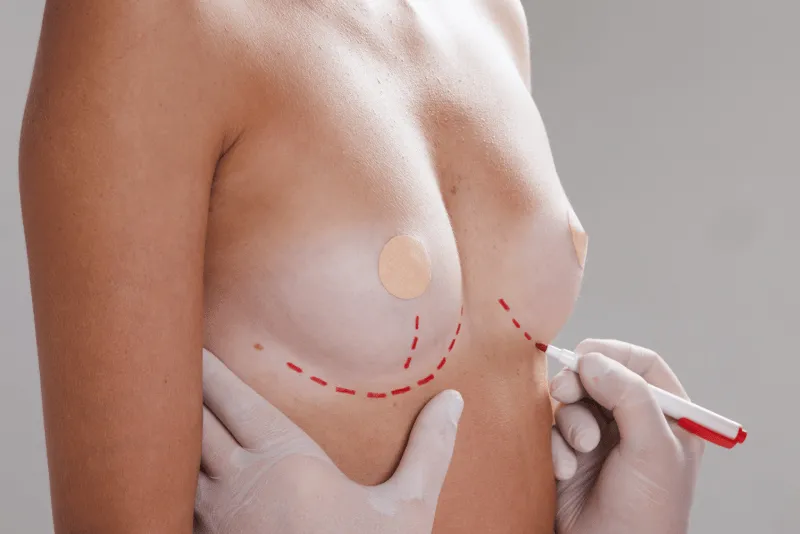
Size selection is not just about “how many CCs” it will be, but a balance related to the patient’s shoulder width, rib cage structure, and height. A very large implant can look both artificial in a thin woman and cause back pain and skin stretch marks over time. The ideal size should be determined by measurements (breast base width, tissue thickness, etc.) to be made by the surgeon. Most surgeons use trial prostheses called “sizing” or 3D simulation devices before surgery to show the patient how different sizes will look on their own body. Remember that a 300cc implant can look huge on one woman while looking very natural on another.
How Does The Amount Of Breast Tissue Determine Implant Selection?
If the patient’s existing breast tissue is sufficient, the surgeon’s hand is much more comfortable because this tissue acts as a “quilt” covering the edges and artificiality of the implant. In this case, even round implants give very natural results. However, in cases where there is almost no breast tissue (breast parenchyma), teardrop models should be preferred because the shape of the implant will be directly obvious from the outside. In addition, placing the implant under the muscle (subpectoral) in patients with a small amount of tissue both allows the prosthesis to be hidden better and minimizes the risk of sagging in the long run.
Which Model Should Be Preferred For Sagging After Breastfeeding?
After breastfeeding, emptying in the upper pole and a slight sagging (ptosis) are generally seen in the breast tissue. If the sagging is not at a very advanced level, round implants can recover the lost volume and recover the breast with a “lift” effect. The ability of the round implant to fill the upper region brings breasts that look deflated after breastfeeding back to a lively and upright form. However, if the sagging is too much, the implant alone may not be enough, and a “breast lift” (mastopexy) procedure may need to be added to the operation.
Which Silicone Is Better For Women Who Are Active In Sports?
Implant selection should be more strategic for women who regularly do fitness, yoga, or running. Especially in athletes who use chest muscles (pectoral muscles) intensely, the risk of rotation of teardrop implants placed under the muscle may be slightly higher. For this reason, professional athletes generally prefer round implants. In addition, the weight of the implant is also important for active women; lightened (such as B-Lite) technologies can increase comfort during sports. Your surgeon will determine the safest positioning of the implant and its shape according to your active lifestyle.
What Does The Projection (Height) Of The Implant Mean?
Projection refers to how much an implant will protrude outward from the rib cage. Low, medium, high, and ultra-high projection options are available. If you have a narrow rib cage but want a large volume, you can gain fullness towards the front without increasing the base width by choosing a “high projection” implant. In the opposite case, a patient with wide breasts can obtain a flatter and more natural volume with a low projection implant. This concept allows you to customize not only the width and length of the implant but also its profile.
Why Is The Consistency (Cohesivity) Of The Gel Inside The Silicone Important?
The gel inside modern silicones used today is in a “cohesive” (staying together) structure. This means that even if the implant is cut, the content does not flow out, it stays together. Gummy Bear implants, also known as high-cohesivity gels, ensure that the implant preserves its shape very well. While softer gels can be preferred in round implants to obtain a natural sway while moving, firmer “form stable” gels are used in teardrop implants so that the shape does not deteriorate. The consistency of the gel directly affects the firmness of the breast when touched and its visual fluidity.
Which Type Has A Higher Risk Of Displacement After Surgery?
The risk of displacement or sliding is technically more critical in teardrop (anatomical) implants. Due to the asymmetrical structure of teardrop implants, even a rotation of a few degrees can be noticed visually immediately. In round implants, there is no such aesthetic risk because the shape stays the same no matter how the implant rotates. To reduce the risk of displacement, surgeons take care to open the “pocket” area where the implant will be placed in exactly compatible dimensions with the implant. In addition, the textured surface structure also minimizes this risk by allowing the implant to mechanically hold onto the tissues.
Does The Recovery Process After Surgery Differ Between Types?
In general, choosing a round or teardrop implant does not change the basic dynamics of the recovery period. The recovery process depends more on the size of the implant and the layer where it is placed (under the muscle vs. above the muscle). However, patients who have a teardrop implant placed may need to follow certain arm lifting restrictions and special medical bra usage rules more meticulously for the first few weeks so that the prosthesis sits fully in place and does not rotate. In both cases, edema and mild pain are normal for the first few days; it may take 3 to 6 months for the full result to appear and for the breasts to soften and take their natural form.
Does Implant Selection Affect Breastfeeding?
This is one of the most frequently asked and most misunderstood questions. The shape of the implant (round or teardrop) does not directly affect the ability to breastfeed. The main effect on breastfeeding is related to where the surgical incision is made and in which plane the implant is placed. Implants placed under the muscle are in the position furthest from the milk ducts and mammary glands, so they do not constitute a functional obstacle. Thousands of women using both round and teardrop implants can breastfeed their babies healthily after surgery. The important thing is to protect the milk ducts in incisions made around the nipple.
Which Implant Remains More Aesthetic As Age Advances?
With the aging process, the skin loses its elasticity and the breast tissue moves downwards. In this process, teardrop implants may sometimes look more compatible as they already have a natural sagging form. However, round implants can create a resistance against the effects of aging by keeping the upper part of the breast full and providing a more vigorous appearance. In the long run, the most aesthetic result is possible by maintaining body weight and the weight of the implant not exceeding the tissue quality. Extremely large implants can cause faster sagging as age advances; therefore, balanced choices should be made at every age.
How Does The Chest Wall Structure Limit The Selection?
Every woman’s chest wall anatomy is different; some may be flat, some concave (pectus excavatum), or convex (pectus carinatum). The structure of the rib cage bones determines how the implant will be positioned and how it will look from the outside. For example, in a woman with narrow breasts, teardrop implants can sometimes leave too much space on the sides; in this case, a round implant with a narrow base but high projection can provide better symmetry. Your surgeon will analyze how the implant will “sit” on this structure by examining your bone structure and will offer you the most stable option.
Which Implant Is More Successful For Asymmetrical Breasts?
Almost every woman has a slight asymmetry between her breasts, but in some cases, this difference is very obvious. To correct asymmetry, a round implant may sometimes be used for one breast and a teardrop for the other, or two implants with different CC values can be chosen. Teardrop implants are very successful in equalizing the level difference by filling the lower pole, especially in patients with different nipple levels. In asymmetrical cases, the surgeon’s planning ability is more important than the shape of the implant. With a personalized approach, a similar volume and form can be achieved in both breasts.
In Which Situations Is An Implant Replacement Necessary?
Although silicone implants are theoretically designed to last a lifetime, sometimes replacement may be necessary for medical or aesthetic reasons. At the top of these is “capsular contracture”; that is, the body seeing the implant as a foreign body and excessively hardening the membrane around it. In addition, rupture of the implant, rotation of the teardrop implant, or the patient wanting a larger/smaller size over time are among the reasons for replacement. In modern 5th generation silicones, the risk of rupture is extremely low, but due to natural processes such as gravity and aging, an “update” surgery after 10-15 years may be the choice of patients.
Should Submuscular Or Subglandular Placement Be Chosen?
The placement of the implant is as critical as the type of prosthesis chosen. Submuscular (under the muscle) placement prevents the edges of the implant from being obvious and provides a more natural softness, especially in patients with little breast tissue. It is also thought to reduce the risk of capsular contracture. Subglandular (above the muscle) placement, on the other hand, allows the recovery process to be faster and less painful, but its potential to cause sagging over time due to the weight of the implant is higher. Today, many surgeons prefer the “dual plane” hybrid method, in which the upper part of the implant remains under the muscle and the lower part remains under the breast tissue.
Do Incision Scars Change Based On The Implant Type?
Incisions used in breast augmentation are usually the breast fold (inframammary), around the nipple (periareolar), or the armpit (axillary). Whether the implant is round or teardrop does not change these incision sites much. However, teardrop implants have a denser gel structure to protect their shape and are usually slightly firmer than round ones; this situation may sometimes require the breast fold incision to be a few millimeters longer. The most popular and safe method is the breast fold incision because it gives the surgeon the opportunity to directly see and control the pocket where the implant will be placed.
Do Breast Augmentation Costs Change Based On The Implant Type?
Yes, implant selection can have a direct impact on costs. Teardrop (anatomical) implants are generally more expensive than round implants due to production technologies and sensitive design processes. In addition, the degree of difficulty of the operation and the auxiliary technologies used (3D simulation, lightweight implants, etc.) are also factors that affect the price. However, cost should be the last criterion in such a permanent surgical procedure. The important thing is that the implant used is an FDA or CE-approved, high-quality brand and the success of the surgeon.
Is It Useful To Use Simulations During The Consultation?
Absolutely yes. 3D simulation devices (such as Crisalix) used in modern aesthetic surgery allow the patient to see possible results after surgery through their own photos. Visual comparisons such as “it looks like this if we put a round one, it looks like that if we put a teardrop one” eliminate the patient’s indecision. Although simulations do not give a 100% guarantee, they are a great communication tool for the patient’s expectations to coincide with the surgeon’s vision. Thanks to this technology, patients go to the operating table much more peacefully and sure of the result on the day of surgery.
How Does Your Doctor’s Experience Influence Implant Selection?
A surgeon’s experience with a particular type of implant is the biggest variable determining the quality of the result. Some surgeons specialize in placing teardrop implants, while others can work wonders with round implants. Seeing “before and after” photos from your surgeon’s previous operations helps you understand his aesthetic sense. An experienced doctor will analyze not only the shape you want but also your anatomical limits and will suggest the longest-term and safest way for you. The sense of trust is the most critical part of this process.
Which Model Has A Higher Satisfaction Rate In The Long Term?
Studies in the literature show that satisfaction rates are over 95% for both models when the right patient selection is made. The key to long-term satisfaction is the “right size.” While excessively large chosen implants can create regret over time, round or teardrop models chosen proportionally to the body increase the patient’s quality of life. Round implant users frequently express their satisfaction with their cleavage appearance, while teardrop implant users express their satisfaction with their natural profiles. Consequently, how you want to see yourself when you look in the mirror is the main factor determining the best model.
What Are Gummy Bear Implants And When Are They Used?
Gummy bear implants are actually the colloquial name for teardrop (anatomical) implants that contain a high degree of cohesive gel. They get this name from the fact that the gel structure preserves its shape even when cut, just like a gummy bear candy. This technology prevents the implant from leaking and ensures that its form does not deteriorate inside the breast tissue for many years. It is an excellent solution for preventing the implant from folding (rippling), especially in patients with very thin skin layers. It is considered one of the most advanced solutions of modern surgery for patients seeking stability and durability.
Why Should Breast Augmentation Surgery Be Planned With Cure Holiday?
Breast augmentation surgery is not just an operation, but an experience that will change your life. Cure Holiday offers you the opportunity to work with the world’s best plastic surgeons and access the most modern implant technologies, not just a treatment, in this sensitive process. With our expertise in health tourism, we are with you with a professional team at every step from pre-operation planning to the recovery process. We ensure that your aesthetic journey is safe and comfortable by bringing together the highest quality FDA-approved implants and the most experienced hands to achieve the best results.
What Kind Of Advantages Does Cure Holiday Offer To Its Patients?
As Cure Holiday, we care not only about the physical changes of our patients but also about their peace and comfort. Thanks to our personalized treatment plans, the most suitable implant selection (round vs. teardrop) for your body type and expectations is meticulously made by our expert surgeons. We also organize all transportation, accommodation, and hospital processes so that you only focus on your new look. By offering our high-standard health service with accessible costs, we make it easier than ever for you to reach the breasts of your dreams.
What Is The Health Tourism Experience Like With Cure Holiday?
The experience you have with Cure Holiday is not just a surgery, but also a holiday where you will feel special. We combine Turkey’s world-renowned medical infrastructure and hospitality with Cure Holiday quality. From your arrival at the airport to luxury accommodation options and post-operation checks, everything is carried out with a system that works like a clock. With our team that you can get 7/24 consultancy without a language barrier, we offer all our patients coming from abroad a sense of trust and compassion as if they were in their own homes.
How Can You Reach Your Dream Appearance With Cure Holiday?
The only step you need to take to have fuller, symmetrical, and aesthetic breasts is to contact us. Cure Holiday’s expert consultants help you determine the most suitable treatment method and surgeon by making a special preliminary assessment for you. We answer all the questions in your mind about whether you will choose a round or teardrop implant with our state-of-the-art imaging and examination techniques. We are waiting for you as the Cure Holiday family to refresh your self-confidence and bring your body contours to the perfection you dream of.
Contact us today to make the right decision and get professional support in your breast augmentation journey; let’s celebrate the happiness of change together.
Free Consultation
Fill out the form below to get your free medical travel plan and price quote.
Sources and how to verify this yourself
- Howe M-S, Keys W, Richards D. Long-term (10-year) dental implant survival: a systematic review and sensitivity meta-analysis. Journal of Dentistry, 2019 — pooled 10-year implant survival 96.4% (95% CI 95.2–97.5%); conservative sensitivity estimate 93.2%. source
- Ministry of Health, Regulation on International Health Tourism and Tourist Health, Official Gazette 26 April 2025, No. 32882 — authorisation requirement for facilities and intermediaries, TÜSKA accreditation, compulsory complication insurance (deadline 31 December 2025 for insurance, 31 December 2026 for accreditation). source
- Ministry of Health, Regulation on Promotion and Information Activities in Health Services, Official Gazette 12 November 2025, No. 33075 — treatment promises and guarantees are prohibited; price and campaign announcements are permitted only within international health tourism. source